Week - 8 Mass Scaling
AIM:
To reduce the run time of the model using mass scaling methods. Also run the same model using implicit solver and compare the implicit and explicit run time.
Explicit Solver:
It is a time dependent solver. The central difference method is used to calculate the field variables at the respective nodal points in the explicit method. For an explicit method, the equilibrium of a system is formulated at the beginning of the respective time increment (time ti) with the known quantities of motion. The basic concept is that determining the temporal progression of displacement, velocity and accleration stepwise. The time domain is discretized into finite time intervals and the equations of motion are then only fulfilled in an approximate manner. Thus only discrete points in time ti are considered and usually a time increment is chosen. For too long timestep the solution can grow exponentially and thus become useless. They must therefore be adjusted to the highest natural frequency that occurs in the system.
Implicit Solver:
In implicit method, the displacement is not a funciton of time. i.e., x= constant. Thus velocities, displacements which are all the time dependent derivatives are turns to zero. Thus mass and damping factors can be negleted. To solve a FEM problem using an implicit method, inversion of stiffness matrix (k) is required. Very Large deformation problems such as crash analysis can result in millions of degrees of freedom, effectively increasing the size of the stiffness matrix. Larger the stiffness matrix longer is the computational time required for its inversion.
Case 1:
Run simulation without TSSFAC and DT2MS values in control timestep card to check the total time duration taken by the solver to complete.
For open the model file go to model>control_timestep>put TSSFAC as 0> DTMS as zero> now save and run the model.
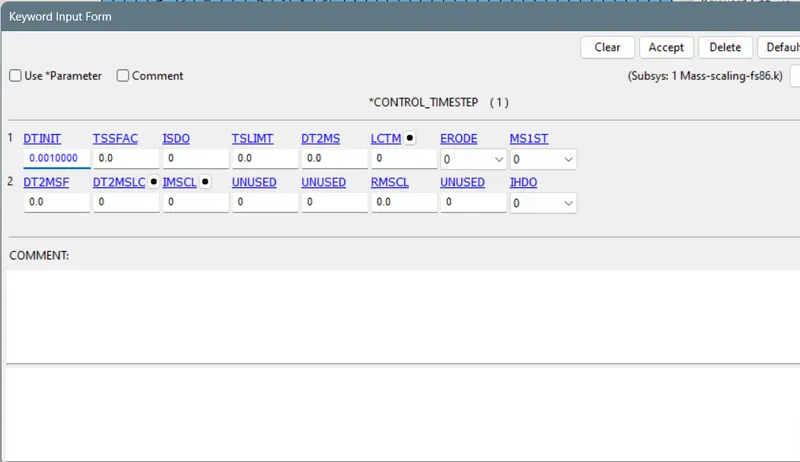
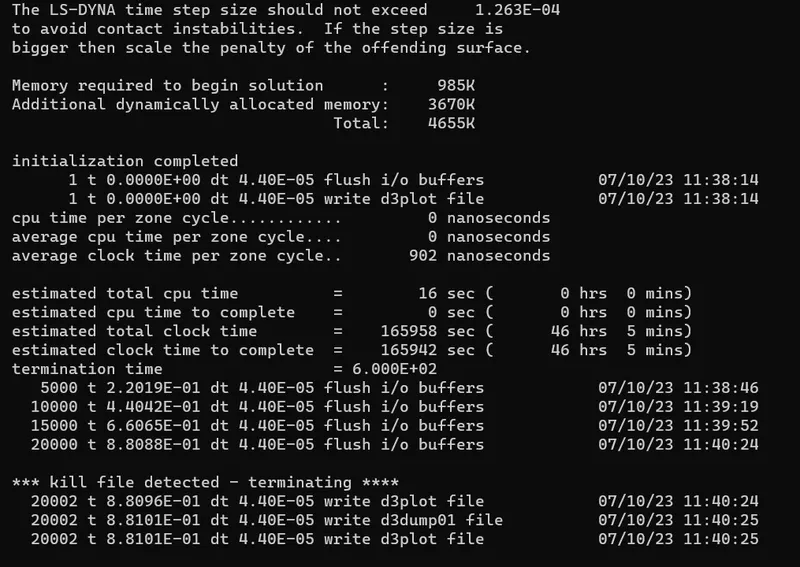
It is observed that the estimated time taken by the solver to complete the simulation is 46hrs 5 min and also no mass scaling is done i.e., added mass is zero.
CASE:2
Find the DT2MS which means change the dt2ms and check the added mass and percentage increase of mass. when it reaches to 1% or lower note dt2ms which is where the mass scaling starts.
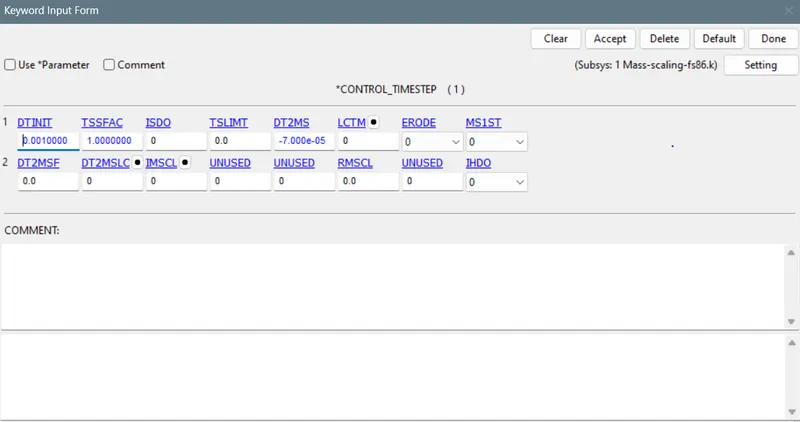
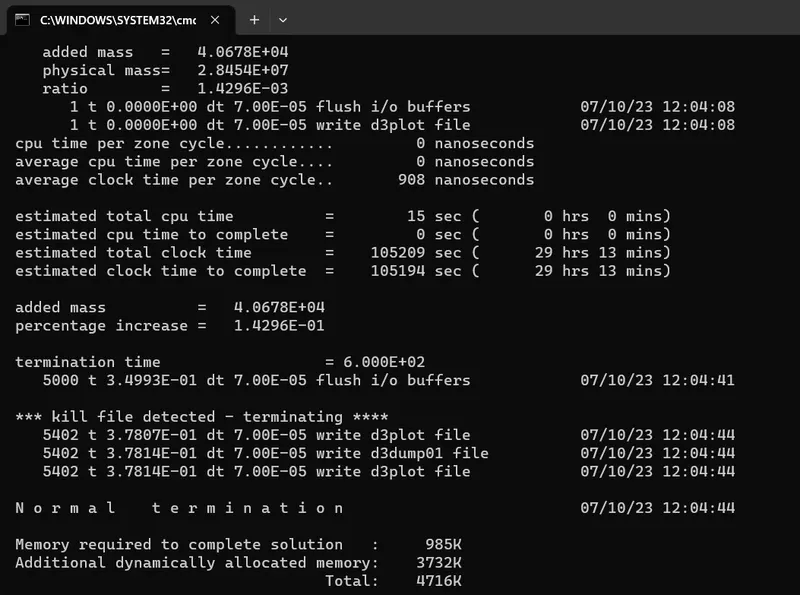
For DT2MS=-7.00E-05, added mass is 4.067e+04 and the percentage increase in total mass is 0.143%. Compared to the previous step the total estimated time required to complete the simulation is 29hrs 13min.So 16 hrs got reduced. Mass scaling is not but adding mass to the particular element where the stress wave was unable to reach from one element to adjacent element. By adding mass to that particular element the density of the element tends to increase result in delaying the stress wave while passing through the element. The negative value in dt2ms represents that only timestep values which are negative and lesser than the dt2ms are considered for mass scalling.
CASE 3:
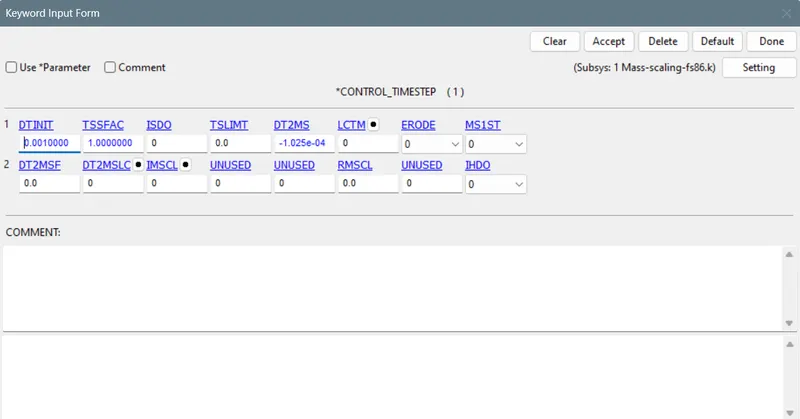
For TSSFAC=1 and DT2MS= -1.025e-04 The total estimated time required to complete the simulation is 18hrs 2min.
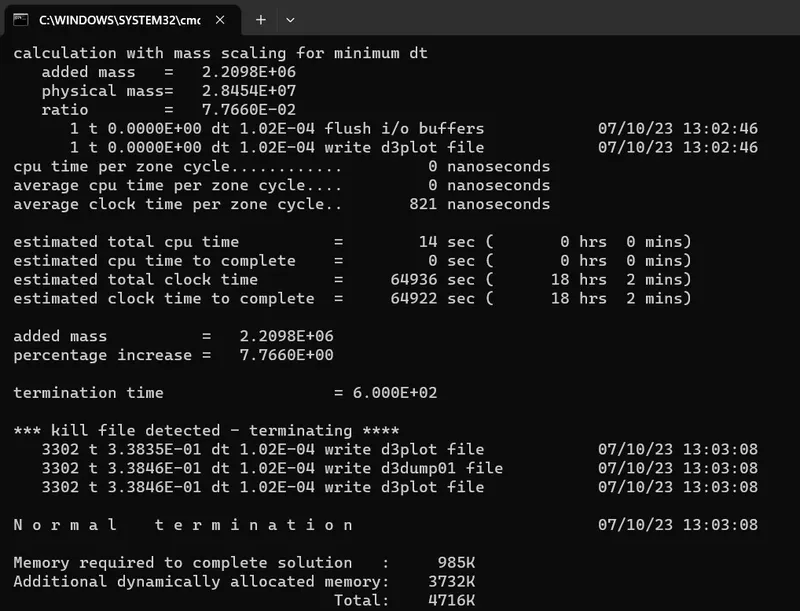
Now the percentage increase in added mass is obtained as 7.76%.
Case 4:
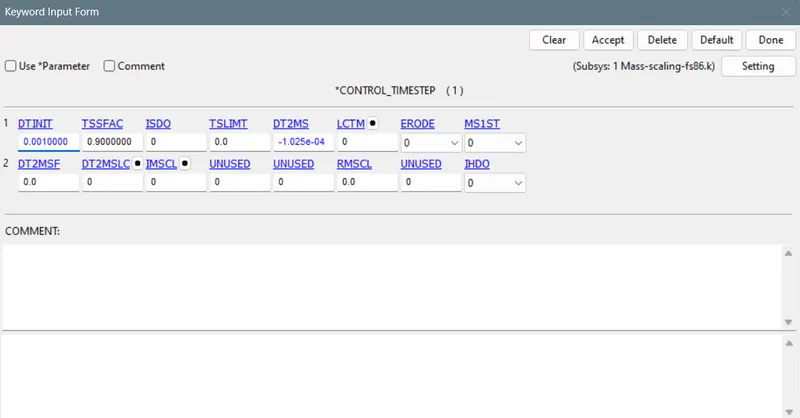
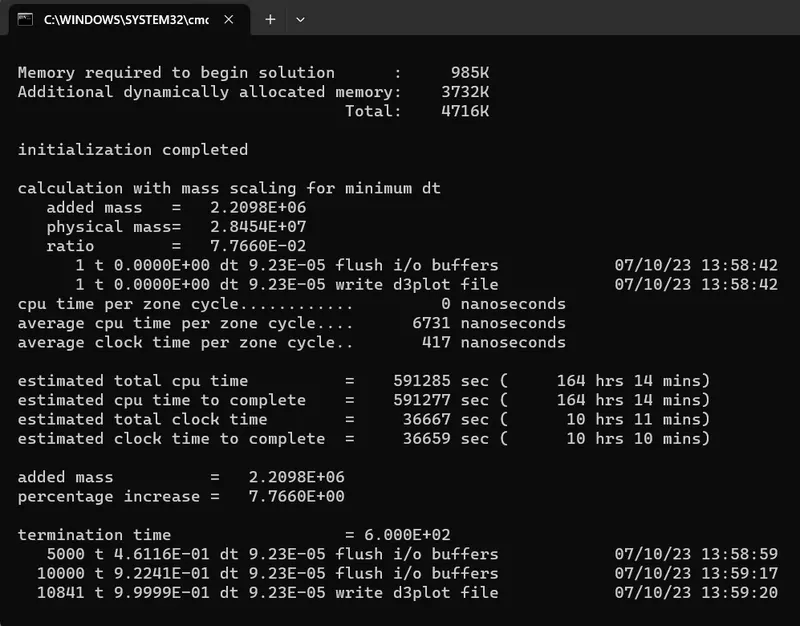
For TSSFAC = 0.9 and DT2MS = -1.025e-04 the percentage increase in total mass is approximately as same as before case 7.76% but the time required to complete the simulation increased as 10hrs 11min.
CASE 5:
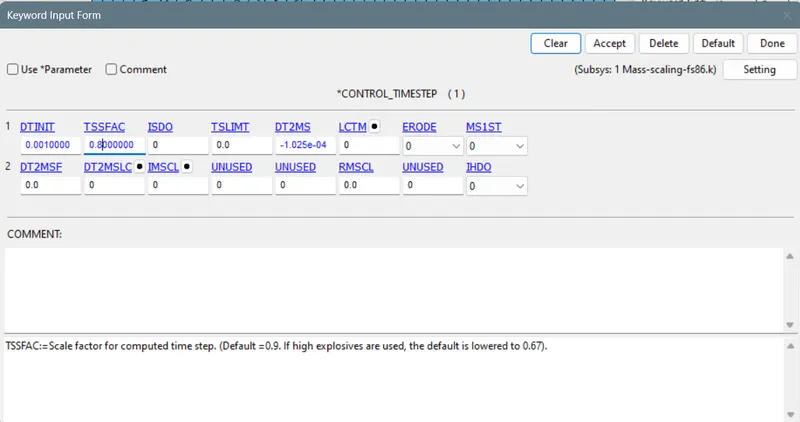
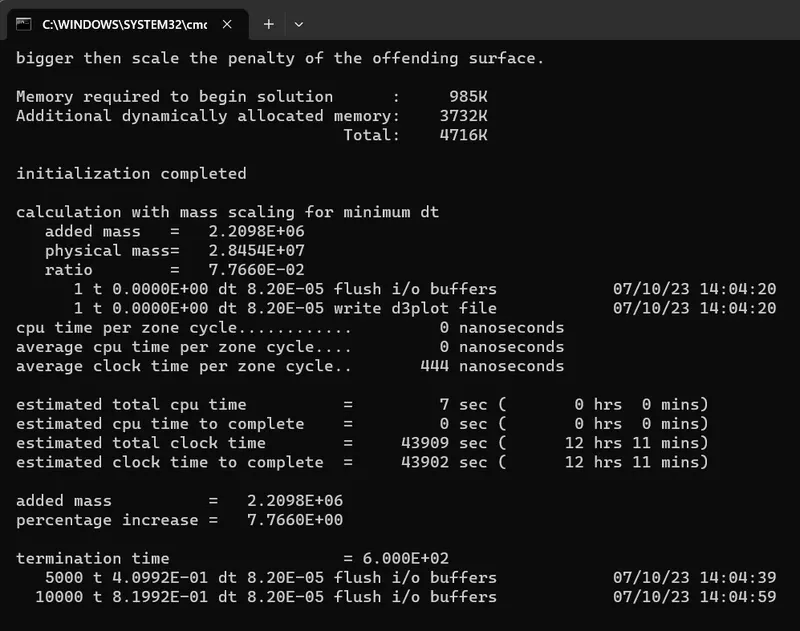
For TSSFAC = 0.8 and DT2MS = -1.025e-04 the percentage increase in total mass is approximately as same as before case 7.76% but the time required to complete the simulation increased as 12hrs 11min.
CASE 6:
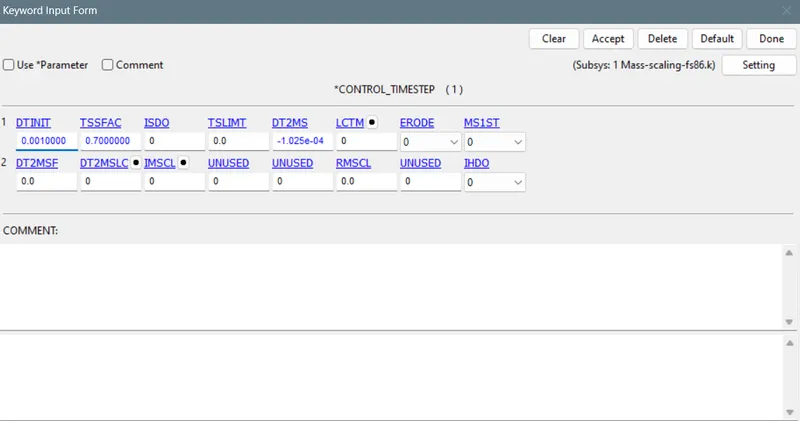
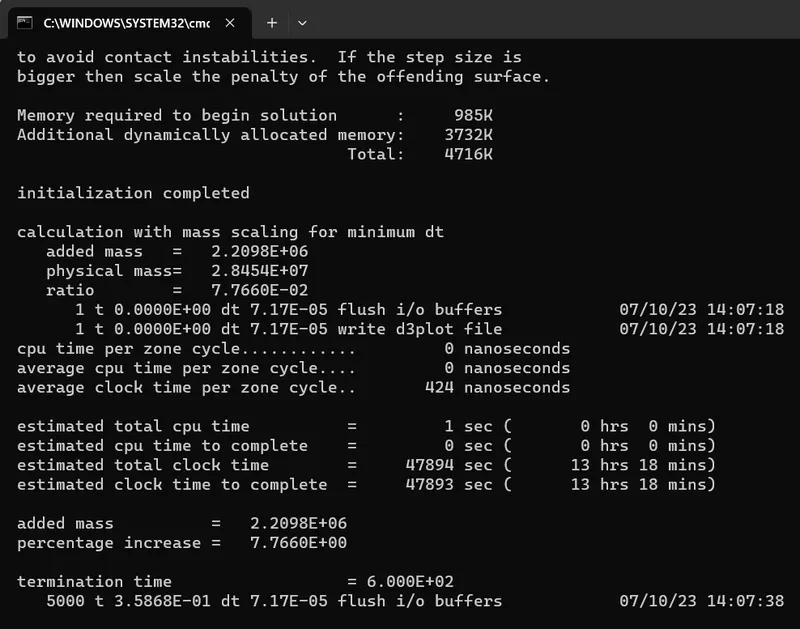
For TSSFAC = 0.7 and DT2MS = -1.025e-04 the percentage increase in total mass is approximately as same as before case 7.76% but the time required to complete the simulation increased as 12hrs 11min
CASE 7:
In case 1 to case 6 we are using explicit solver and control time step card is used to do mass scaling. Now the implicit solver is used to run the simulation.
CONTROL_IMPLICIT_AUTO:
For that delete the control timestep card. Now go to keyword>Implicit Auto>put IAUTO value as '1' to automatically control the timestep size. The minimum allowable time step size should be 1/1000 times the termination time. The termination time of the model is 600ms so the minimum allowable time step size is 0.6.
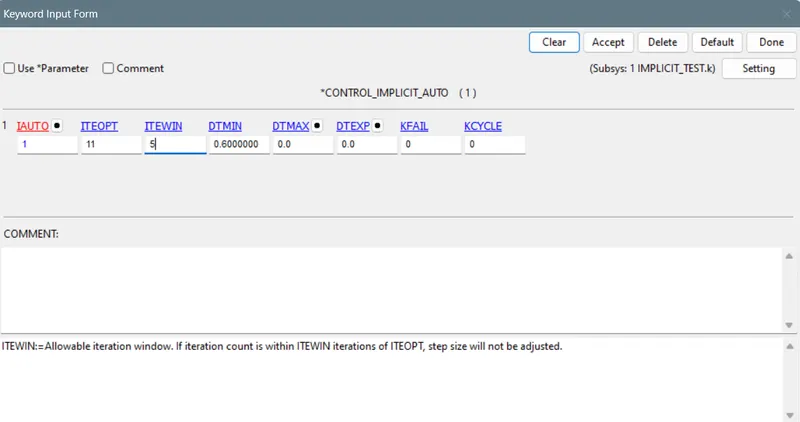
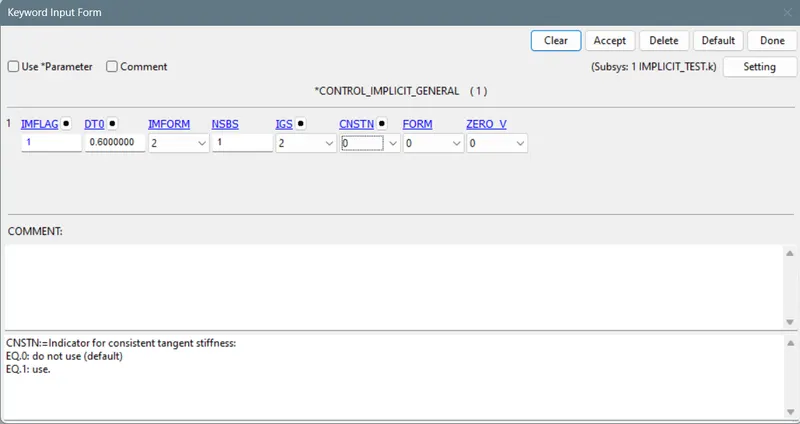
CONTROL_IMPLICIT_GENERAL:
Enter the IMFLAG value as 1 to activate the implicit analysis card. Remaining options maintain default values.
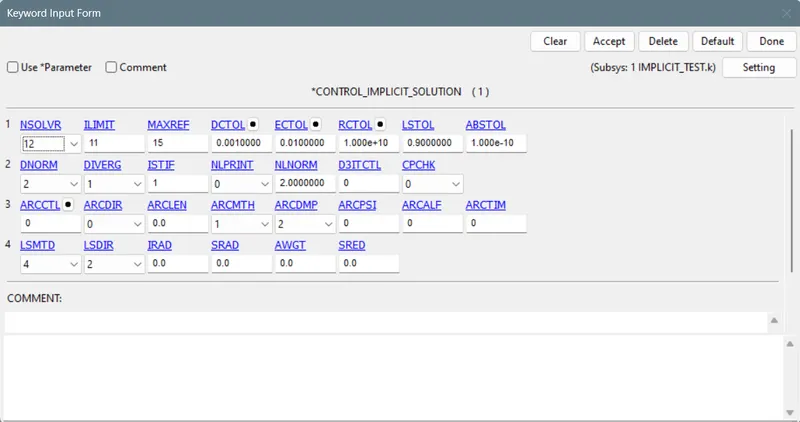
CONTROL_IMPLICIT_SOLUTION:
All card values are assumed as default.
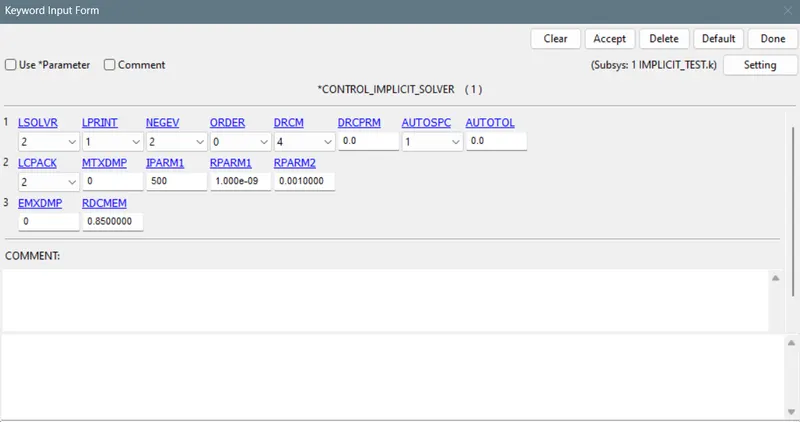
CONTROL_IMPLICIT_SOLVER:
In LPRINT option enter value as 1 in order to print the output details. Also NEGEV value should be selected as 2 inorder to print the warning message on the output window. Remaining variables kept as default values.
OUTPUT:
The estimated time to complete the model is 7 min.
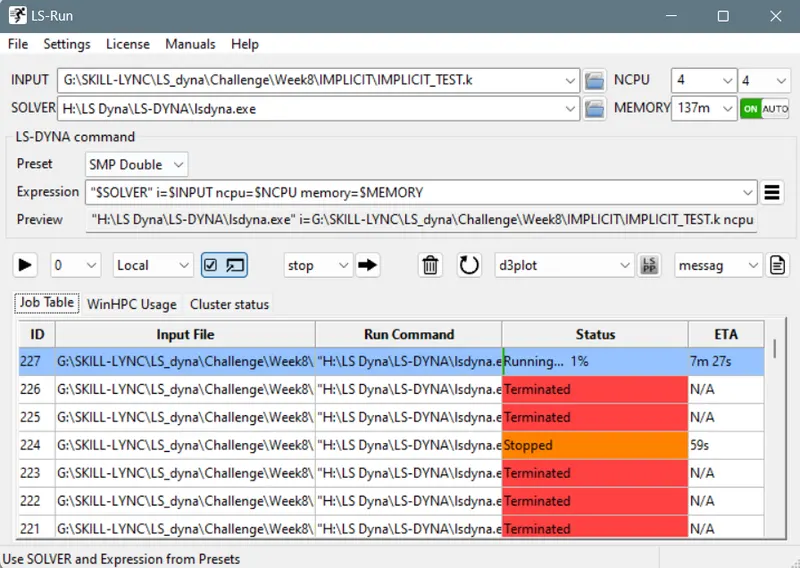
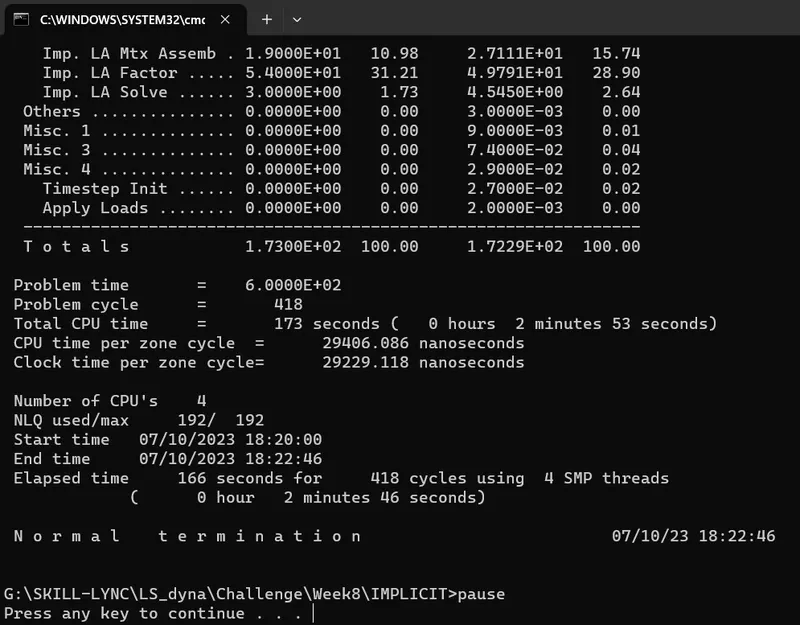
The model is completed at 2 minutes 46 seconds. For each step within 2 iteration, the equilibrium is achieved.
CONCLUSION:
Thus using explicit method mass scaling is done up to 8% and for TSSFAC values are varied and analyzed. Then is model is analyzed on implicit method and the results are analyzed.