Week - 8 Mass Scaling
MASS SCALING OF FE MODEL
AIM :
- To evaluate the simulation results in order to reduce the run time with the help of mass scaling in LS-Dyna.
OBJECTIVE :
- To understand the concept of a computatinal time with and without a mass-scale factor.
- To learn about the mass scaling Technique to reduce the computational time for the analysis.
- To run the same model using an implicit solver with necessary changes and compare implicit and explicit runtime.
DATABASE:
- The hard limit on mass scaling is 8% and stability should be completely intact.
DELIVRABLES :
- A histogram should be plotted to compare the runtime with mass scaling trials.
SOFTWARE USED :
- Solver tool - LS-Prepost 4.7.17 and LS-Run 1.0.100838
BACKGROUND : MASS SCALING
- Mass-scaling is a technique that is used for the process of scaling the element’s mass in explicit simulations to adjust its timestep for reducing the computational time.
- This manual form of mass scaling is done independently of the automatic mass scaling invoked with DT2MS in *CONTROL_TIMESTEP.
- LS-DYNA allows two different types of mass-scaling using the DT2MS parameter from *CONTROL_TIMESTEP with the default set to no mass-scaling.
- *CONTROL_TIMESTEP with the default set to no mass-scaling.
- When DT2MS is less than zero, LS-DYNA adds a mass of each element whose timestep is below abs(DT2MS) such that the element’s updated DT is equal to abs(DT2MS).
- When DT2MS is greater than zero, LS-DYNA adds mass to elements whose DT is below abs(DT2MS) and “removes” mass from elements whose DT is greater than zero.
- DT2MS>0 is seldom used while DTM2<0 is frequently used for overcoming the smallest computed timestep.
- when using DT2MS<0 to ensure that the added mass does not have an adverse effect on the simulation accuracy.
- If stability is a problem with the default TSSFAC of 0.9, try 0.8 or 0.7. If you reduce TSSFAC, you can increase |DT2MS| proportionally so that their product, and hence timestep, is unchanged. TSSFAC doesn’t affect the mass scaling percentage.
Timestep Significance:
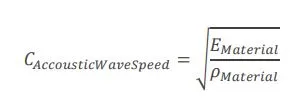
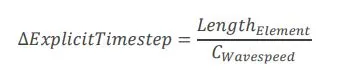
In the simplest case (small, deformation theory), the time step is controlled by the acoustic wave propagation through the material.
PROCEDURAL STEPS :
STEP 1 : Import K file.
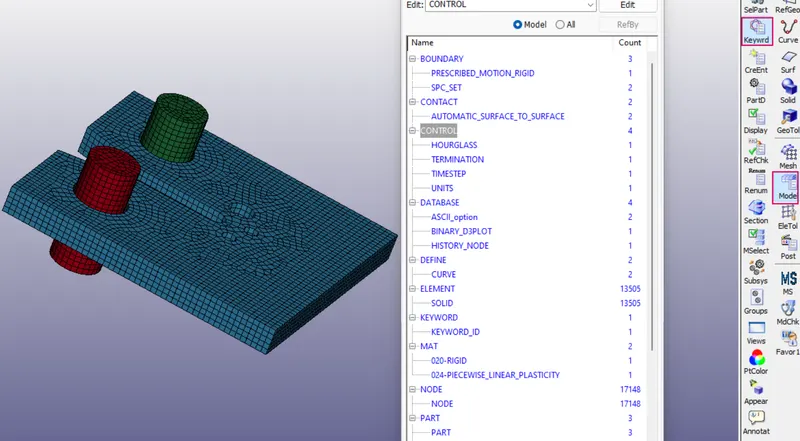
- Imported the K format type of file using LS-Prepost software.
- File > Import > LS-Dyna keyword file > browsed to selected the K type of file > imported it.
- In order to check the keywords contained in the file we have to follow the below steps.
- Side bar > model and part > keyword manager > checked the model.
- Its an explicit simulation data.
CASE 1 : MODIFICATION THE DT2MS VALUE TO ACHIEVE 8% MASS PERCENTAGE.
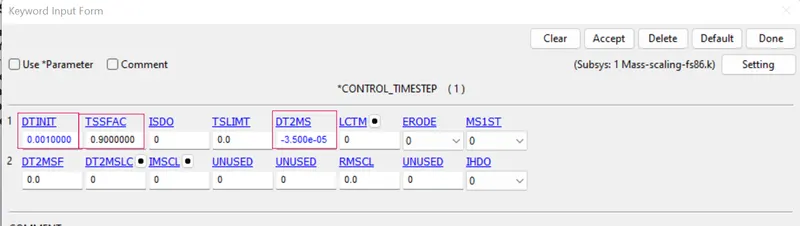
TRIAL 1 : Run the simulation of control card value as (DT2MS = -3.5E-5 s & TSSFAC= 0.9 s )
- DTMS and TSSFAC are the important parameters in the *CONTROL_TIMESTEP card that affects the timestep and the runtime of the simulation, so we will change these values in each iteration to obtain an optimized runtime with a stable solution and to make sure mass scaling doesn’t go beyond 8%.
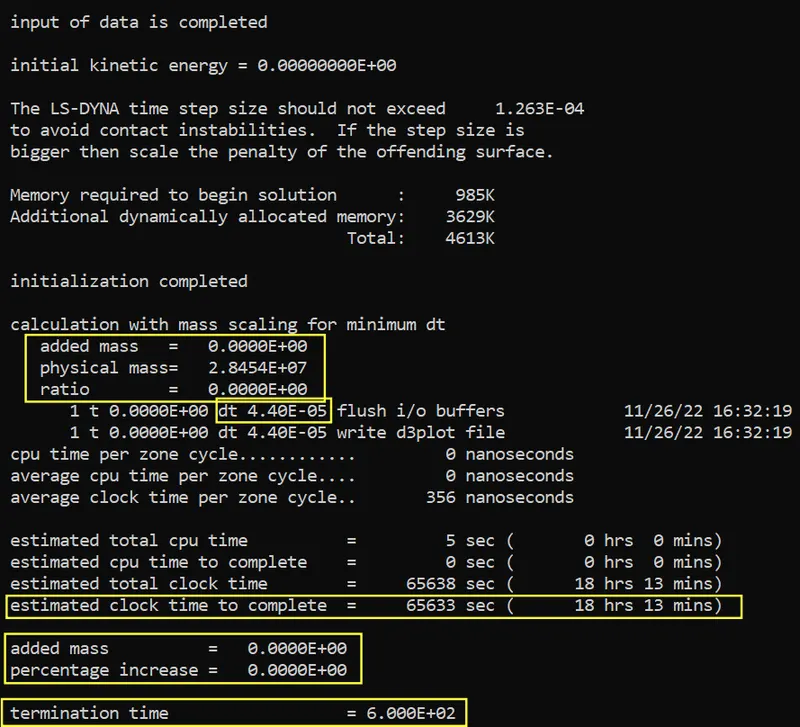
From Trial one is got the following values from the simulation,
- Physical mass = 2.84*e⁷ kg.
- TSSFAC- scale factor for computed timestep = 0.9 s
- DT2MS- time step size for mass scaled solution = -3.5*e⁻⁵ s
- dt - timestep size = 4.4*e⁻⁵ s
- Added mass = 0 Kg
- Percentage increase = 0%
- Mass scaling ratio = 0
- Estimated clock time = 11 hrs 21 mins.
TRIAL 2 : Run the simulation of control card value as (DT2MS = -3.0 e-5 s & TSSFAC= 0.9 s )
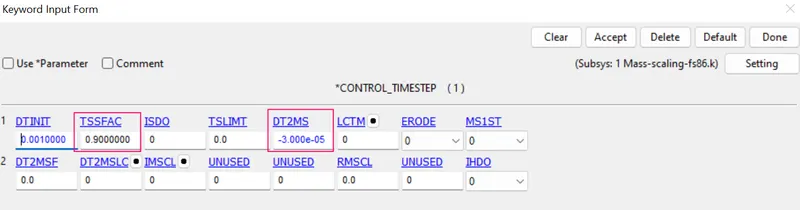
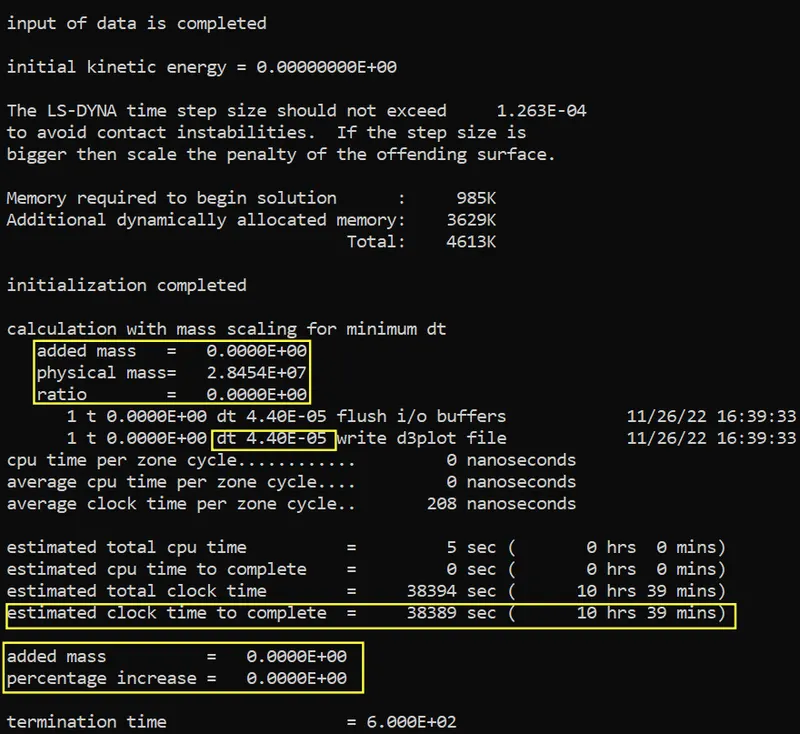
From Trial-2 is got the following values from the simulation,
- Physical mass = 2.84*e⁷ kg.
- TSSFAC- scale factor for computed timestep = 0.9 s
- DT2MS- time step size for mass scaled solution = -3.0*e⁻⁵ s
- dt - timestep size = 4.4*e⁻⁵ s
- Added mass = 0 Kg
- Percentage increase = 0%
- Mass scaling ratio = 0
- Estimated clock time = 10 hrs 39 mins.
TRIAL 3 : Run the simulation of control card value as (DT2MS = -2.0 e-5 s & TSSFAC= 0.9 s )
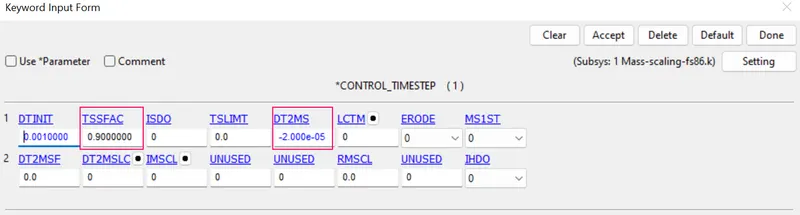
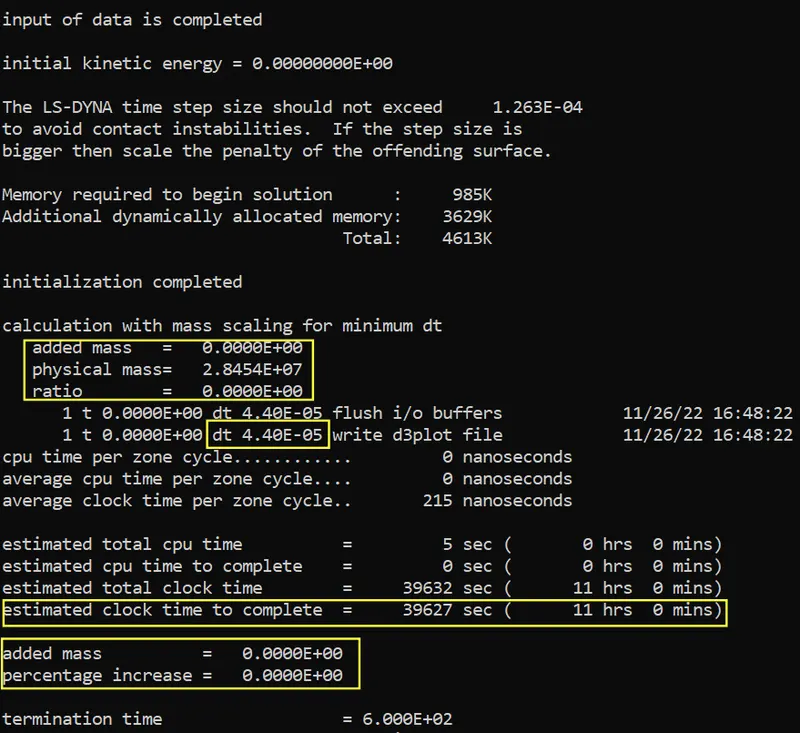
From Trial-3 is got the following values from the simulation,
- Physical mass = 2.84*e⁷ kg.
- TSSFAC- scale factor for computed timestep = 0.9 s
- DT2MS- time step size for mass scaled solution = -2.0*e⁻⁵ s
- dt - timestep size = 4.4*e⁻⁵ s
- Added mass = 0 Kg
- Percentage increase = 0%
- Mass scaling ratio = 0
- Estimated clock time = 11 hrs 0 mins.
TRIAL 4 : Run the simulation of control card value as (DT2MS = -1.0 e-5 s & TSSFAC= 0.9 s )
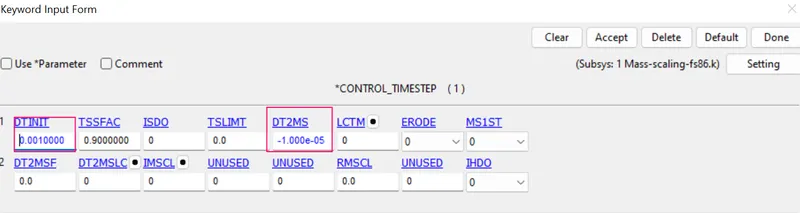
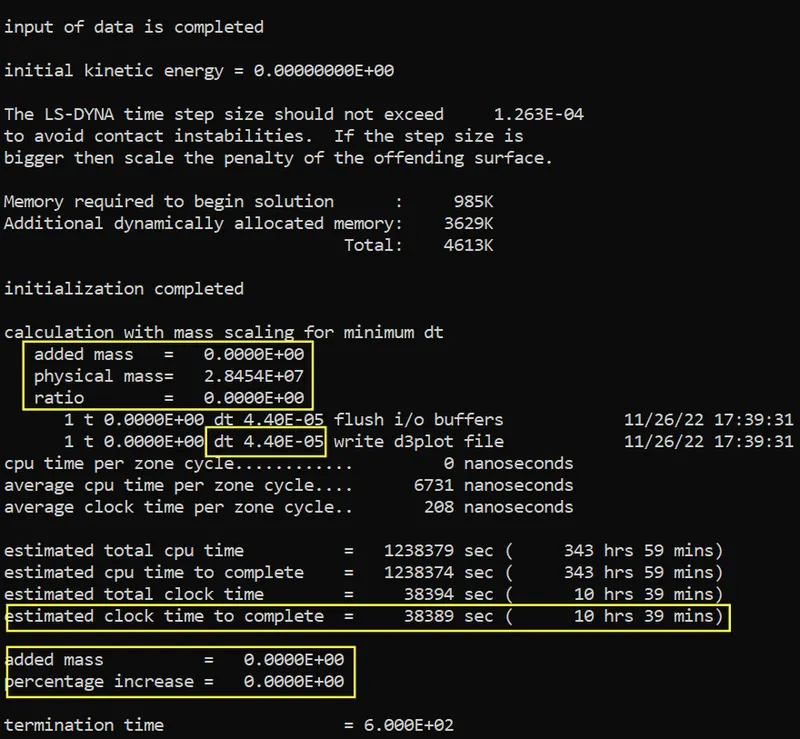
From Trial-4 is got the following values from the simulation,
- Physical mass = 2.84*e⁷ kg.
- TSSFAC- scale factor for computed timestep = 0.9 s
- DT2MS- time step size for mass scaled solution = -1.0*e⁻⁵ s
- dt - timestep size = 4.4*e⁻⁵ s
- Added mass = 0 Kg
- Percentage increase = 0%
- Mass scaling ratio = 0
- Estimated clock time = 10 hrs 39 mins.
TRIAL 5 : Run the simulation of control card value as (DT2MS = -3.0 e-4 s & TSSFAC= 0.9 s )
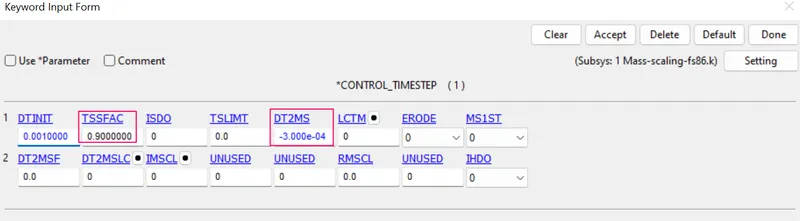
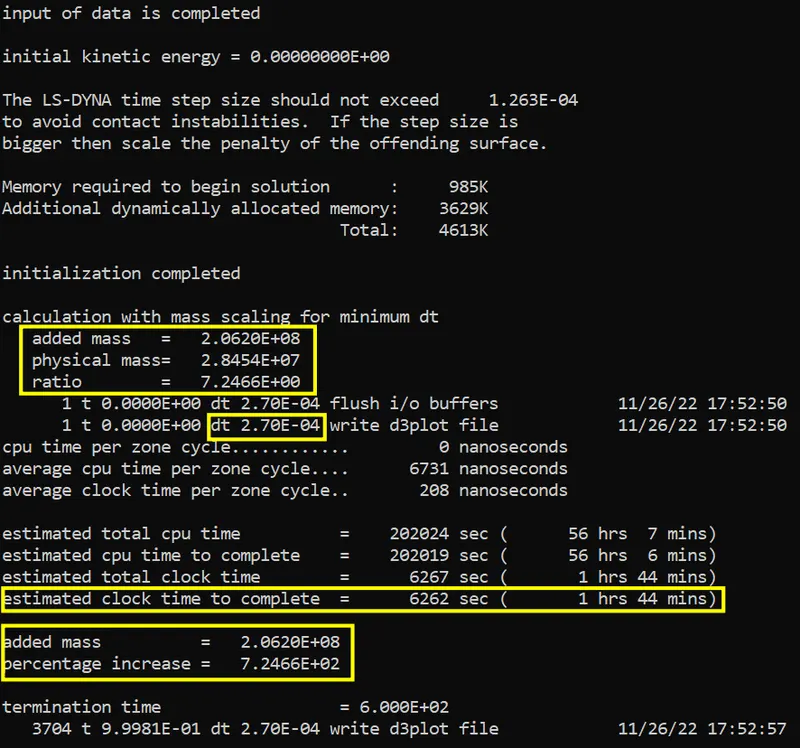
From Trial-5 is got the following values from the simulation,
- Physical mass = 2.84*e⁷ kg.
- TSSFAC- scale factor for computed timestep = 0.9 s
- DT2MS- time step size for mass scaled solution = -3.0*e⁻⁴ s
- dt - timestep size = 2.7*e⁻⁴ s
- Added mass = 2.06*e⁷ Kg
- Percentage increase = 7.24 %
- Mass scaling ratio = 7.24
- Estimated clock time = 1 hrs 44 mins.
TRIAL 6 : Run the simulation of control card value as (DT2MS = -2.0 e-4 s & TSSFAC= 0.9 s )
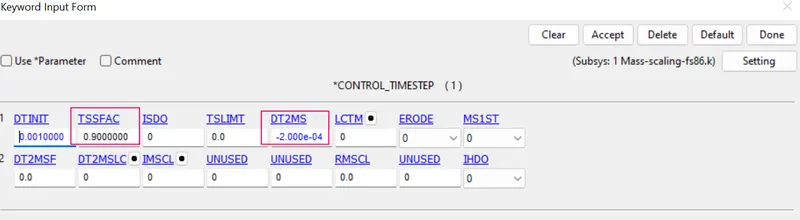
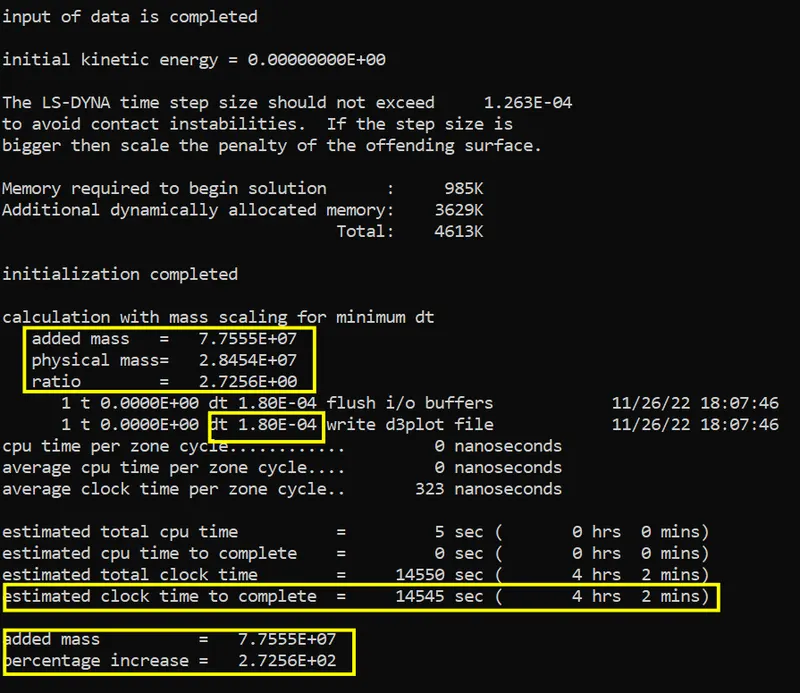
From Trial-6 is got the following values from the simulation,
- Physical mass = 2.84*e⁷ kg.
- TSSFAC- scale factor for computed timestep = 0.9 s
- DT2MS- time step size for mass scaled solution = -2.0*e⁻⁴ s
- dt - timestep size = 1.8*e⁻⁴ s
- Added mass = 7.75 *e⁷ Kg
- Percentage increase = 2.72 %
- Mass scaling ratio = 2.75
- Estimated clock time = 4 hrs 2 mins.
TRIAL 7 : Run the simulation of control card value as (DT2MS = -1.0 e-4 s & TSSFAC= 0.9 s )
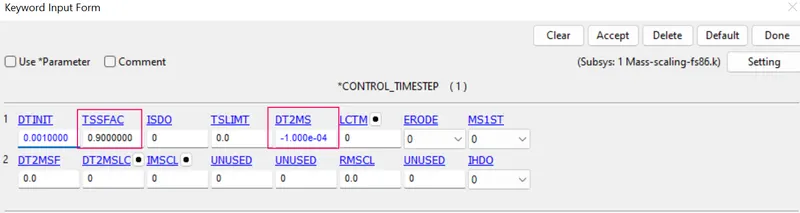
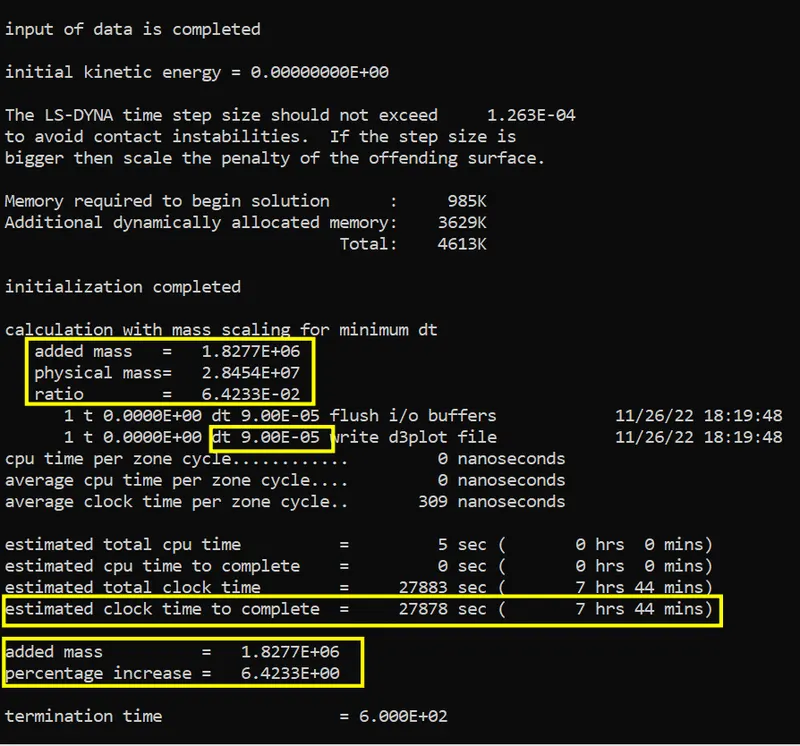
From Trial-7 is got the following values from the simulation,
- Physical mass = 2.84*e⁷ kg.
- TSSFAC- scale factor for computed timestep = 0.9 s
- DT2MS- time step size for mass scaled solution = -1.0*e⁻⁴ s
- dt - timestep size = 9*e⁻⁵ s
- Added mass = 1.82 *e⁶ Kg
- Percentage increase = 6.42 %
- Mass scaling ratio = 6.42 *e⁻²
- Estimated clock time = 7 hrs 44 mins.
TRIAL 8 : Run the simulation of control card value as (DT2MS = -1.05*e-4 s & TSSFAC= 0.9 s )
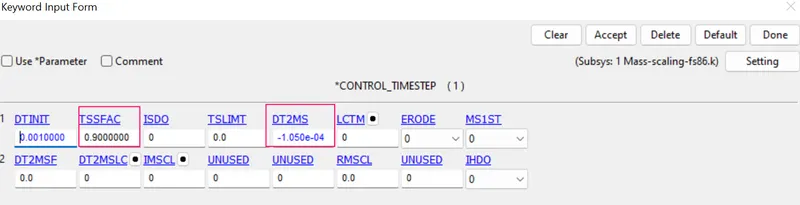
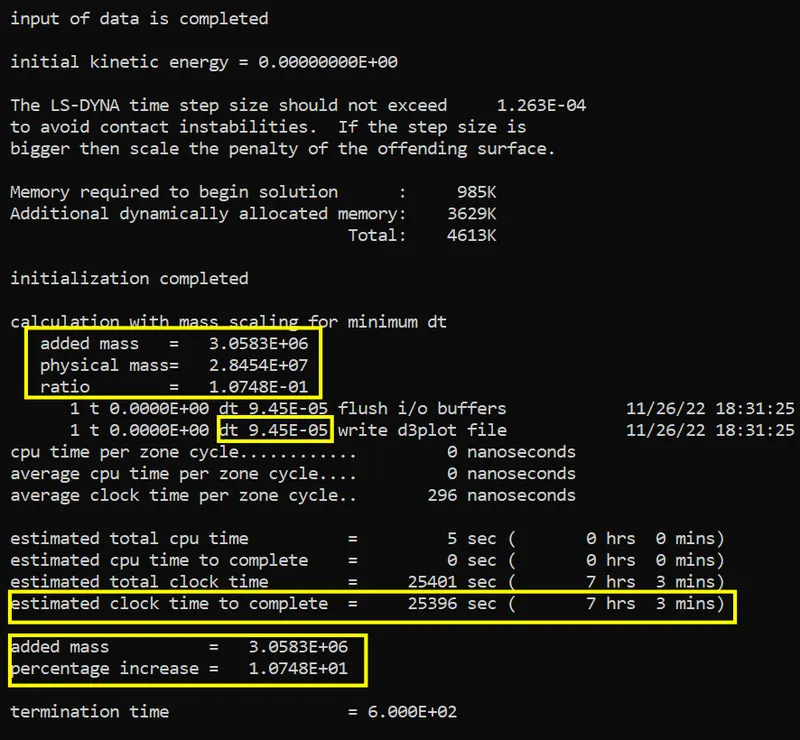
From Trial-8 is got the following values from the simulation,
- Physical mass = 2.84*e⁷ kg.
- TSSFAC- scale factor for computed timestep = 0.9 s
- DT2MS- time step size for mass scaled solution = -1.05*e⁻⁴ s
- dt - timestep size = 9.45*e⁻⁵ s
- Added mass = 3.05*e⁶ Kg
- Percentage increase = 10.74 %
- Mass scaling ratio = 0.01
- Estimated clock time = 7 hrs 3 mins.
TRIAL 9 : Run the simulation of control card value as (DT2MS = -1.03*e-4 s & TSSFAC= 0.9 s )
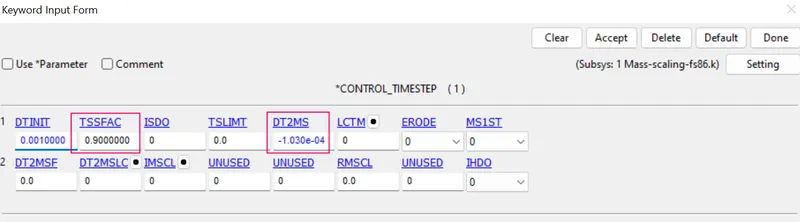
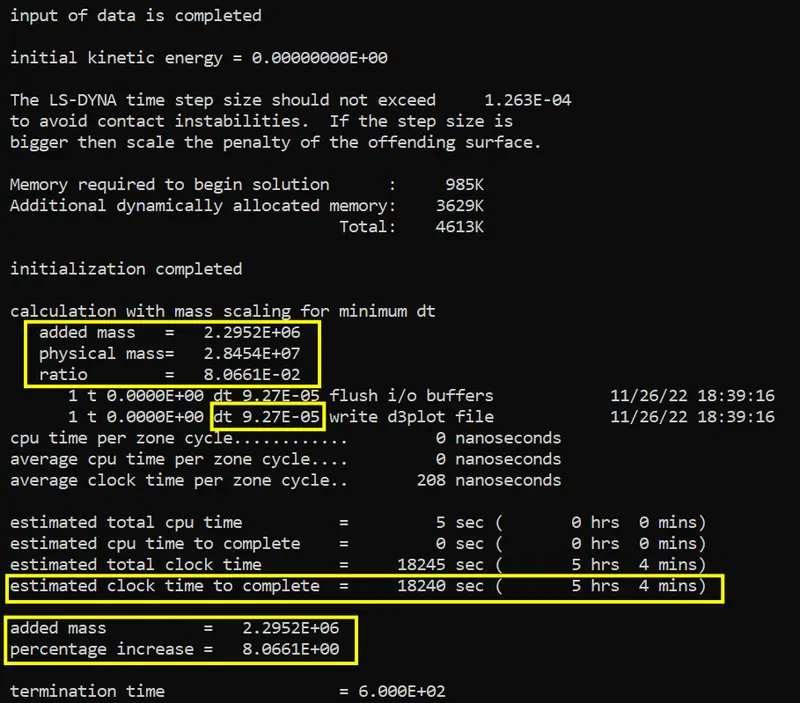
From Trial-9 is got the following values from the simulation,
- Physical mass = 2.84*e⁷ kg.
- TSSFAC- scale factor for computed timestep = 0.9 s
- DT2MS- time step size for mass scaled solution = -1.03*e⁻⁴ s
- dt - timestep size = 9.27*e⁻⁵ s
- Added mass = 2.29*e⁶ Kg
- Percentage increase = 8.06 %
- Mass scaling ratio = 8.06*e⁻²
- Estimated clock time = 5 hrs 4 mins.
TRIAL 10 : Run the simulation of control card value as (DT2MS = -1.029*e-4 s & TSSFAC= 0.9 s )
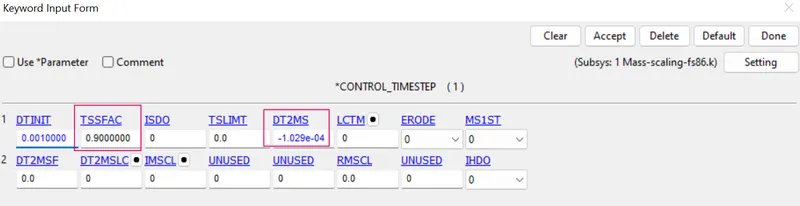
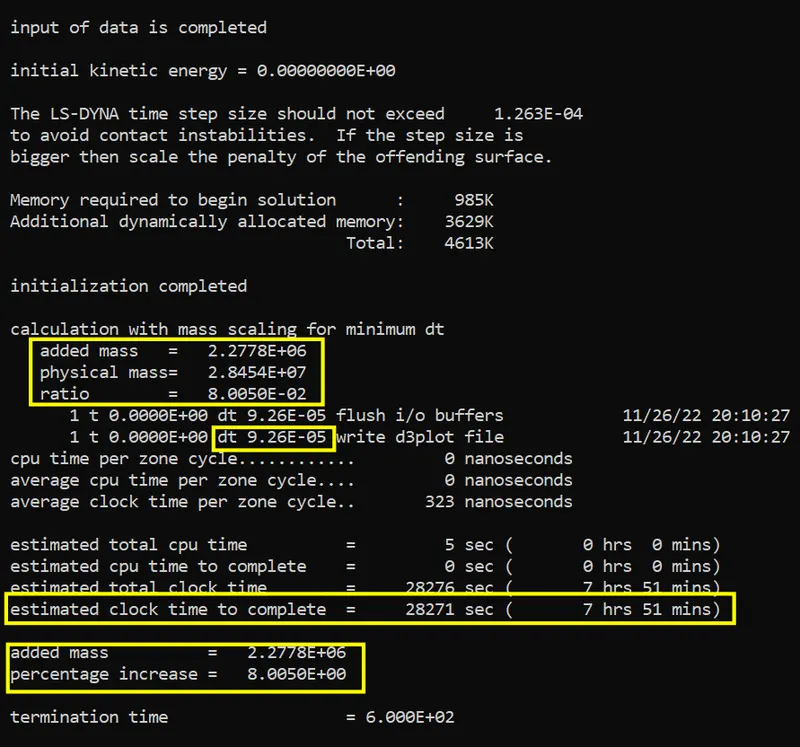
From Trial-10 is got the following values from the simulation,
- Physical mass = 2.84*e⁷ kg.
- TSSFAC- scale factor for computed timestep = 0.9 s
- DT2MS- time step size for mass scaled solution = -1.029 *e⁻⁴ s
- dt - timestep size = 9.26*e⁻⁵ s
- Added mass = 2.27*e⁶ Kg
- Percentage increase = 8.005 %
- Mass scaling ratio = 8.005*e⁻²
- Estimated clock time = 7 hrs 51 mins.
Got the estimated time: 7 hrs 51mins and added mass is 8.005 %
From trial 1-10 we understand as,
- The estimated clock time had reduced by increasing the DTMS value .
- Further increases of DT2MS value will only increase the mass percentage of the model.
- Therefore from the next case, vary the TSSFAC (Time Scale Factor) values to find whether it has any change in the mass percentage.
CASE 2 : MODIFICATION THE TSSFAC VALUE TO ACHIEVE 8% MASS SCALING
TRIAL 11 : Run the simulation of control card value as DT2MS = -1.03*e-4 s & TSSFAC= 0.8 s
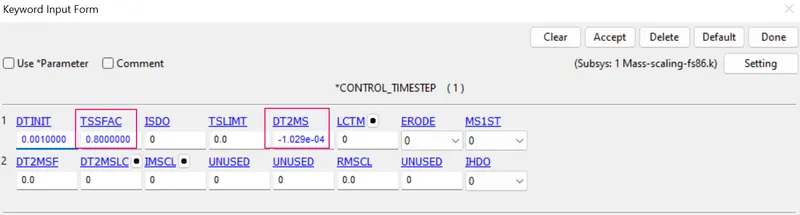
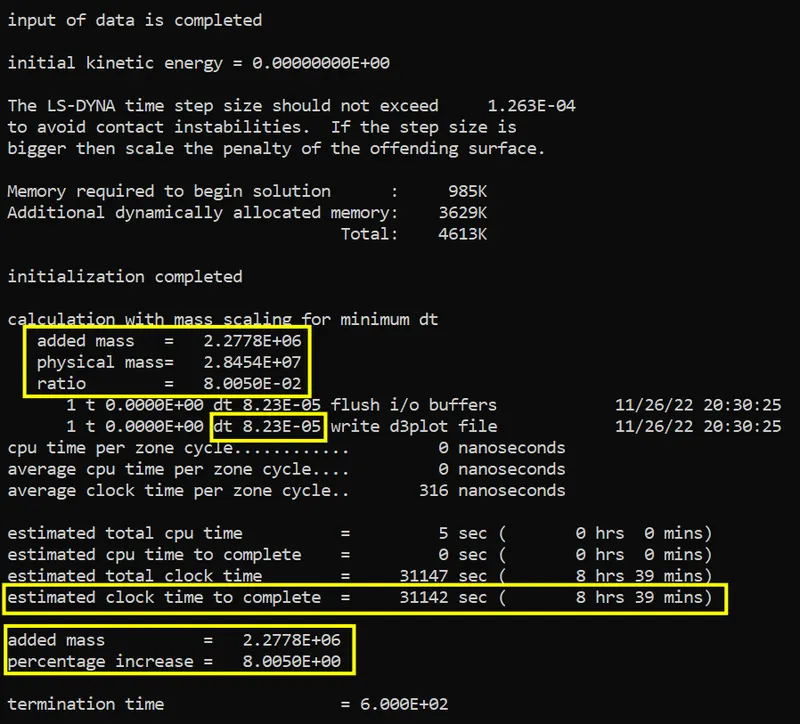
From Trial-11 we got the following values from the simulation,
- Physical mass = 2.84*e⁷ kg.
- TSSFAC- scale factor for computed timestep = 0.8 s
- DT2MS- time step size for mass scaled solution = -1.029*e⁻⁴ s
- dt - timestep size = 8.23*e⁻⁵ s
- Added mass = 2.27*e⁶ Kg
- Percentage increase = 8.005 %
- Mass scaling ratio = 8.005*e⁻²
- Estimated clock time = 8 hrs 39 mins.
TRIAL 12 : Run the simulation of control card value as DT2MS = -1.03*e-4 s & TSSFAC= 0.7 s
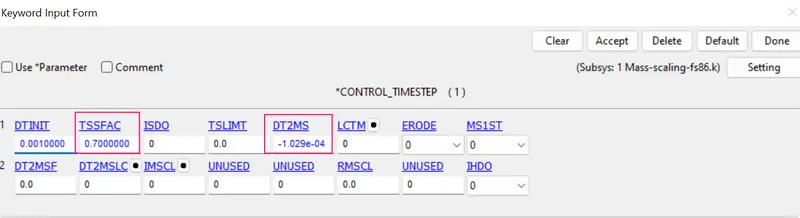
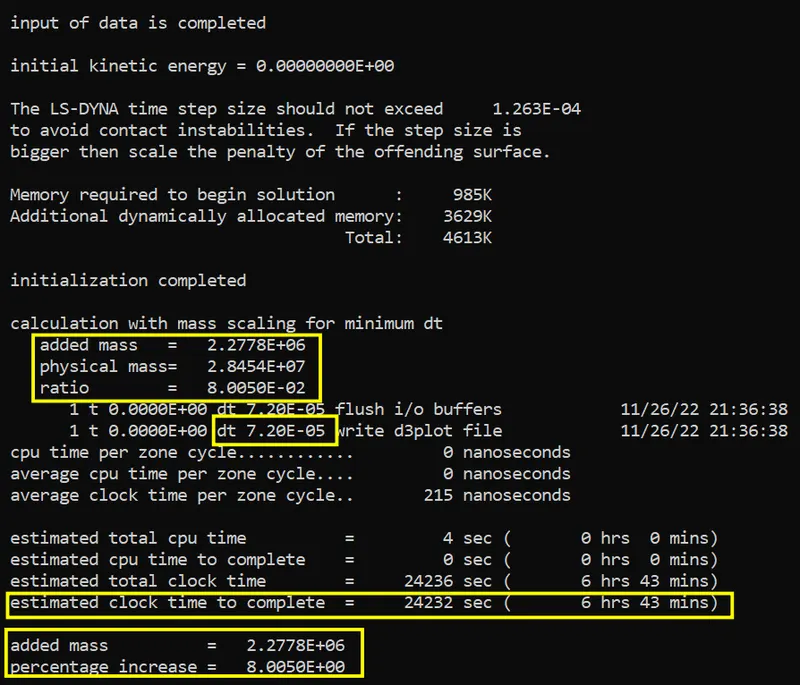
From Trial-12 we got the following values from the simulation,
- Physical mass = 2.84*e⁷ kg.
- TSSFAC- scale factor for computed timestep = 0.7 s
- DT2MS- time step size for mass scaled solution = -1.029*e⁻⁴ s
- dt - timestep size = 7.20*e⁻⁵ s
- Added mass = 2.27*e⁶ Kg
- Percentage increase = 8.005 %
- Mass scaling ratio = 8.005*e⁻²
- Estimated clock time = 6 hrs 43 mins.
TRIAL 13 : Run the simulation of control card value as DT2MS = -1.03*e-4 s & TSSFAC= 0.6 s
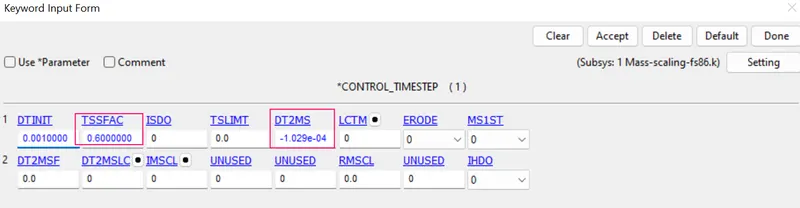
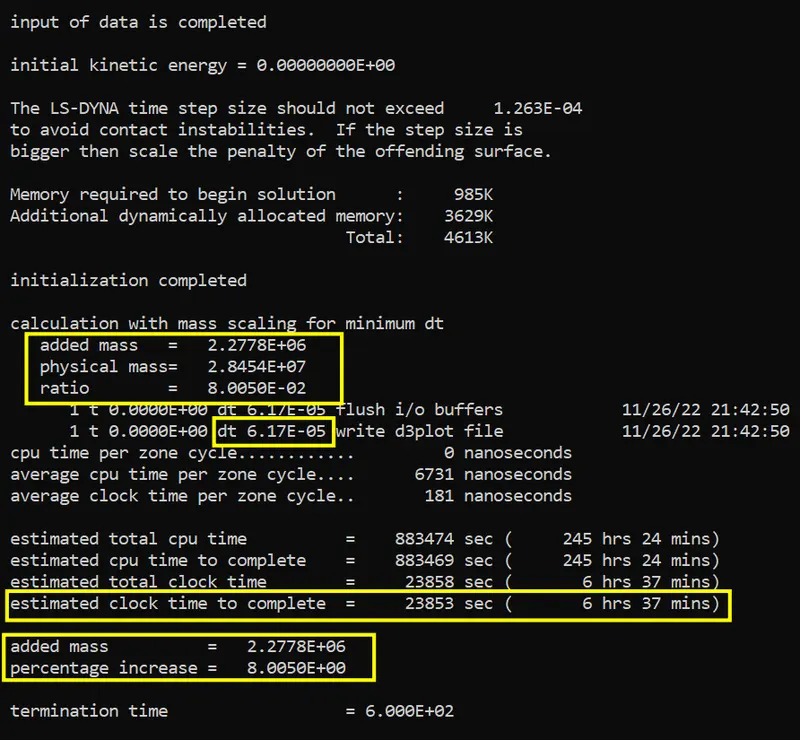
From Trial-13 we got the following values from the simulation,
- Physical mass = 2.84*e⁷ kg.
- TSSFAC- scale factor for computed timestep = 0.6 s
- DT2MS- time step size for mass scaled solution = -1.029*e⁻⁴ s
- dt - timestep size = 6.17*e⁻⁵ s
- Added mass = 2.27*e⁶ Kg
- Percentage increase = 8.005 %
- Mass scaling ratio = 8.005*e⁻²
- Estimated clock time = 6 hrs 37 mins.
TRIAL 14 : Run the simulation of control card value as DT2MS = -1.03*e-4 s & TSSFAC= 0.5 s
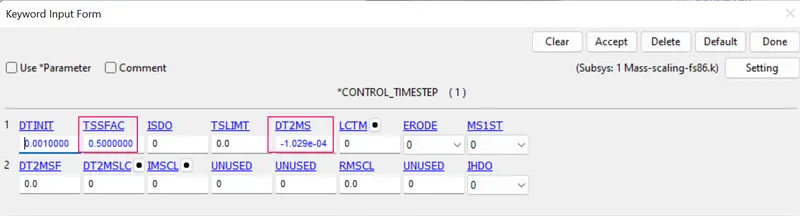
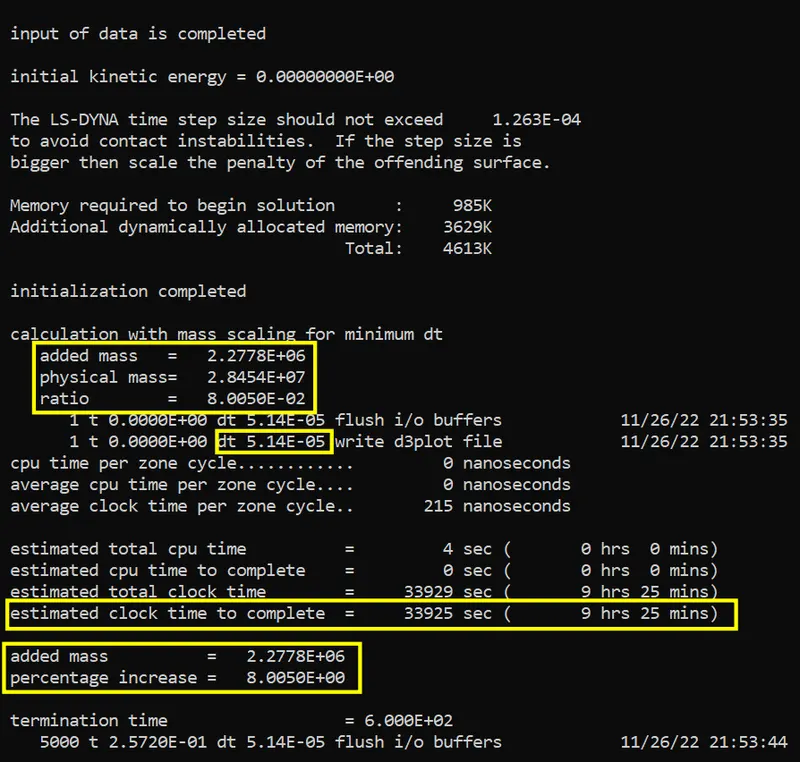
From Trial-14 we got the following values from the simulation,
- Physical mass = 2.84*e⁷ kg.
- TSSFAC- scale factor for computed timestep = 0.5 s
- DT2MS- time step size for mass scaled solution = -1.029*e⁻⁴ s
- dt - timestep size = 5.14 *e⁻⁵ s
- Added mass = 2.27*e⁶ Kg
- Percentage increase = 8.005 %
- Mass scaling ratio = 8.005*e⁻²
- Estimated clock time = 9 hrs 25 mins.
TRIAL 15 : Run the simulation of control card value as DT2MS = -1.029*e-4 s & TSSFAC= 0.4 s
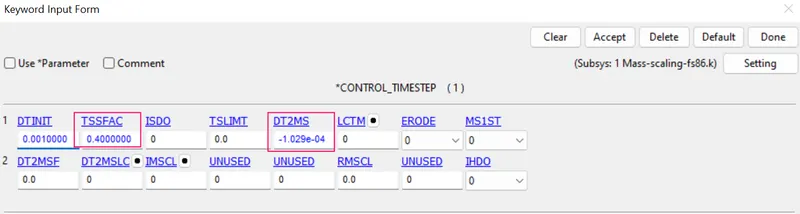
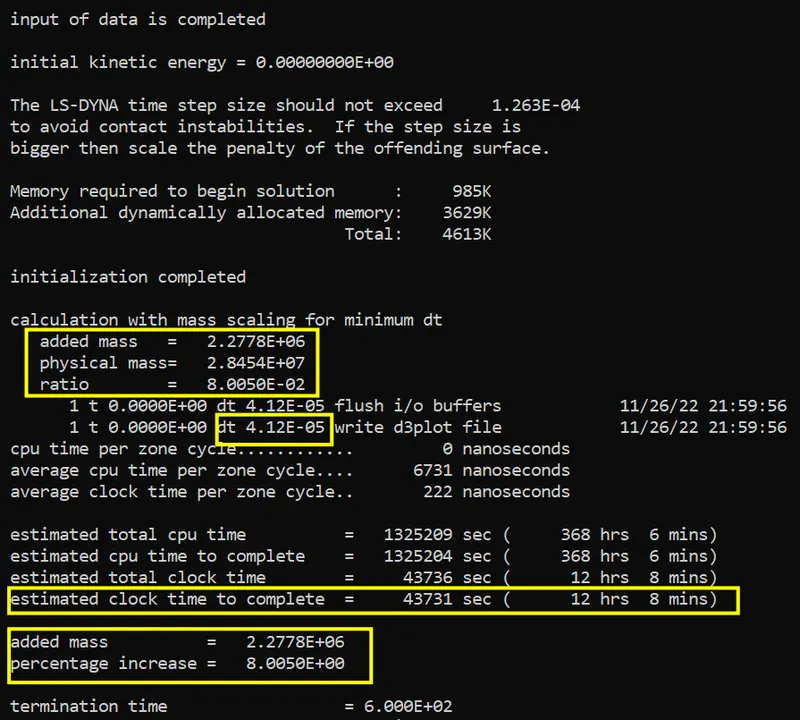
From Trial-15 we got the following values from the simulation,
- Physical mass = 2.84*e⁷ kg.
- TSSFAC- scale factor for computed timestep = 0.4 s
- DT2MS- time step size for mass scaled solution = -1.029*e⁻⁴ s
- dt - timestep size = 4.12 *e⁻⁵ s
- Added mass = 2.27*e⁶ Kg
- Percentage increase = 8.005 %
- Mass scaling ratio = 8.005*e⁻²
- Estimated clock time = 12 hrs 8 mins.
- From trial 11 to 15- we understand as,
Time scale factor(TSSFAC ) doesn't change the added mass , mass scaling ratio and mass percentage as remains the same, but the dt values and estimated clock time varies according to the Time scale factor(TSSFAC ).
Comparison of control time step trials datas in Explicit analysis
| Trial no | Physical mass (kg) |
TSSFAC |
DT2MS(sec) |
dt(Timestep)(sec) |
Added mass (kg) |
Mass Percentage increase (%) | Mass scaling ratio | Estimated clock time (sec) |
| 1. | 2.84*e⁷ | 0.9 | -3.5*e⁻⁵ | 4.4*e⁻⁵ | 0 | 0 | 0 | 40860 |
| 2. | 2.84*e⁷ | 0.9 | -3.0*e⁻⁵ | 4.4*e⁻⁵ | 0 | 0 | 0 | 38340 |
| 3. | 2.84*e⁷ | 0.9 | -2.0*e⁻⁵ | 4.4*e⁻⁵ | 0 | 0 | 0 | 39600 |
| 4. | 2.84*e⁷ | 0.9 | -1.0*e⁻⁵ | 4.4*e⁻⁵ | 0 | 0 | 0 | 38340 |
| 5. | 2.84*e⁷ | 0.9 | -3.0*e⁻⁴ | 2.7*e⁻⁴ | 2.06*e⁷ | 7.24 | 7.24 | 6240 |
| 6. | 2.84*e⁷ | 0.9 | -2.0*e⁻⁴ | 1.8*e⁻⁴ | 7.75*e⁷ | 2.72 | 2.75 | 14520 |
| 7. | 2.84*e⁷ | 0.9 | -1.0*e⁻⁴ | 9*e⁻⁵ | 1.82*e⁶ | 6.42 | 6.42*e⁻² | 27840 |
| 8. | 2.84*e⁷ | 0.9 | -1.05*e⁻⁴ | 9.45*e⁻⁵ | 3.05*e⁶ | 10.74 | 0.01 | 25380 |
| 9. | 2.84*e⁷ | 0.9 | -1.03*e⁻⁴ | 9.27*e⁻⁵ | 2.29*e⁶ | 8.06 | 8.06*e⁻² | 18240 |
| 10. | 2.84*e⁷ | 0.9 | -1.029 *e⁻⁴ | 9.26*e⁻⁵ | 2.27*e⁶ | 8.005 | 8.005*e⁻² | 28260 |
| 11. | 2.84*e⁷ | 0.8 | -1.029 *e⁻⁴ | 8.23*e⁻⁵ | 2.27*e⁶ | 8.005 | 8.005*e⁻² | 31140 |
| 12. | 2.84*e⁷ | 0.7 | -1.029 *e⁻⁴ | 7.20*e⁻⁵ | 2.27*e⁶ | 8.005 | 8.005*e⁻² | 24180 |
| 13. | 2.84*e⁷ | 0.6 | -1.029 *e⁻⁴ | 6.17*e⁻⁵ | 2.27*e⁶ | 8.005 | 8.005*e⁻² | 23820 |
| 14. | 2.84*e⁷ | 0.5 | -1.029 *e⁻⁴ | 5.14 *e⁻⁵ | 2.27*e⁶ | 8.005 | 8.005*e⁻² | 33900 |
| 15. | 2.84*e⁷ | 0.4 | -1.029 *e⁻⁴ | 4.12 *e⁻⁵ | 2.27*e⁶ | 8.005 | 8.005*e⁻² | 43680 |
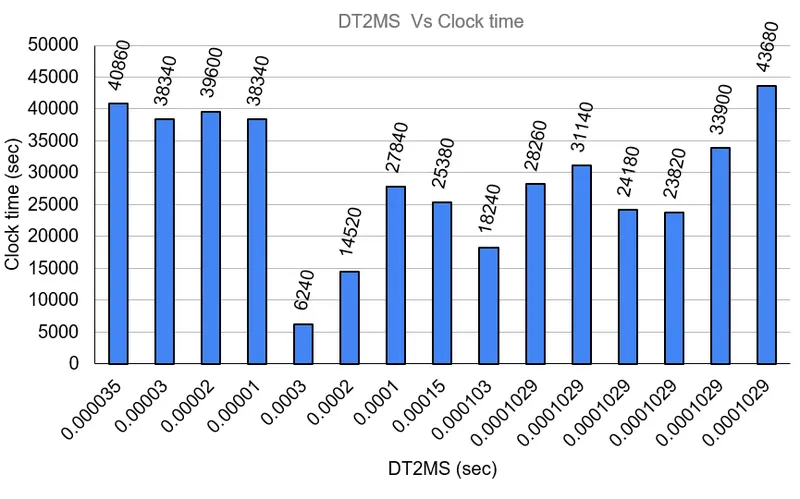
HISTOGRAM PLOT OF DT2MS Vs ESTIMATED CLOCK TIME
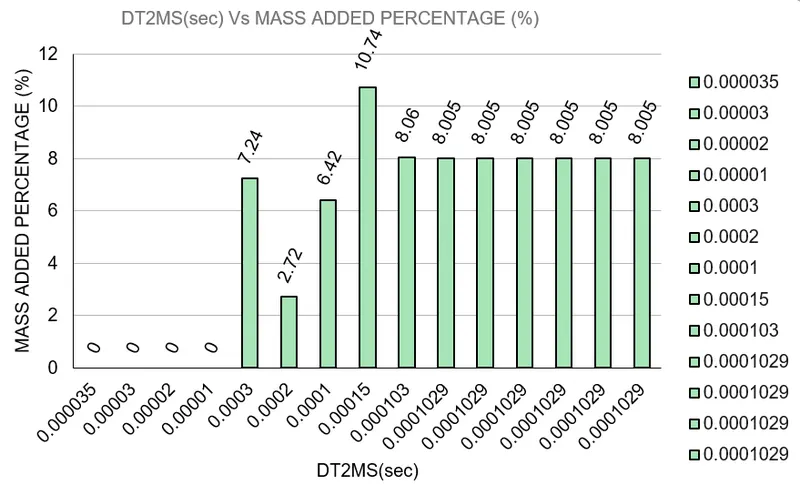
HISTOGRAM PLOT OF DT2MS Vs PERCENTAGE OF MASS
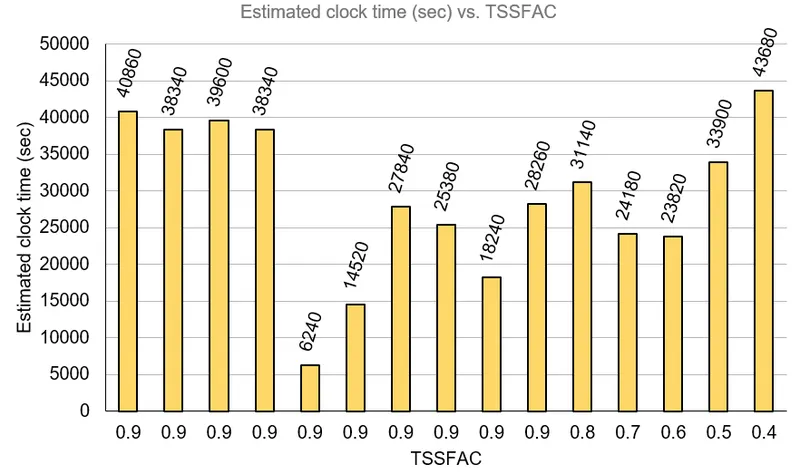
HISTOGRAM PLOT OF TSSFAC Vs ESTIMATED CLOCK TIME
HISTOGRAM PLOT OF TSSFAC Vs PERCENTAGE OF MASS
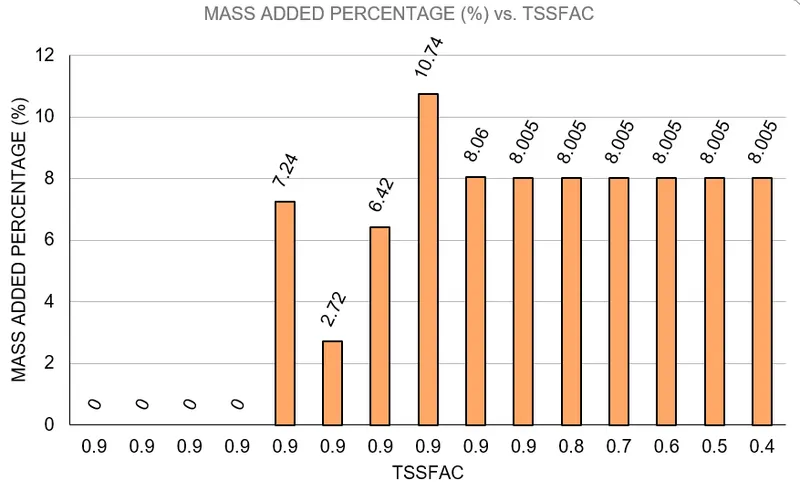
From the comparison table and column chart we understand as,
- Trial 1-4 : By gradually increase the value of DT2MS, there is no added mass , mass percentage increase and mass scaling ratio and also Dt (time step ) value remain same.but computational time is gradually decreased.
- Trial 5-9 : Then increase the value of DT2MS, added mass presented in the model , mass percentage is gradually increased From (7.24% to 8.06%) and also Dt (time step ) was also initially increased then suddenly decreased.
- Trial 10 : DT2MS=-1.029*e⁻⁴ and TSSFAC = 0.9 for that valuesmass percenatage is achieved -8% with computational time is 28260 sec . so computational time reduction is 12600 secs (3hrs 30 mins) is to achieved hard limit of mass pecentage.
- Trial 1-10 : Estimated clock time had reduced by increasing the DT2MS value.Further increases of DT2MS value will only increase the mass% of the model.
- Trial 11-15 : By decrease the value of TSSFAC ranges from (0.9 to 0.4) doesn't change the added mass , mass scaling ratio and mass percentage as remains the same, but Dt (time step ) values are gradually increased. at the same time computational time varies randomly respected Time scale factor(TSSFAC ) .
IMPLICIT ANALYSIS
Now run this same file using an implicit solver. Additional control cards are used to run this simulation in an implicit solver.
STEP 1: Define a control cards
Simulation of implicit analysis and define related control parameters such as CONTROL_IMPLICIT_GENERAL ,CONTROL_IMPLICIT_SOLUTION ,CONTROL_IMPLICIT_SOLVER & CONTROL_IMPLICIT_AUTO.
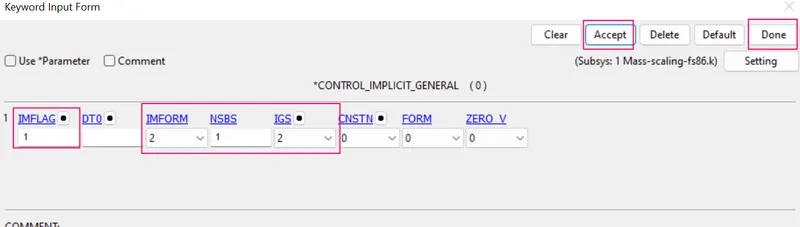
STEP 1A : Define a CONTROL_IMPLICIT_GENERAL card.
- In order to create control implicit general card by the following methods.
- Sidebar > model > keyword manager > all > CONTROL > IMPLICIT_GENERAL >IMFLAG is 1 (implicit analysis) and other parameters remain same as per default values > accept and done.
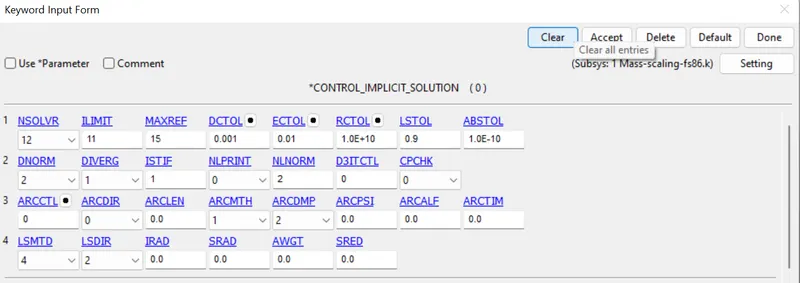
STEP 1B : Define a CONTROL_IMPLICIT_SOLUTION card.
- In order to create control implicit solutionl card by the following methods.
- Sidebar > model > keyword manager > all > CONTROL > IMPLICIT_SOLUTION >NSOLVR is 12 (nonlinear ) and other parameters remain same as per default values > accept and done.
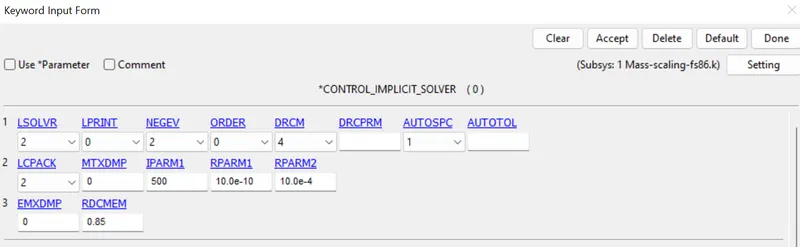
STEP 1C : Define a CONTROL_IMPLICIT_SOLVER card.
- In order to create control implicit solver card by the following methods.
- Sidebar > model > keyword manager > all > CONTROL > IMPLICIT_SOLVER > LSOLVR is 2( Parallel multi-frontal sparse solver ) and other parameters remain same as per default values > accept and done.
STEP 1D : Define a CONTROL_IMPLICIT_AUTO card.
- In order to create control implicit auto card by the following methods.
- Sidebar > model > keyword manager > all > CONTROL > IMPLICIT_AUTO > rparameters remain same as per default values > accept and done.
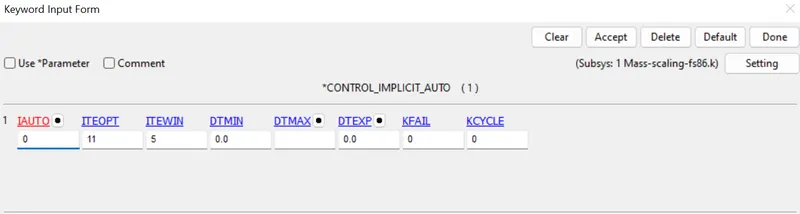
TRAIL 16 : Run the simulation of control card value as DT2MS = -3.5*e-5 s & TSSFAC= 0.9 s for implicit analysis
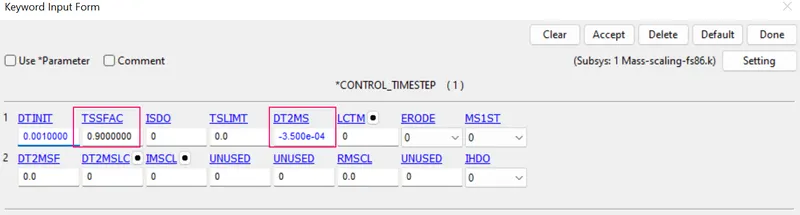
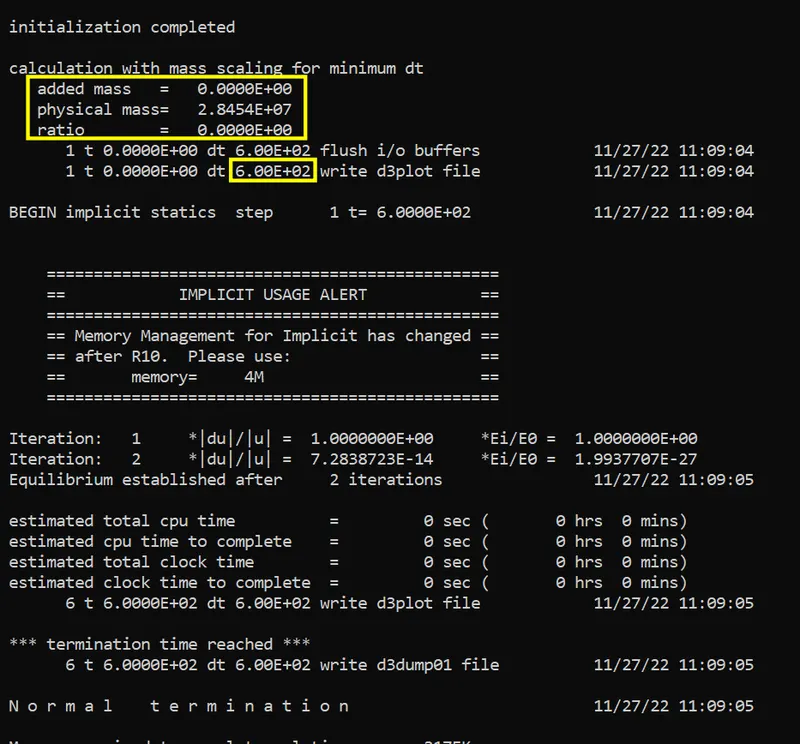
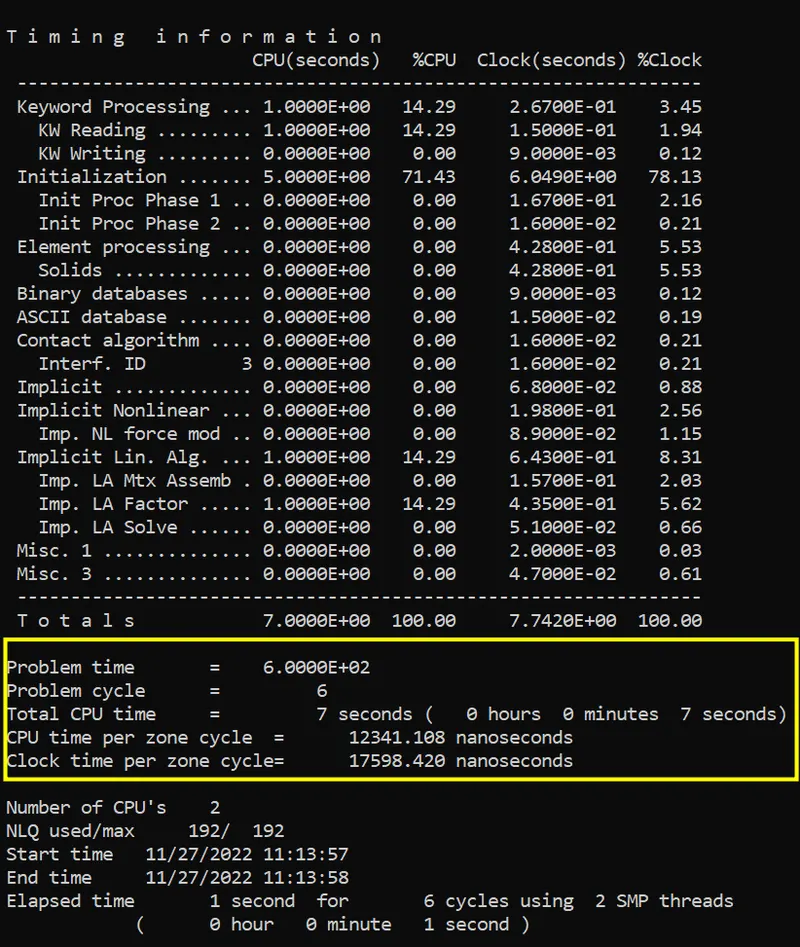
TRAIL 17 : Run the simulation of control card value as DT2MS = -1.029*e-4 s & TSSFAC= 0.9 s for implicit analysis
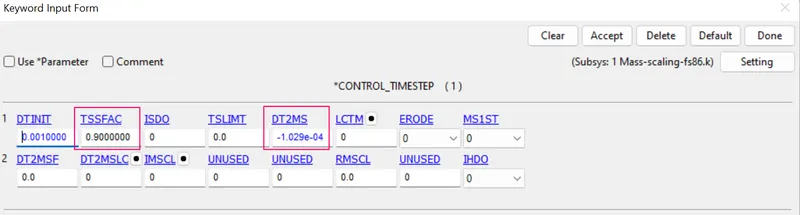
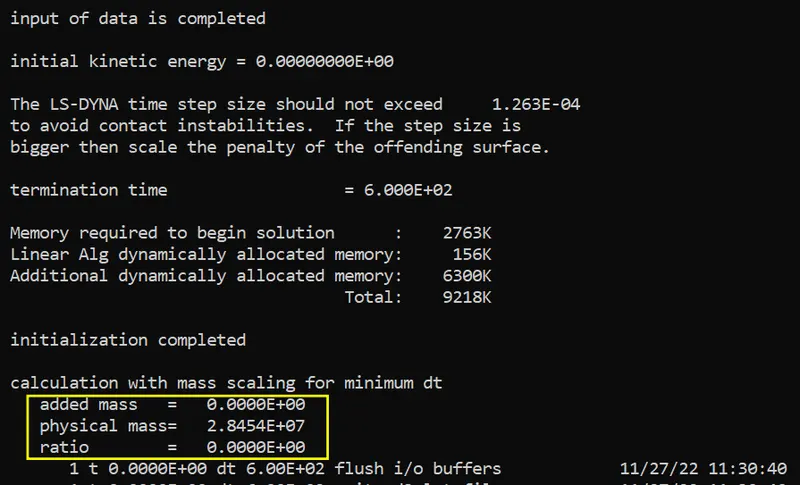
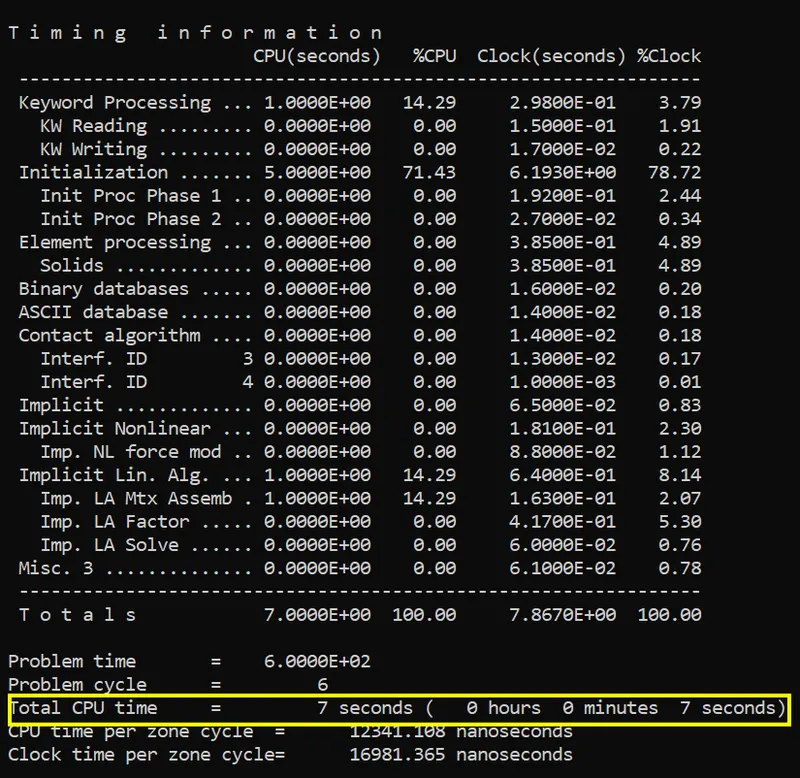
From (Trial 16 -17 )implicit analysis simulation results,we understand as
- There is no added mass and mass scaling ratio and the computational time is very less -7 seconds.
- The Factor DT2MS and TSSFAC don't affect Implicit Analysis as the Implicit analysis doesn't use a Physical Time Factor.
Comparison of Explicit run time Vs Implicit run time.
| S.NO | DT2MS (sec) | TSSFAC (sec) | Explicit run time (sec) | Implicit run time (sec) |
| 1. | -3.5*e-5 | 0.9 | 65,580 | 7 |
| 2. | -1.029*e-4 | 0.9 | 43,980 | 7 |
- The runtime required to complete the simulation varies for different valuesof DT2MS when using explicit analysis.
- Then the variation in runtime for different values of DT2MS is negligible when using implicit analysis.
- From the result, DT2MS and TSSFAC parameters have no effect on implicit's runtime. and also there is no added mass , mass percentage and mass scaling ratio in implicit analysis.
CONCLUSION:
- Learned about the mass scaling Technique to reduce the computational time for the analysis.
- We have also bought mass scaling percentage to 8% by varying the DT2MS values and then we have also found that TSSFAC (Time Step Factor) doesn't depend on the adding mass to the model.
- After, that we have run the analysis using implicit control cards which gives us the result that the implicit analysis is based on iterations and doesn't depend on mass scaling.
- Finally, we also compared explicit and implicit analysis data also we have plotted the histogram for first 10 trials DT2MS vs Estimated Time and DT2MS vs % of mass added then trials (11 to 15 histogram plot of TSSFAC vs Estimated Time and T2MS vs % of mass added.