Week - 8 Mass Scaling
Week - 8 Mass Scaling
Aim: Use of Mass scaling to reduce the total time taken to complete the simulation in explicit analysis and also in implicit analysis.
Introduction:
The models with high complexity takes more time to solve and so to reduce the time taken to solve, mass scaling technique is used where we know that timestep depends on density. By adding the mass ,the density increases the time step increases.
Mass scaling is technique used to reduce the total time taken to run the simulation. This can be done in LS PrePost Control_Timestep card using tssfac (time scaling factor) and dt2ms. By running this problem we can also check that tssfac used to control the stability of the simulation and has no affect on mass addition.
Increasing dt2ms in -ve adds mass to the model and increases the time step. Similarly for dt2ms in +ve, the simulation removes mass to decrease the time step to the given dt2ms and vice-versa. This dt2ms is generally used to limit it to order of 10^-5 of termination time.
So here termination time is 600 and so dt2ms max can be 6.0E-3
In this model, first the model is run without mass scaling. Then keeping the tssfac as 0.9 the simulation is run for different dt2ms values and run time is noted. The dt2ms is increased to value keeping the percentage of mass scaling in view. Then changing tssfac to 0.7 the simulations are run.
- First the model is opened in notepad and run in LS Run without mass scaling.
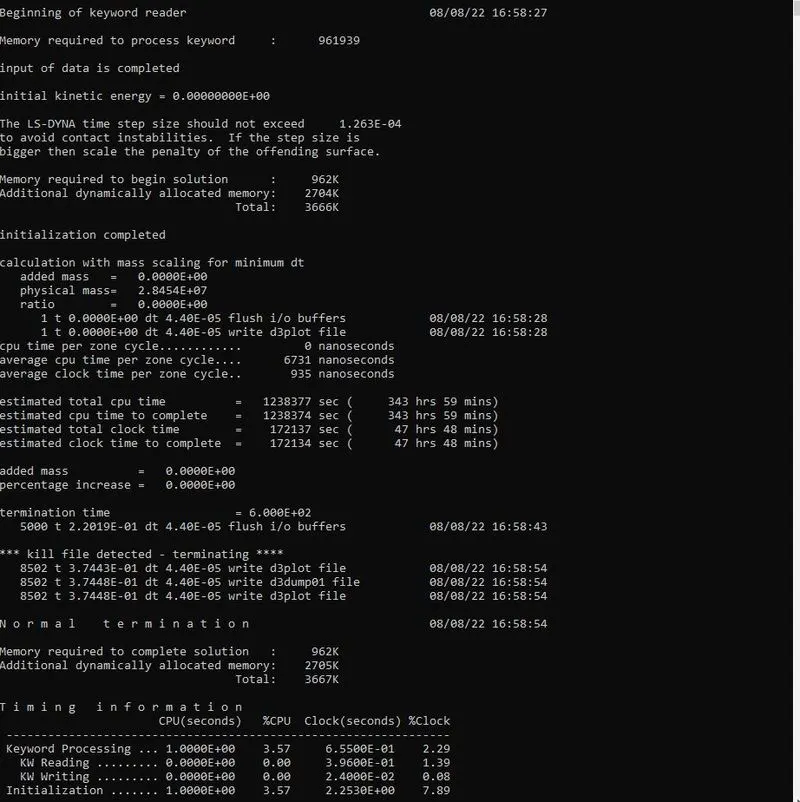
The run time shown is 344 hrs and no mass scaling and dt is 4.40E-05
2. Next the mass scaling is activated by increasing the dt2ms to value bigger than dt above
dt = 4.0E-5 and tssfac = 0.9
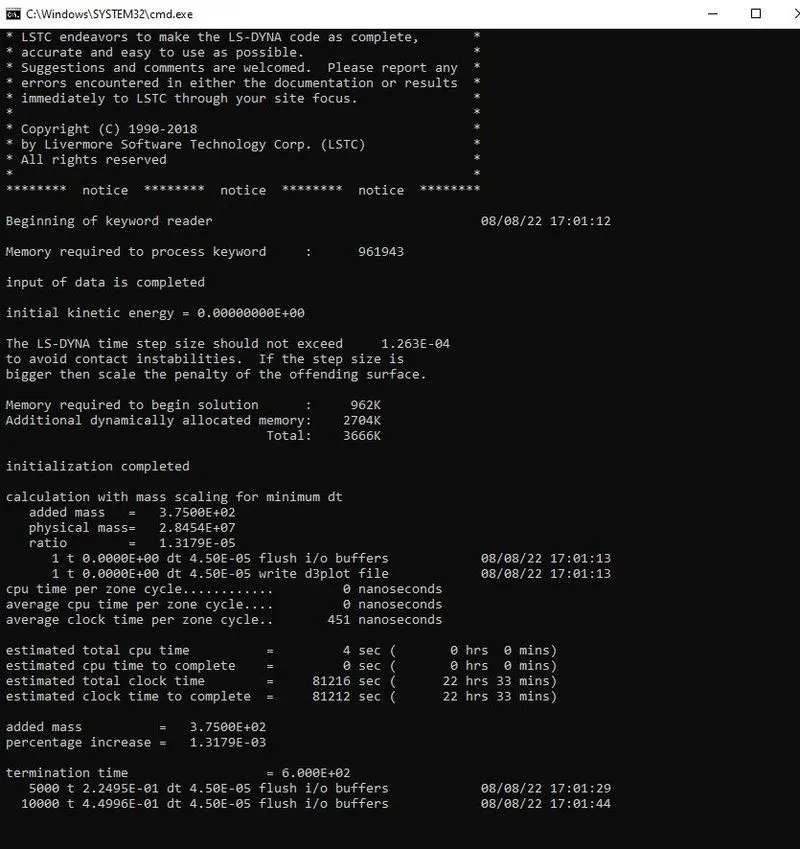
3.Here mass percentage increase is 0.1317 % and dt is 4.5E-05
dt = 50E-04 and tssfac = 0.9
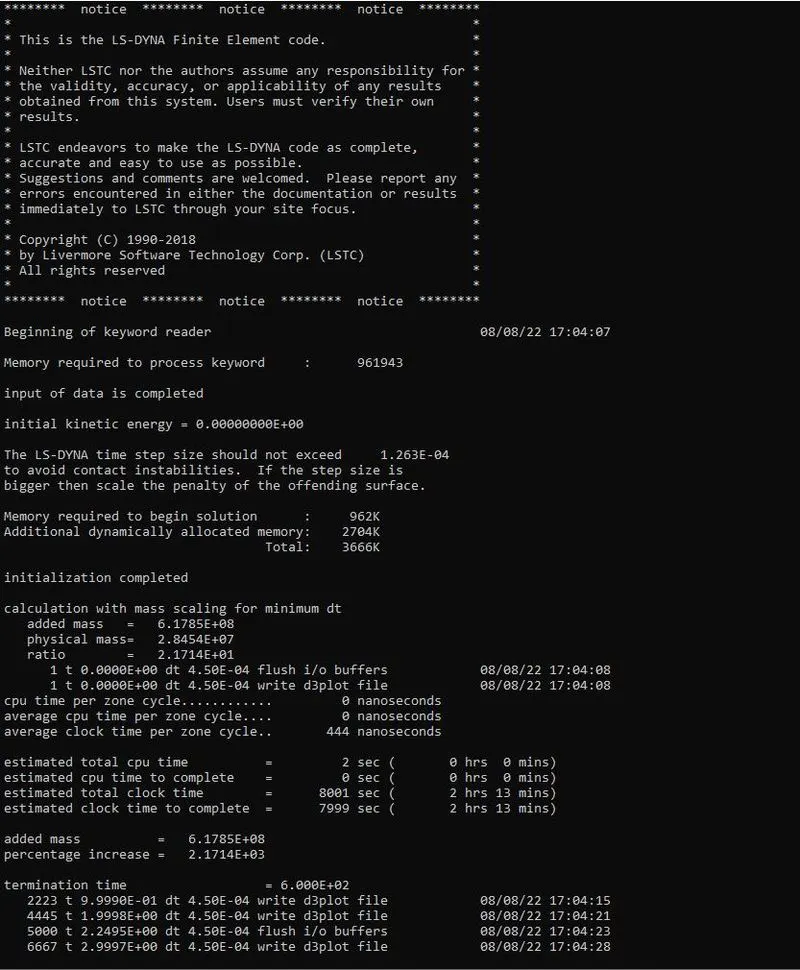
Rerunnig simulation:
At dt=1.03299E-04, tssfac=0.9 we have, percentage increase of 8.0050%
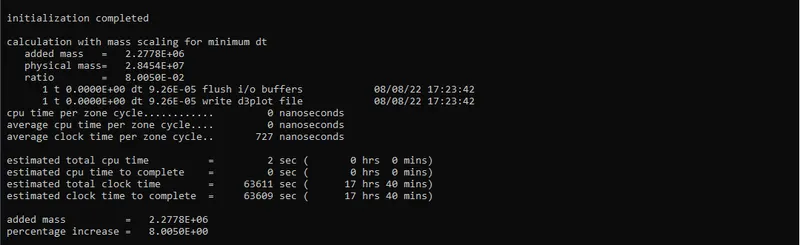
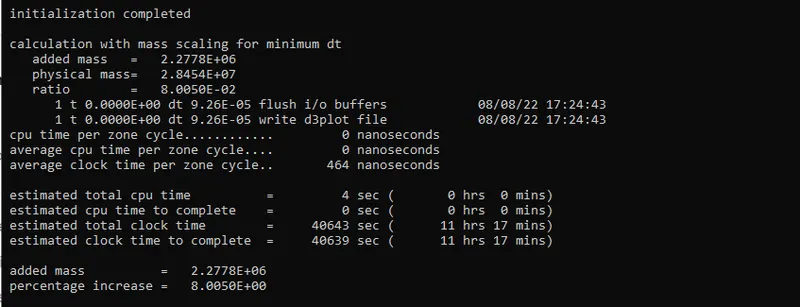
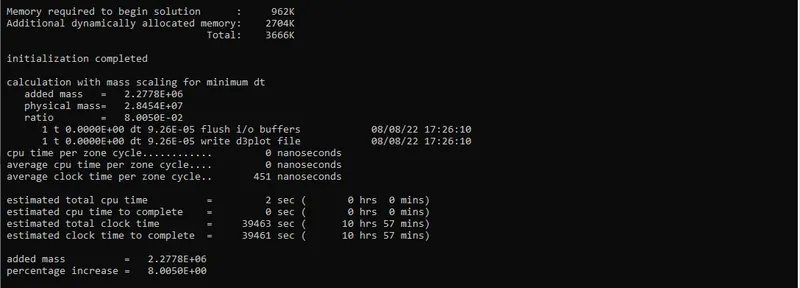
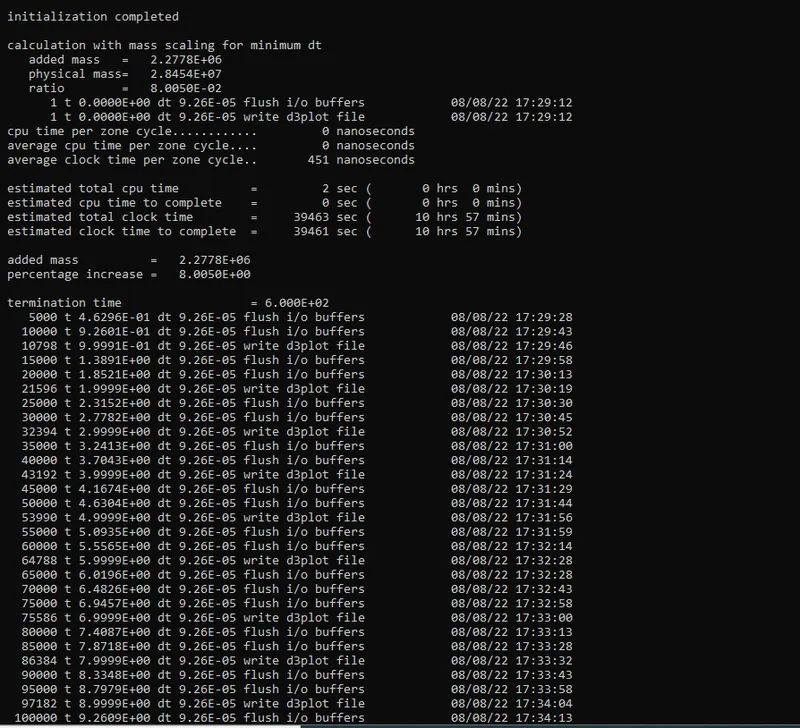
Here mass percentage increase is 10.7 % and dt increased to 9.45E-05
So the optimum value to keep mass scaling is beteween 1.0E-4 to 1.05E-4
Tabling the trail and error
| tssfac | dt2ms | Run Time | mass % increase | dt |
| 0.9 | 5.00E-04 | 22 hrs 33 min | 10.247 | 4.50E-05 |
| 0.9 | 1.04500E-04 | 17 hrs 40 min | 9.953 | 9.09E-05 |
| 0.9 | 1.03600E-04 | 13 hrs 45 min | 8.205 | 9.19E-05 |
| 0.9 | 1.03400E-04 | 11 hrs 17 min | 8.005 | 9.26E-05 |
| 0.9 | 1.03299E-04 | 10 hrs 57 min | 8.005 | 9.26E-05 |
Implicit Analysis:
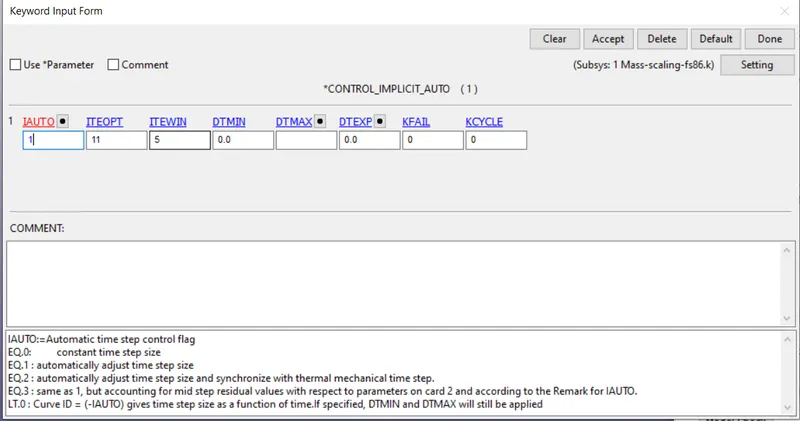
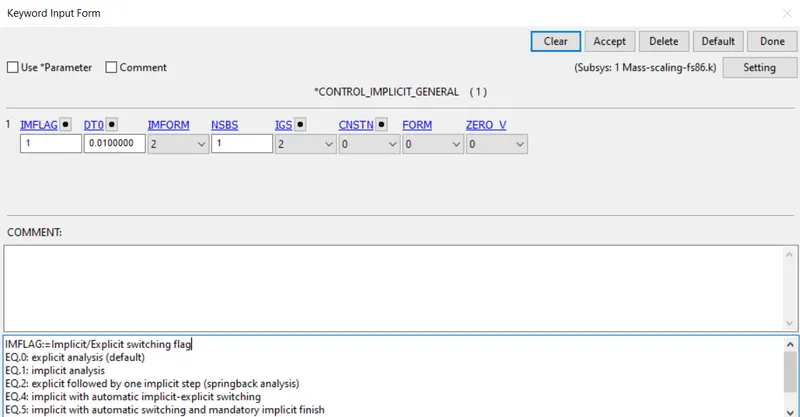
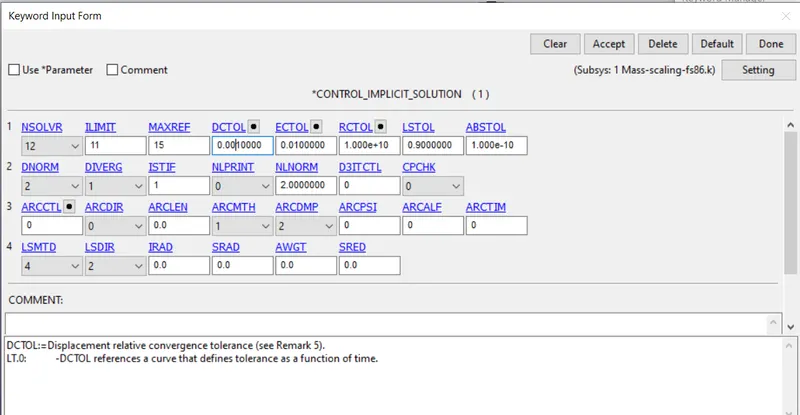
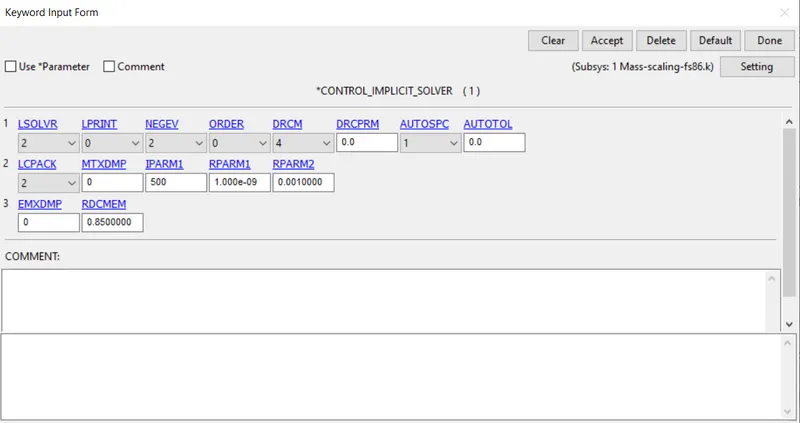
After the explicit analysis with mass scaling, implicit solver is enabled by using the following control cards
IMPLICIT_AUTO: Automatically adjust time step
IMPLICIT_GENERAL:
IMPLICIT_SOLUTION:
IMPLICIT_SOLVER:
Results:
For Explicit analysis the optimum value for dt2ms in taking tssfac 0.9 is 1.02899E-04.
By taking lower tssfac the problems stabilizes further and so optimum value is tssfac = 0.7 and dt2ms = 1.03299E-04, here we get mass % = 8.005 just above 8% and is acceptable.
For Implicit Analysis:
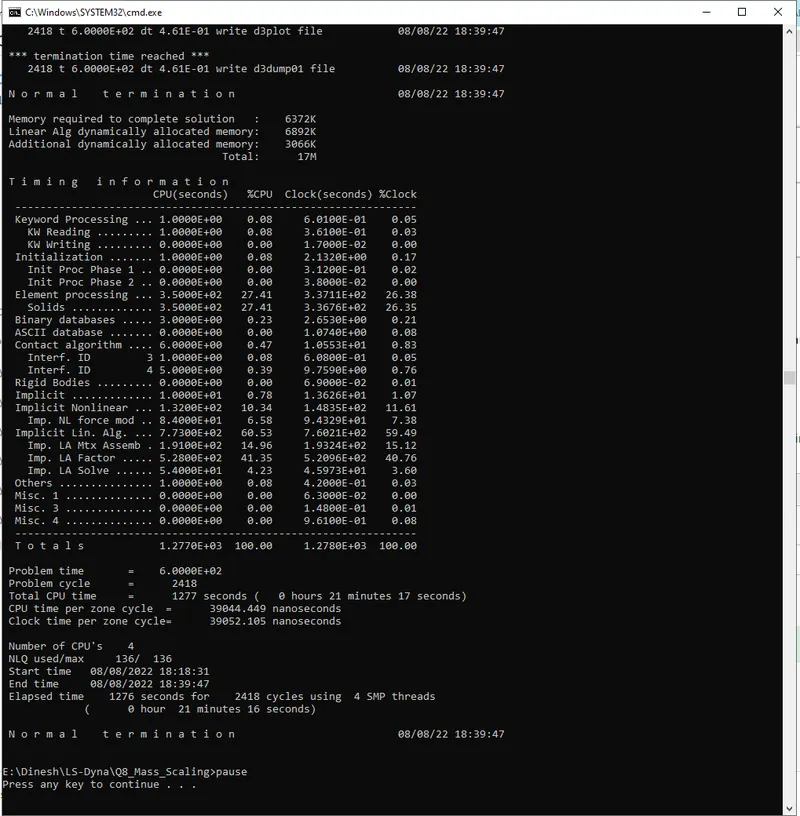
The run time is not given at start of simulation but at the end of termination and it is of 1 min 53 sec. This implicit depends on the time step taken and can't be compared with explicit mass scaling.