Week 8: Literature review - RANS derivation and analysis
Aim --> Literature review - RANS derivation and analysis
Objective -->
- To study the Reynolds decomposition on Navier-Stokes Equations and derive the Reynolds-Averaged Navier-Stokes Equation (RANS).
- To Understand the term Reynolds stress tensor that appears as a result of Averaging.
- Compare turbulent viscosity with molecular viscosity.
Theory
Reynolds Average Turbulence Models (RANS Models)
- The main idea revolves around the time Averaging of Navier-Stokes Equations. This is done by Reynolds decomposition. Again, after averaging, the non-linearity of the Navier–Stokes equations gives rise to terms that must be modelled. We use Reynolds decomposition for Averaging. The turbulence models should be regarded as engineering approximations rather than scientific laws.
- Reynolds decomposition is used on a solution variable where the instantaneous quantities are decomposed into time-averaged and fluctuating quantities.
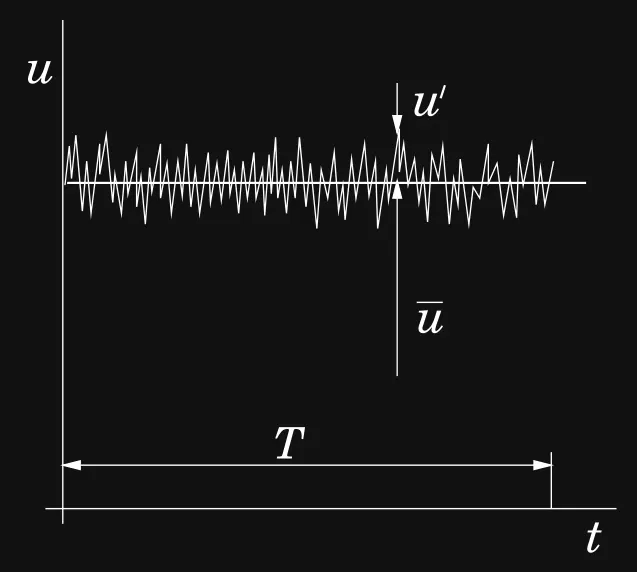
φ(x,y,z, t) = φ_(x,y,z) + φ′(x,y,z, t).............. For stationary turbulence
Derivation of the RANS models for 2D flow
Reynolds decomposition
u(x,t) = u_avg(x) + u'(x,t)...................(1)
u --> instantaneous velocity
u_avg --> time-averaged quantity
u' --> fluctuating quantity
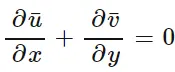
1. Continuity equation (RANS)
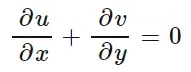
Applying 1 to the continuity equation
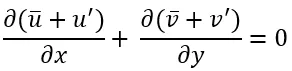
Applying the time-averaging method

Since the Average of the fluctuating terms is zero we can write,
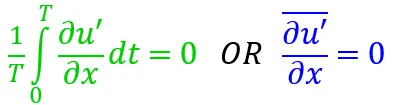
--> Finally we arrive at the RANS equation for mass conservation
2. Momentum Equation (RANS)
Conservation of Momentum x-direction (Navier-Stokes)

where nu = mu/rho (kinematic viscosity)
--> Adding continuity equation on the LHS and regrouping
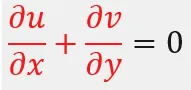


but, 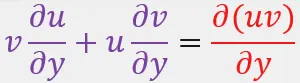 and
and 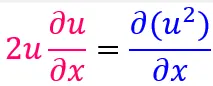
--> then the equation becomes

--> Now Applying Reynolds decomposition and Time averaging the above equation we get the following equations

Reynolds decomposition --> 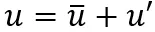

--> On further solving, we separate the average and fluctuating terms inside the average integral,

--> The terms marked in red colour are averages of the fluctuation terms and compute to a null value. the terms in red can be neglected.

--> Integrating the terms over the time period T we get,

--> Here, we are focusing on the flow inside the turbulent boundary layer where the gradient along the x-direction is negligible according to the order of magnitude analysis, so the term in red colour is neglected.
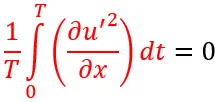
--> On solving further we have the RANS equation for x-direction momentum.

- The LHS terms represent the inertial terms that are time-averaged.
- the term in blue colour is the momentum diffusion due to molecular viscosity.
- The term in green colour represents momentum diffusion due to turbulent motion. This term when averaged is called Reynolds stress. We use turbulent models (k-e,k-w etc.) for the modelling of this term.
- In turbulent flow, the interface between two layers becomes unstable and breaks apart to form rotating structures known as eddy having a range of length scale and time scale.
- As we can see in the above derivation, the term RANS equation that is causing turbulence originates from the time-averaging process of the convection term. Also, the convection terms are non-linear in nature.
Reynolds stress
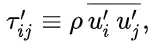
In fluid dynamics, the Reynolds stress is the component of the total stress tensor in a fluid obtained from the averaging operation over the Navier–Stokes equations to account for turbulent fluctuations in fluid momentum.