Week 8: Literature review - RANS derivation and analysis
AIM: -
Apply Reynold’s decomposition to the NS equations and come up with the expression for Reynold’s stress.
INTRODUCTION OF RANS: -
Different classes of RANS turbulence models exist:
Zero-equation models. In this class, only a system of partial differential equations PDEs for the mean-field is solved, and no other PDEs are used.
One-equation models. With respect to, (i) this class involves an additional transport equation for the calculation of the turbulence velocity scale, usually cast in terms of the average turbulent kinetic energy K.
Two-equation models. With respect to (ii), this class involves an additional transport equation for the calculation of the turbulence length scale, usually cast in terms of the scalar dissipation rate of turbulent kinetic energy. Classes (ii) and (iii) are also called mean turbulent energy MTE closures—representing a subset of the wider category of mean turbulent field MTF closures—by Mellor and Herring.
f a time-averaging of the NS equations and the continuity equation for incompressible fluids, the basic equations for the averaged turbulent flow will be derived in the following. The flow field can then be described only with help of the mean values.
In order to be able to take a time-average, the momentary value is decomposed into the parts mean value and fluctuating value.
The basic tool required for the derivation of the RANS equations from the instantaneous Navier–Stokes equations is the Reynolds decomposition. Reynolds decomposition refers to separation of the flow variable into the mean (time-averaged) component and the fluctuating component. Because the mean operator is a Reynolds operator, it has a set of properties. One of these properties is that the mean of the fluctuating quantity is equal to zero.
RENOLDS STRESS MODEL
The Reynolds stress model (RSM) is the most elaborate turbulence model in (U)RANS turbulence models. Abandoning the isotropic eddy-viscosity hypothesis, the RSM closes the Reynolds-averaged Navier-Stokes equations by solving transport equations for the Reynolds stresses, together with an equation for the dissipation rate. This means that five additional transport equations are required in 2D flows and seven additional transport equations must be solved in 3D.
ADVANTAGES
Specifically, RSM can show better performance involving the following types of flows:
- Free shear flows with strong anisotropy, like a strong swirl component, including flows in rotating fluids,
- Flows with sudden changes in the mean strain rate,
- Flows where the strain fields are complex and reproduce the anisotropic nature of turbulence itself,
- Flows with strong streamline curvature, secondary flows, and
- Buoyancy flows.
DISADVANTAGES
However, the penalty for this flexibility is a high degree of complexity in the resulting mathematical system, thus leading to reduced numerical robustness, requires increased computational resources. Thus, people typically start with a more stable turbulence closure model, such as k-ɛ model, and then run the RSM. The RSM may require more iterations to converge than the k-ɛ and the k-ω models due to the strong coupling between the Reynolds stresses and the mean flow.
RANS EQUATION: -
All fluid motions, whether turbulent or not, are governed by the dynamical equations for a fluid. These can be written using Cartesian tensor notation as:
 (1)
(1)
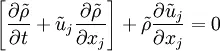 (2)
(2)
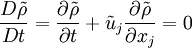 (3)
(3)
 (4)
(4)
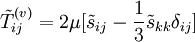 (5)
(5)
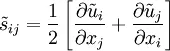 (6)
(6)
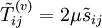 (7)
(7)
Throughout this material, unless explicitly stated otherwise, the density  and the viscosity
  will be assumed constant. With these assumptions, the instantaneous momentum equations for a Newtonian Fluid reduce to:
 (8)
(8)
where the kinematic viscosity, , has been defined as:
 (9)
(9)
(10)
 (11)
(11)

 The mass conservation equation can be similarly decomposed
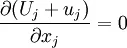


Now the terms in square brackets on the right have the dimensions of stress. The first term is, in fact, viscous stress. The second term, on the other hand, is not a stress at all, but simply a re-worked version of the fluctuating contribution to the non-linear acceleration terms. The fact that it can be written this way, however, indicates that at least as far as the motion is concerned, it acts as though it were a stress- hence its name, the Reynolds stress.
TURBULENT VISCOSITY:-
The turbulent transfer of momentum by eddies giving rise to internal fluid friction, in a manner analogous to the action of molecular viscosity in laminar flow, but taking place on a much larger scale. Eddy viscosity is a function of the flow, not of the fluid.
MOLECULAR VISCOSITY:-
At a molecular level, viscosity is a result of the interaction between the different molecules in a fluid. This can be also understood as friction between the molecules in the fluid. Just like in the case of friction between moving solids, the viscosity will determine the energy required to make a fluid flow.
DIFFERENCE:_
The utility of the analogy is strained by the fact that while the molecular viscosity is a property of the fluid, the eddy viscosity is a property of the flow.