Week 8: Literature review - RANS derivation and analysis
Aim: Deriving a Reynolds averaged Navier stokes equation.
Objective:
- Derive equation using Reynolds decomposition.
- Explain the end results of derivation.
Introduction:
Governing equation for the boundary layer:
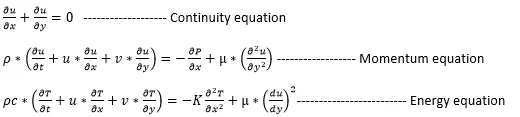
We can solve these three equation by direct numerical substitution this method is called DNS.
But there is a problem with the direct numerical solution technique let’s find out how.
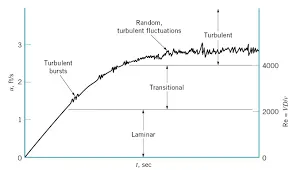
This diagram represents the transition from laminar to turbulent flow we can see the fluctuation which occurs in a turbulent region, to model this fluctuation accurately we should rely upon turbulent time scale in which turbulent frequency changes, this time scale is very small and occurs in a very small distance, so if we take our governing equation and solve for small time scale and a huge number of cells to accommodate the turbulent distances this will cause a great amount of time to be solved using the powerful computer too and will be computationally expensive.
To get a predictive solution for the above problem we use turbulence modeling.
Steps in turbulence modeling:
- Integrating governing equation for a time much larger than the turbulent time scale
- Applying Reynolds decomposition and convert this equation into Reynold’s averaged Navier stokes equation.
Reynolds averaged Navier stokes method (RANS):
Reynolds decomposition:
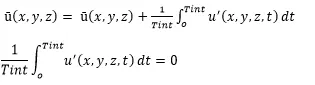
This method applies decomposition to local velocity varying with time and space into time-averaged quantity and fluctuating quantity.

Where,
u = Instantaneous velocity at any point in time and space,
ū = Time-averaged quantity
u’ = Fluctuating quantity
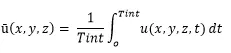
Where,
Tint = Integration time (much larger than turbulence time scale)
And,
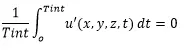
Since the fluctuation gets buried away at larger time scales (they cancel out).
We can also prove that,
Taking decomposition equation and integrating it for the time (T-->∞) we get,

The integration of average quantity will again give an average quantity itself.
Applying Reynold’s decomposition to Navier stokes equations:
Continuity equation:
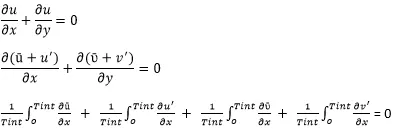
The fluctuating term gets zero, and time integration of average quantity is average quantity itself.

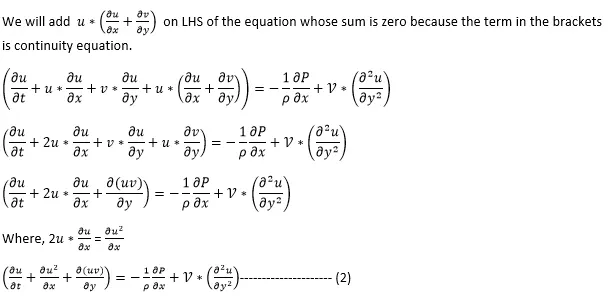
Momentum equation:

We should make some changes in the momentum equation,

Applying Reynolds decomposition to equation (2) will give,

All the terms with fluctuating turbulence quantity get canceled for large-time integrations.
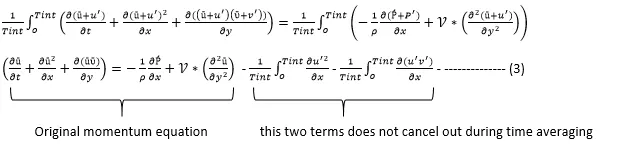
When we take a large integration time, the fluctuation should die down, but in actuality, the fluctuating terms we got in RHS are squared quantity, which means ‘-ve ‘ and ‘+ve’ fluctuating terms rather than getting canceled squared to positive quantity.
When we consider (u’ v’) term, u’ says how the velocity is fluctuating in the x-direction, and v’ says how the velocity is fluctuating in the y-direction, we are taking the fluid with low momentum v’ and introducing it into the high momentum zone, it will slow down the high momentum fluid flow, hence giving a net negative velocity, hence ‘+ve’ increase in v’ yields ‘-ve’ value of u’ and the net result from product of this two quantity is ‘-ve ’ value.
Assumption:
We will assume the equation in the boundary layer, in boundary layer gradient of velocity in the y-direction is much greater than that of x-direction and hence we can neglect it.
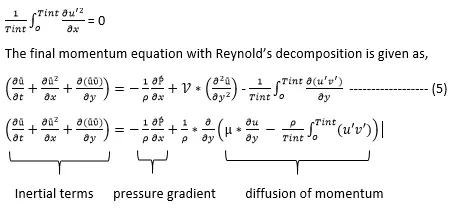
Diffusion of momentum is divided into two types:
- Molecular diffusion,
 / Viscous stress
 - Momentum diffusion because of turbulence,
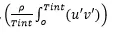 /Reynolds stress
Viscous stress:
Viscous stresses are caused by molecular diffusion across the boundary enclosing the control volume. If the molecular diffusion causes fluid molecules to move into a region of fluid with a different velocity, then momentum is transferred and viscous stress exists.
Reynolds stress:
Turbulence will give rise to velocity fluctuations in both the horizontal (velocity u) and vertical (velocity v) directions characterized by u' and v'. The associated momentum fluctuation is called the turbulent stress or Reynolds stress.
Turbulent viscosity:
The viscosity caused due to bulk mixing which is a result of the high kinetic energy of molecules is known as turbulent viscosity, molecular viscosity is due to the interaction between the molecules which restricts the movement of other molecules/collision of molecules, and this viscosity is generally seen at a low Reynolds number (laminar flows).
We see the molecular viscosity in the viscous sublayer where it is a function of the velocity gradient.
And turbulent viscosity is seen in the region where turbulence dominates at higher velocities.