Week 8 Challenge
Solution:
Ultracapacitor:
An ultracapacitor, also known as a supercapacitor or electrical double-layer capacitor (EDLC), is an energy storage device that stores electrical energy via electrostatic charge rather than chemical reactions like batteries.
- Uses:
- Energy Storage: Ultracapacitors are used for short-term energy storage in applications where rapid charge and discharge cycles are required, such as regenerative braking systems in vehicles.
- Peak Power Assist: They are employed to provide peak power assistance in conjunction with batteries, smoothing out fluctuations in power demand.
- Backup Power: Ultracapacitors can provide short-term backup power in electronic devices and systems, ensuring uninterrupted operation during power interruptions.
- Hybrid Vehicles: In hybrid vehicles, ultracapacitors can be used to capture and release energy during braking and acceleration, improving overall efficiency.
- Grid Stabilization: They are utilized in grid stabilization systems to store and release energy quickly, helping to maintain stability during fluctuations in power demand or supply.
- Advantages:
- High Power Density: Ultracapacitors can deliver and absorb power quickly, making them suitable for high-power applications.
- Long Cycle Life: They have a longer cycle life compared to batteries, enduring hundreds of thousands to millions of charge-discharge cycles.
- Rapid Charging: Ultracapacitors can be charged and discharged rapidly, often in seconds or minutes, without significant degradation.
- Wide Operating Temperature Range: They operate effectively across a wide temperature range, making them suitable for various environmental conditions.
- Maintenance-Free: Ultracapacitors require minimal maintenance compared to batteries since they don't rely on chemical reactions.
- Disadvantages:
- Low Energy Density: Ultracapacitors typically have lower energy density compared to batteries, meaning they store less energy per unit mass or volume.
- Voltage Limitations: They are typically limited to lower voltages compared to batteries, which may necessitate series connection for higher voltages.
- High Cost: Ultracapacitors can be more expensive per unit of energy stored compared to traditional batteries, although costs are decreasing with advancements in technology.
- Self-Discharge: They have a higher self-discharge rate compared to batteries, which can result in energy loss over time if not managed effectively.
- Limited Energy Storage: While suitable for high-power applications, ultracapacitors may not be ideal for long-term energy storage due to their lower energy density.
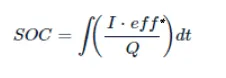
Equations used to model Ultracapacitor in Simulink
Where,
I - Ultracapacitor current
SOC - State of charge of ultracapacitor
Vmax - Maximum Voltage
R - Lumped resistance
Puc - Power required by the ultracapacitor
eff - efficiency during charge discharge cycle
eff* - Columb efficiency
Q - electric charge
C - Capacitance
Simulink Model:
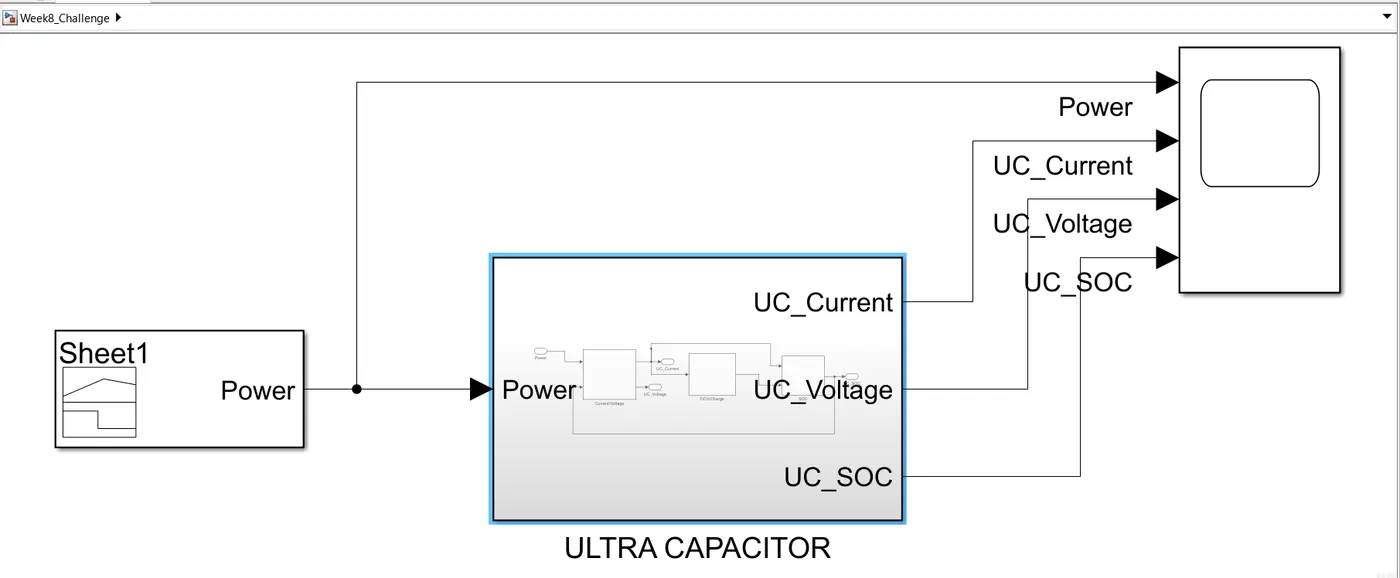
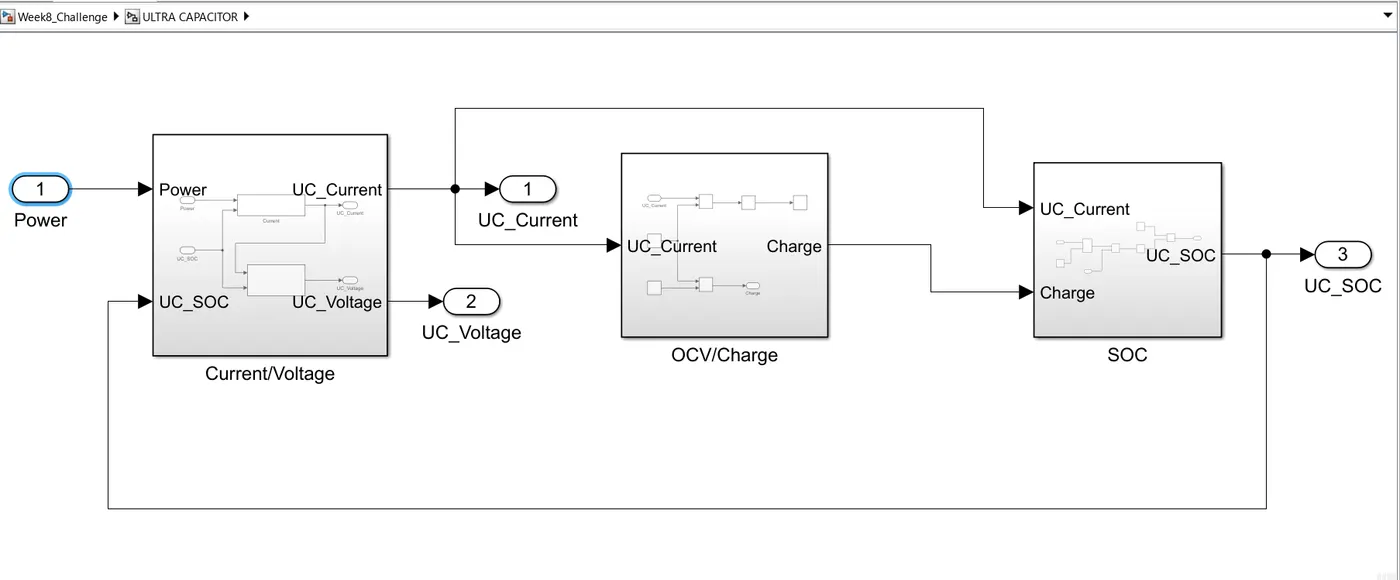
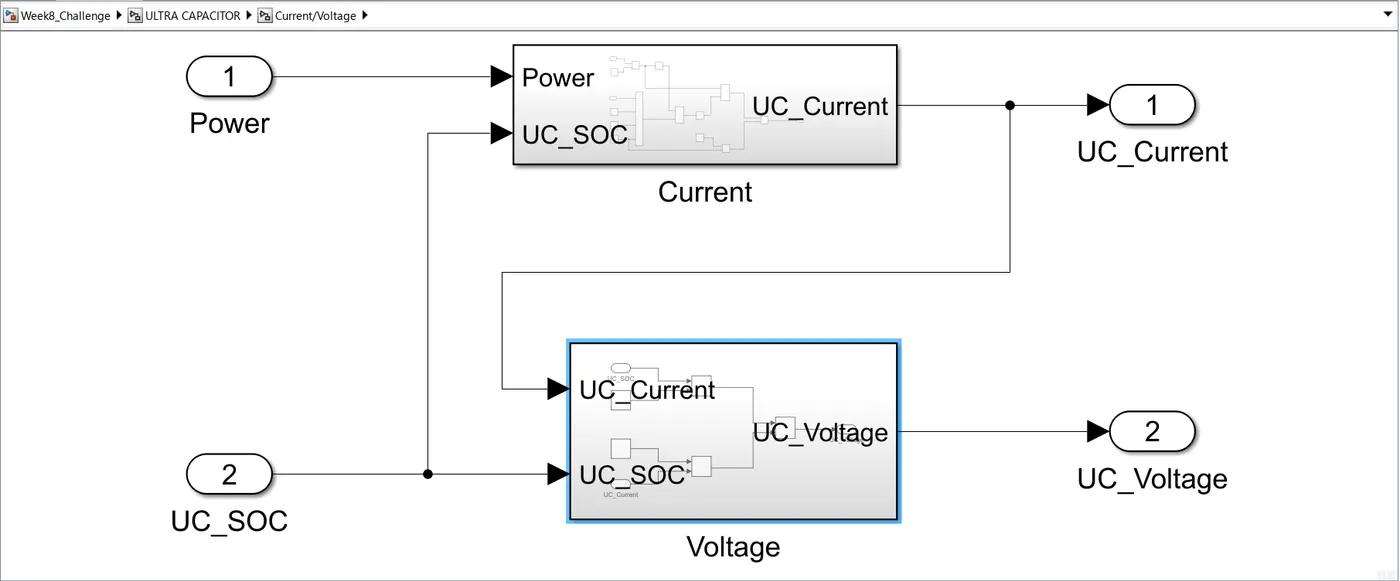
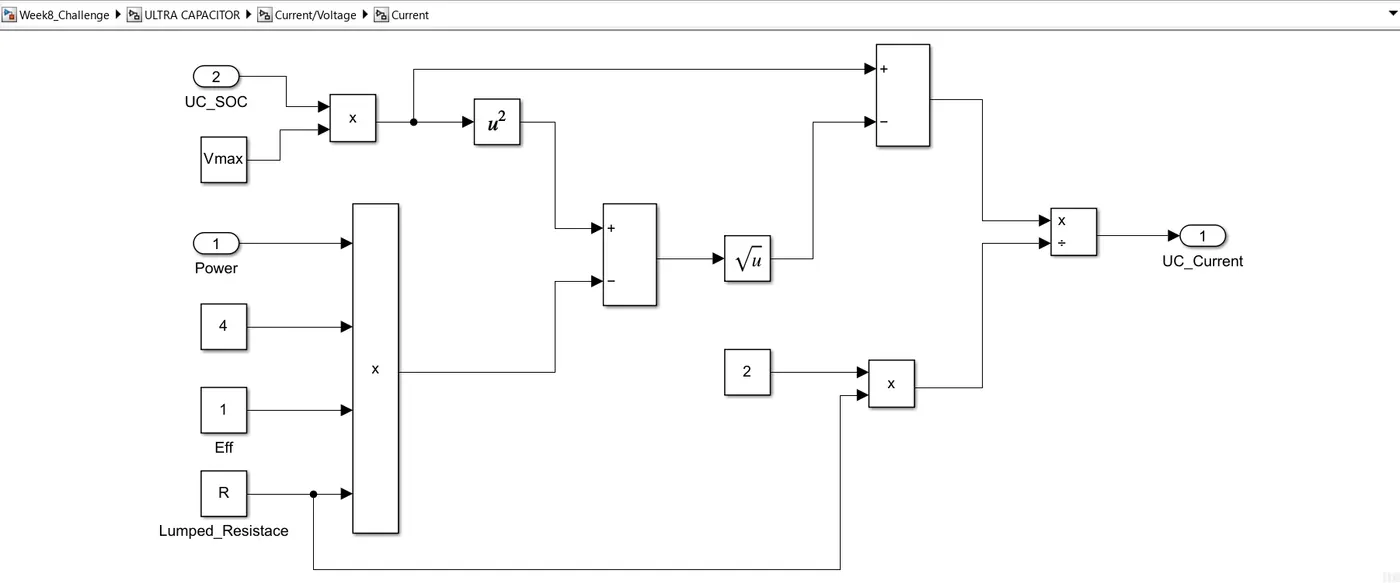
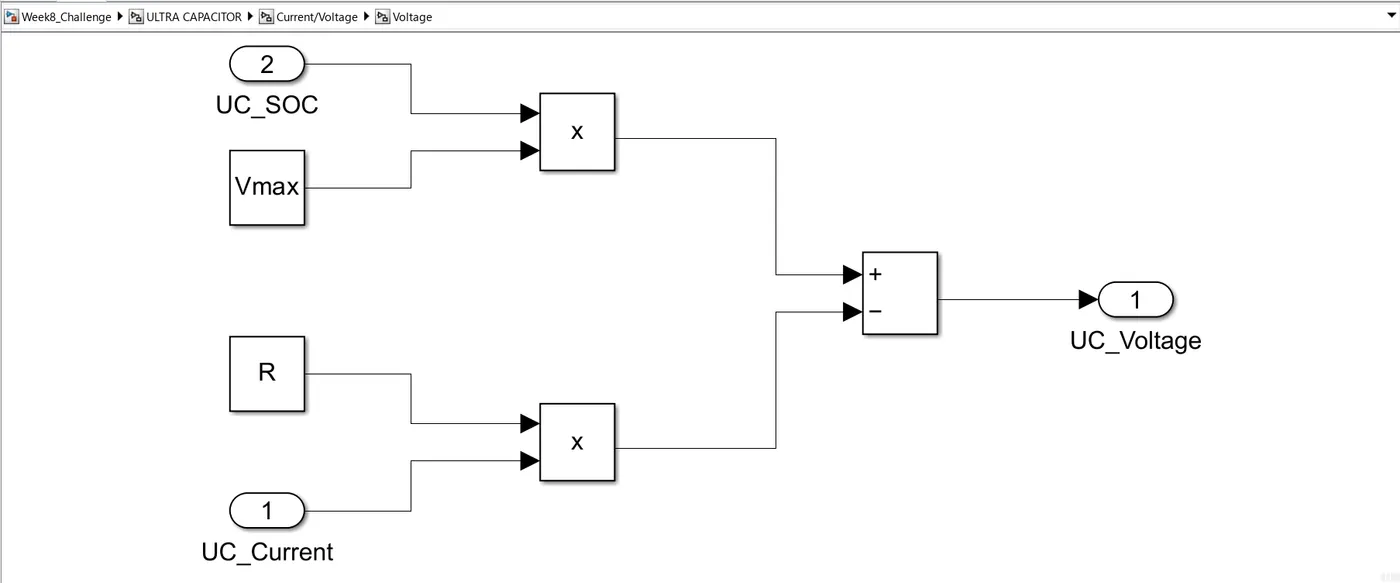
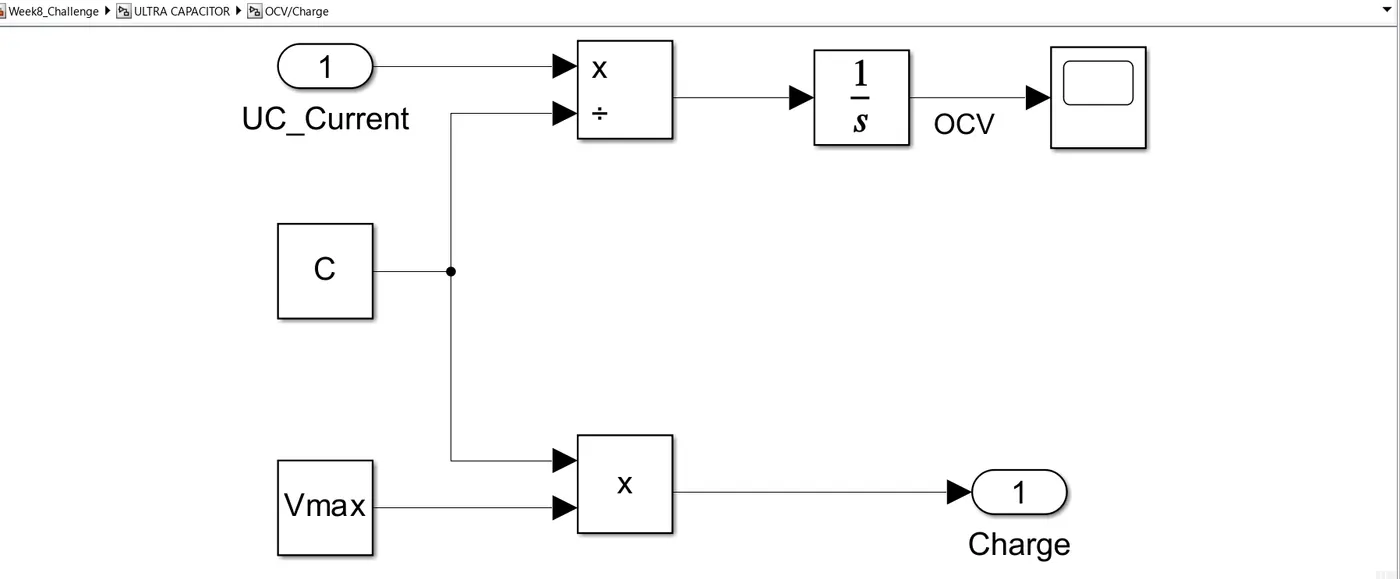
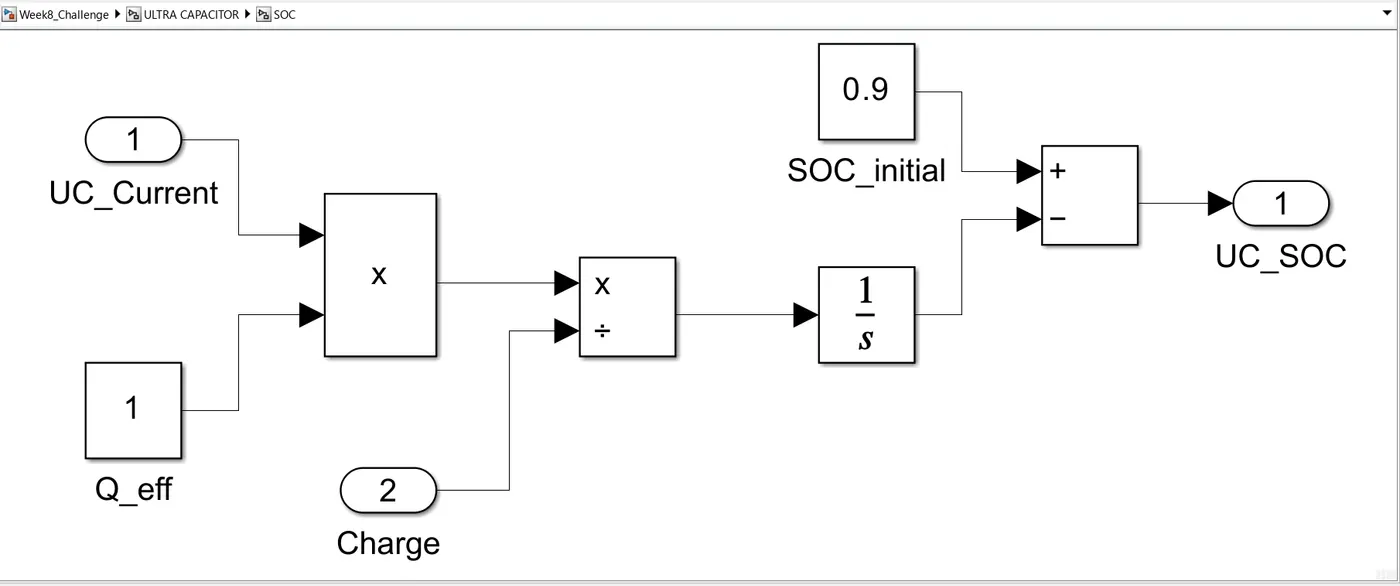
- The subsystems for the calculation of current, SOC, Voltage, open circuit voltage, Charge of the ultracapacitor is modeled using the equations givenn above.
- The signal builder block provides the power demand of the ultracapacitor. This power demand is fed into the ultracapacitor subsystem.
- The ultracapcitor subsystem consists of Current/Voltage, OCV/Charge and SOC Subsystems.
- The Power signal and SOC of ultracapacitor from SOC subsystem is given as inputs to Current/Voltage subsystem.
- The output from this block is UC_Current and UC_Voltage values.
- The output UC_Current is given as input to OCV/Charge subsystem. This subsystem calculates the open circuit voltage and ultracapacitor charge values for the overall simulation period.
- The ultracapacitor charge value calculated from OCV/Charge subsystem along with the UC_Current value is given as input to SOC subsystem.
- SOC subsystem provides the SOC of ultracapacitor as UC_SOC. This SOC value is given as feedback to UC_Current subsystem block.
- This process loop continues untile the simulation stop time reach.
Parameters used for Simulation:
R = 0.1
Vmax = 750
C = 83
Q_eff = 0.9
UC_max_SOC = 0.9
UC_min_SOC = 0.3
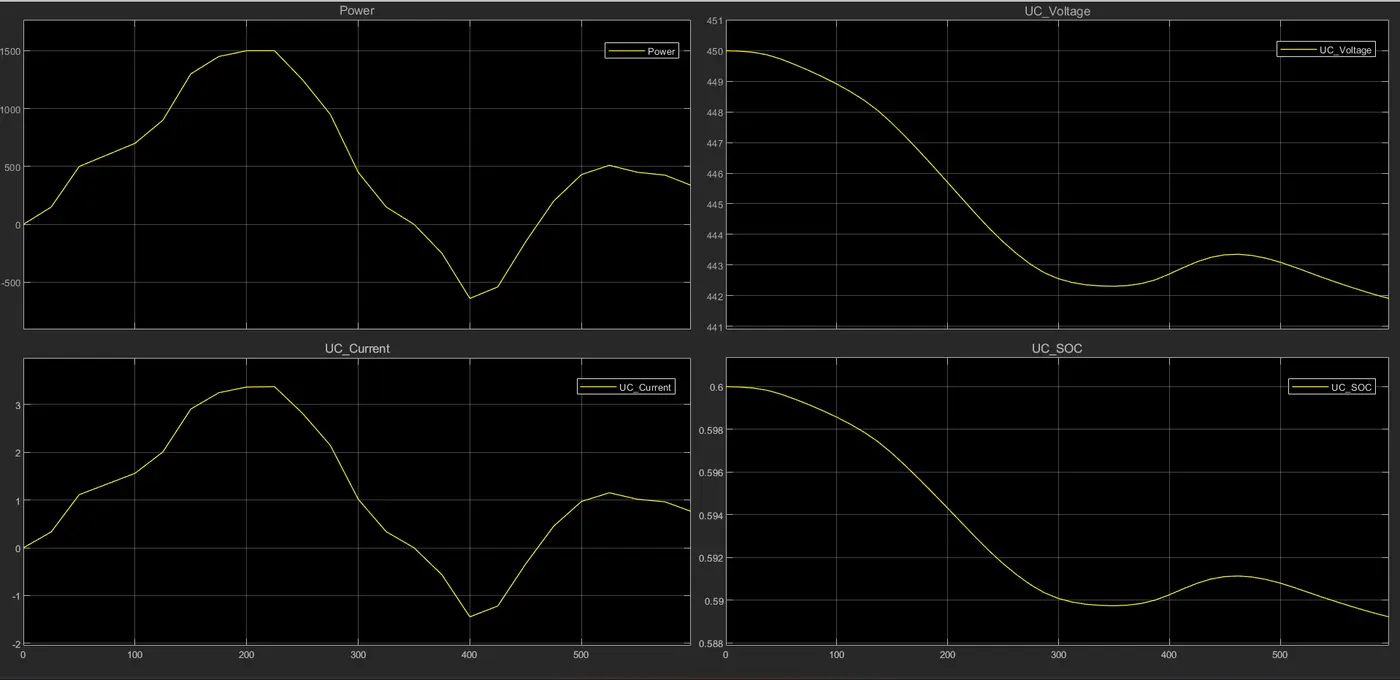
Result Screenshot:
Conclusion:
The ultracapacitor current follws the power demand. During the positive power demand, the SOC and the Voltage of the capacitor drops as it represents disharge cycle. Whereas, during the negative power demand, the SOC and the voltage increases as it represents charging of ultracapacitor.