Week-6 Challenge: EV Drivetrain
Solution:
Q.No. 1:
Power Convertors Circuits:
A power convertor is an electrical circuit that changes electric energy from one form and level into the desired form and level. It is also used to change the magnitude or polarity of the input signal.
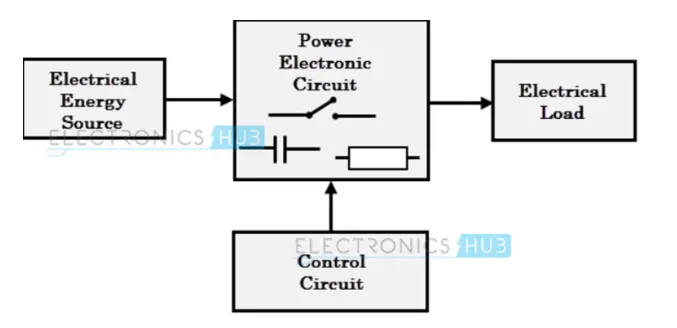
Types of power converter circuits are employed in electric and hybrid electric vehicle are,
- Rectifier (AC to DC converter):
Rectifier circuit converts AC input to DC output. Rectifies are used in the charging circuit of Electric Vehicles.
- Invertor (DC to AC converter):
Invertor circuit converts DC input to AC output. Invertors are used in Motor drive circuits of Electric Vehcles using Induction motor.
- Chopper (DC to DC converter):
Chppoer circuit converts the DC input of one level to DC out put another level. Choppers are used in the auxillary circuits of Electric Vhicles
Q.No. 2:
V(bat) = 72V
Ia = 400A
Ra = 0.5Ω
KΦ = 0.7Vsec
Chopper switching frequency = 400Hz
duty cycle, d = 70%
Voltage across motor terminal, V = V(bat)*d
= 72*0.7
V = 50.4V
The vehicle speed-torque characteristics are given by,

The Motor speed-torque characteristic is given by
w = V/KΦ-Ra/(KΦ)^2*Tm
Tm = (KΦ)^2/Ra*(V/KΦ-w) = VKΦ/Ra-(KΦ)^2/Ra*w
At stady state, motor characteristic = vehicle characteristic
Tm = Tv
VKΦ/Ra-(KΦ)^2/Ra*w=24.7+(0.0051)w^2
50.4*0.7/0.5-0.7*0.7*w/0.5=24.7=0.0051*w^2
0.0051w^2+0.98W=45.86
solving the above equation, w = 38.915 or -231.0.718
Since the speed cannot be negative, w=38.915 rad/sec
N=w*60/2pi = 38.915*60/2/3.14 = 371.79 = 372 rpm
The steady sate speed of a EV for 70% duty cycle is 372 rpm.
Q.No. 3:
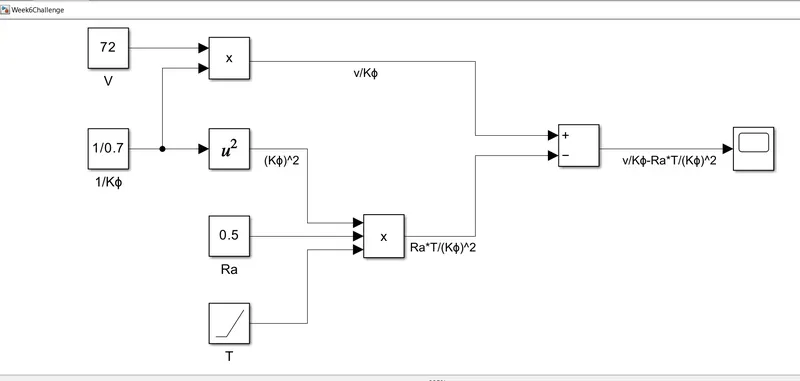
The mathematical model for the speed - torque equation is developed in Simulink
ω= V/Kϕ-Ra/Kϕ^2.T
- The constants are defined in the constant block (V=72V, Kϕ=0.7, Ra=0.5)
- Troque value is varied from 0 to 100 in steps of 1 using the ramp signal block
- V and 1/Kϕ is multipled in product block
- (1/Kϕ)^2 is obtained though the square block
- Ra, (1/Kϕ)^2 and T (torque) is multimpled in the product block
- output from the 2 product block is added in sum block to obtain the speed in rad/sec
- The graph of speed v/s torque is plotted using the scope
Simulink Screenshot:
Result Screenshot:
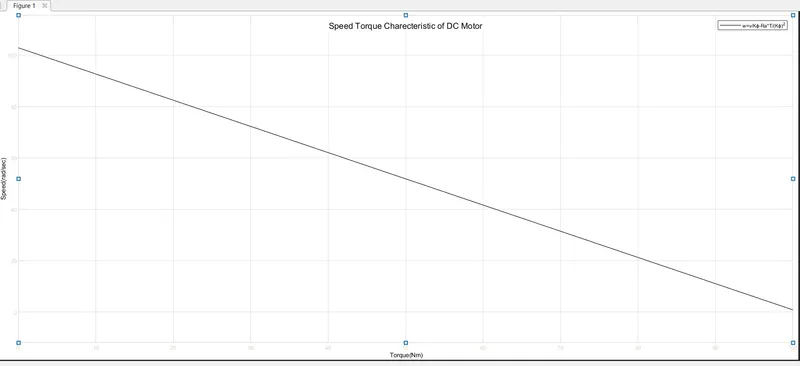
With the increase in torque, speed decreases.
Q.No. 4:
Authors perspective:
- The author says that there are various types of Electric vehicle drives and not all drives are the same. It differs based on the performance and price. This is compared with the gas powered vehicle engine, which are of different type and are designed to suit personal requirements, such as price and performance.
- The components used in the past and that are being used in the present is compared. The lead acid battery is replaced by Lithium-ion battery, the DC motors are replaced by either Brushless DC motor or Induction motor and the contactors are replaced by modulating inverters. In the future these elements could be replaced by the new technology.
- The author predicts that induction motor and brushless DC motor will be used for many years in the future and provides a comparison between the two.
- The brushless DC motor to produce constant rotating torque, it is necessary that the magnitude and polarity of the stator currents be continuously varied which is achieved by inverter. Hence the Brushless DC motor is useless without an inverter.
- The stator of both Brushless DC motor and Induction motor is the virtually same as both has three sets of “distributed windings” that are inserted within the stator core. The rotor of Induction motor does not have permanent magnets, it is made of stacked steel laminations which hold the conductors.
- Current flowing in the stator winding produces a rotating magnetic field which produces voltage and current in the rotor windings, this current interact with the original magnetic field to produce a rotating torque. When connected to a supply, they are constant speed machines as the shaft speed is proportional to the supply frequency.
- The induction motor does not need inverter as it has the ability to start under load when connected to 3 phase supply. The induction motor cannot operate on DC, AC supply is required. It has limited starting torque and running peak torque capabilities compared to DC type machines. Inverter can be used to power the induction motor from the DC supply, speed control can be achieved by adjusting the inverter frequency. However, the Torque performance is low compared to DC machine which can be overcome by adding feedback loop such that the inverter produces the exact desired frequency.
- The author compares the advantages and limitations between Brushless DC motor and Induction Motor.
- In present most of the HEVs use Brushless DC motors except few which use induction motor.
- The main difference between the 2 are the rotor and the inverter control. The difference in inverter control is relatively small. The major difference is the heat generated in the rotor. In DC brushless drives the heat produced in the rotor is less hence the cooling is easier and the peak point efficiency is generally higher.
- As the DC motors have permanent magnets, it is not easy to change B, hence eddy current and hysteresis loss cannot be reduced when the torque is less. Induction motors does not have permanent magnet and the value of magnetic flux can be varied by varying voltage. At light loads the inverter can reduce voltage such that magnetic losses are reduced and efficiency is maximized.
- Induction motor when operated with smart inverter has advantage over DC Brushless motor. Though the peak efficiency of Induction Motor is less than the Brushless motor, the average efficiency may actually be better.
- Induction motors are cost effective as it does not have permanent magnets which are expensive. but the control of Induction motor is complex compared to Brushless DC motor which makes it difficult to achieve stability over the entire torque-speed range
- Author concludes that DC brushless drives will likely continue to dominate in the hybrid and coming plug-in hybrid markets, and that induction drives will likely maintain dominance for the high-performance pure electrics. induction and DC brushless live and work side by side during the coming golden era of hybrid and electric vehicles.
- Authors intension was to compare the advantages and limitations of Induction motor and Brushless DC motor in Eclectic vehicles and conclude which motor is best suitable for the required application in HEV and Pure EV