Week 8 - Challenge 6 - Core & Cavity Design
AIM:
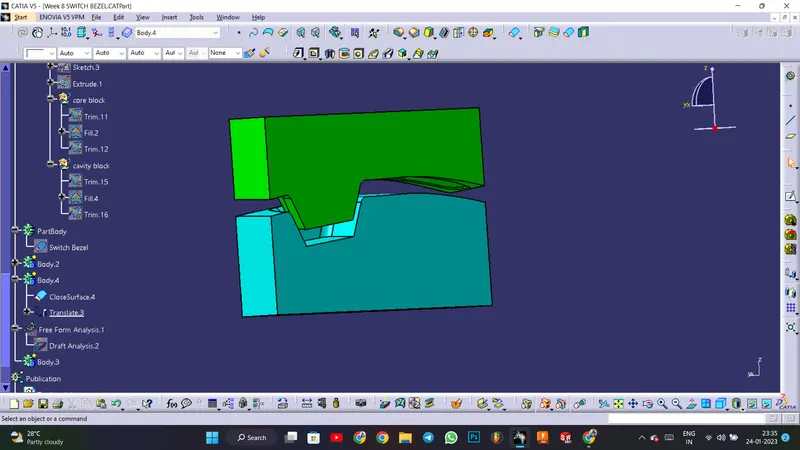
To Create the Core and cavity blocks for the switch bezel component.
PROCEDURE:
Creating a Tooling axis along z : Using the bisecting line method, the tooling axis is drawn.
BISECTING LINE METHOD: Using a dummy tooling axis, the bisecting line method is essentially used to identify the correct tooling axis. When using the bisecting line method, a line is utilised to either bisect the two lines or indicate an error, indicating that the two lines are parallel to one another. We intersect the surface with the appropriate plane to determine whether or not the surface is toolable. This produces a drawing with two lines, which we can then bisect to produce a third line at the intersection of the two lines. If there is no plane at the other side draw the line with appropriate angle(6 degree), so that it satisfies the draft angle
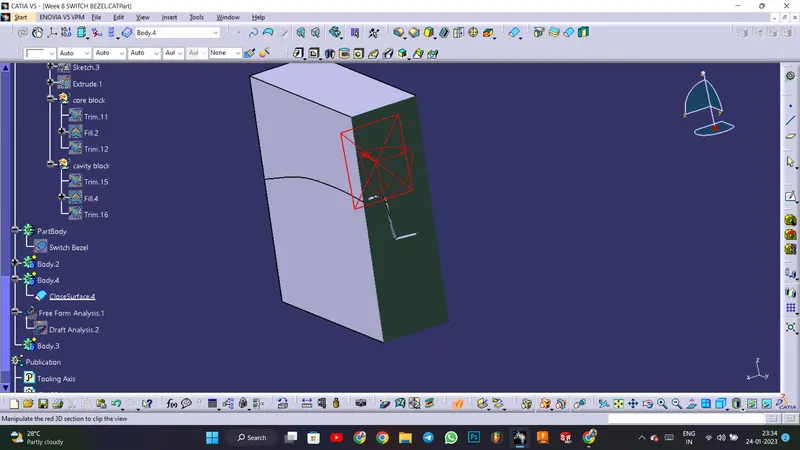
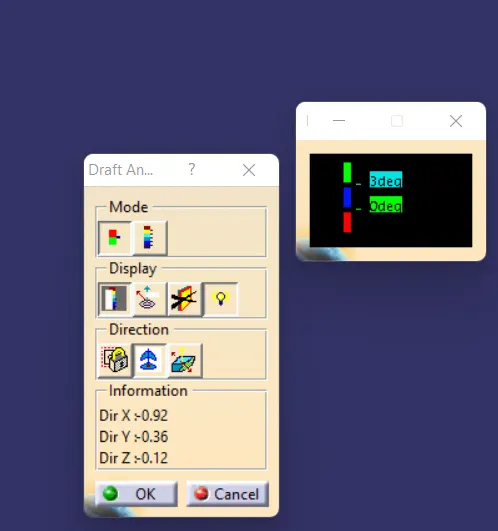
Draft Analysis : Use the Featured Draft Analysis tool in the tools to now analyse the draft. After locating the compass and aligning it with the tooling axis, click on the lock symbol after aligning, and then click again on the surface after opening the draft analysis tool box.
PARTING SURFACE:
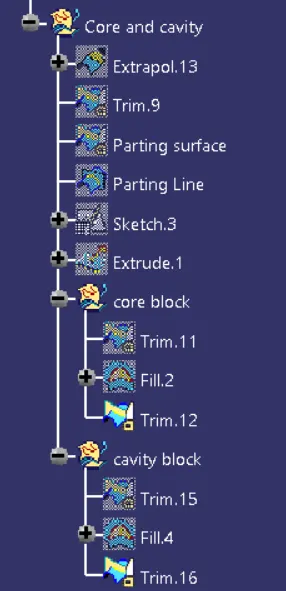
Injection moulds typically consist of two main parts: the movable half and the fixed half. In order to prevent melt flow leakage and maintain a specific holding pressure, these two halves are pressed tightly from a sealed hollow during the injection moulding process. This pressed surface is known as the parting surface, and is typically the biggest projection outline of the part.
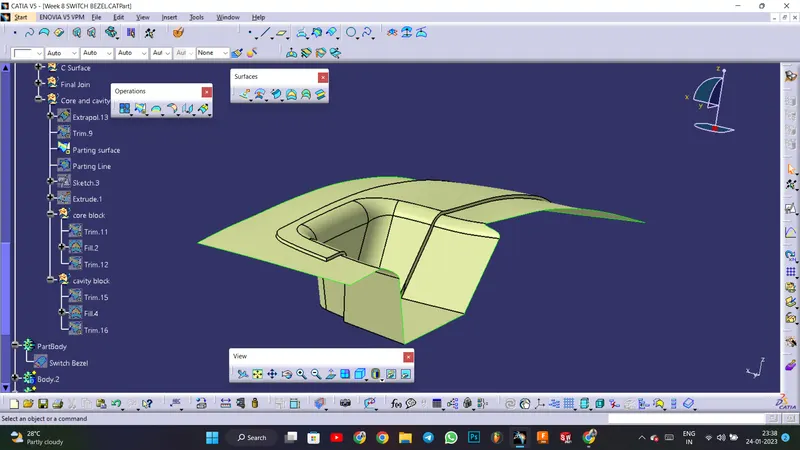
PARTING LINE:
A separating line is a requirement for items made by injection moulding.
It is the boundary between the two mould halves that meet. On injection-molded items, it appears as a line that surrounds the whole object. It mostly basically consists of a line that goes horizontally along the centre.
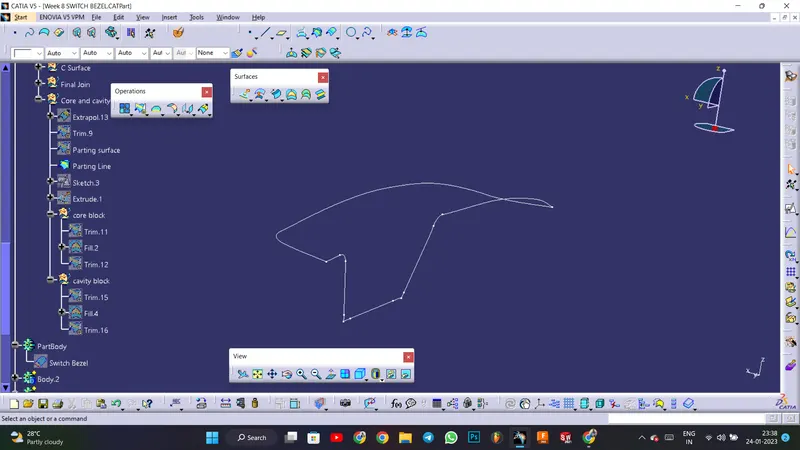
CORE DESIGN
- Core - A portion of the mold that goes inside a cavity to form the interior of a hollow part.
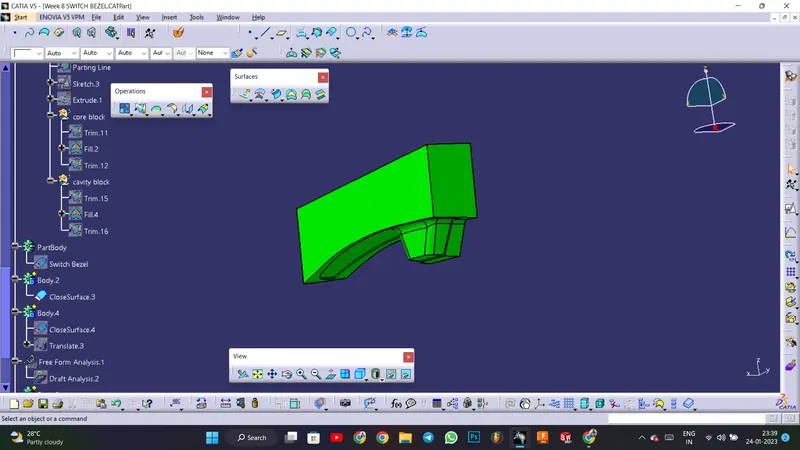
- Core-cavity - A term used to describe a mold created by mating A-side and B-side mold halves.
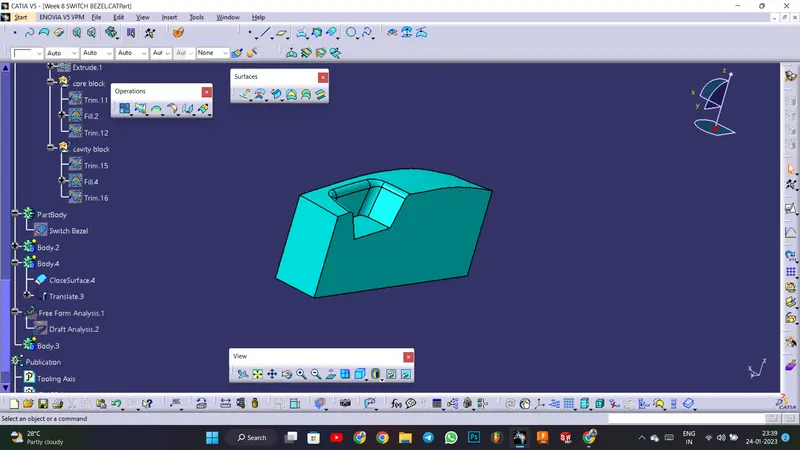
CAVITY DESIGN
- A mould is a hollow structure, usually composed of stainless steel, into which plastic is injected to create a plastic component.
- The mould cavity, which is a hole in the mould fashioned like the desired object, is filled with plastic.