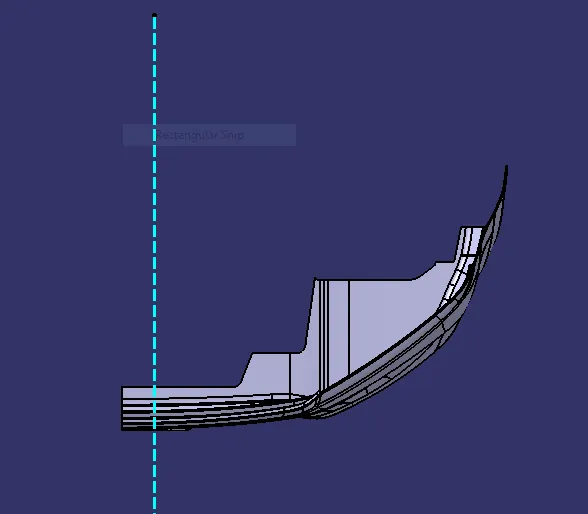
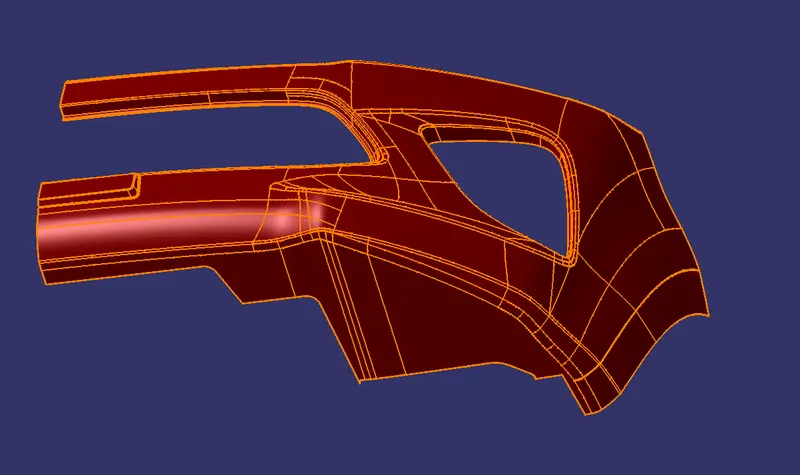
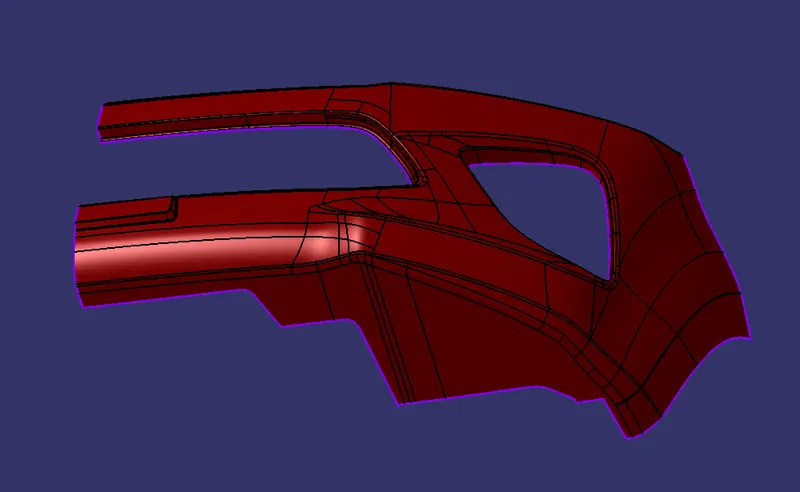
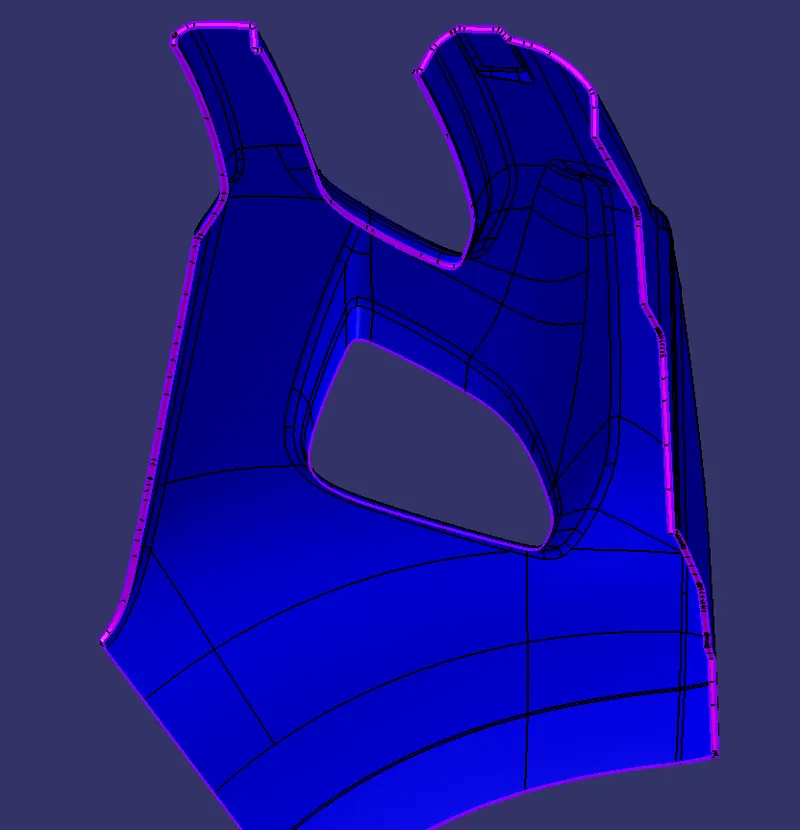
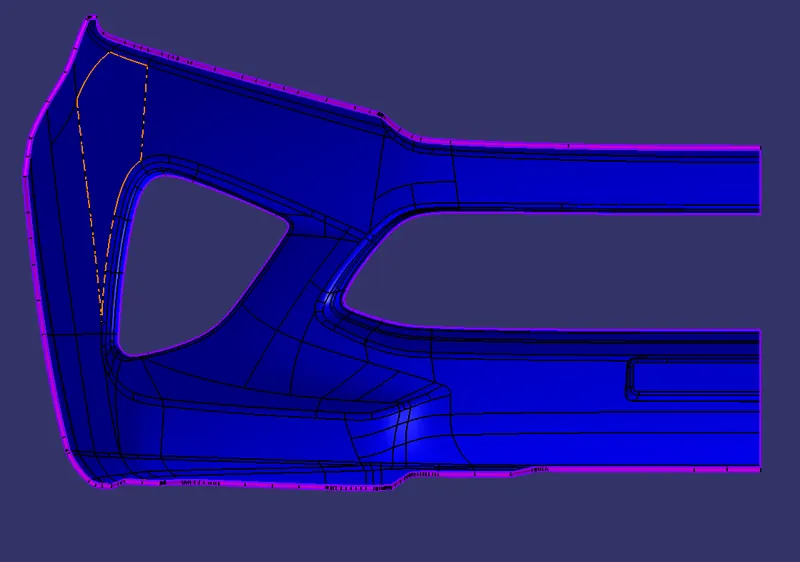
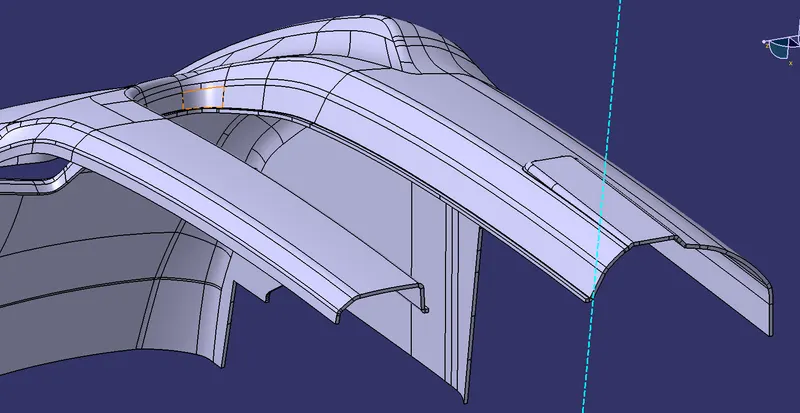
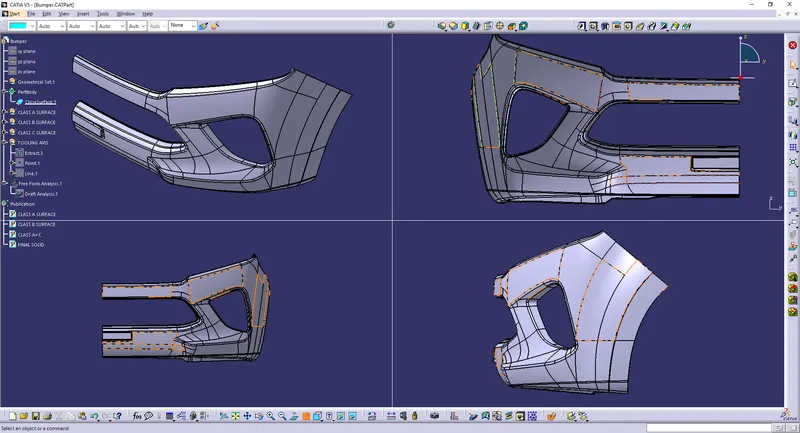
Aim: To create BUMPER Plastic component through the given Class A surface. To begin with, the tooling axis for the given Class A surface should meet the requirement of Draft angle and at the end perform Draft Analysis. Thickness of component to be 3 mm.
PROCEDURE:
Part I
* Import the .STEP file into CATIA V5.
* fit the object to screen. Save the file into CATPART
*Open the file save it.
*use varnier tool to check the flat surfaces.
CREATING TOOLING AXIS
*By changing orientation and select a axis at which maximum part is visible.
*choose a surface and use point [•]
point >on surface >select a Surface >'0'
Choose line [/]
line point-direction select points Select axis
* The created line is the tooling axis Publish it.
Part II:
Offset → select the Class A Surface
*Click on the other side, so we obtain the.offset of A surface of 3mm which is considered as class B
*Fillet all the edges of required dimension
*class B surface is ready - Publish it
Part III:
* Make surface A visible and make boundary limit as required.
Sweep-> Using boundary and surface>90>and give okay
Now Join the Surface A &C.
*Use extrapolate . and completely check there is no open boundaries
*C surface is created and Join A+c and publish it
*Make the b surface visible and just extrapolate the extra edges
*Trim the extra surfaces and the required part of 3 mm thickness is created
*Go to Part Modelling Close surface → fill
* So the surface model is converted into part model.
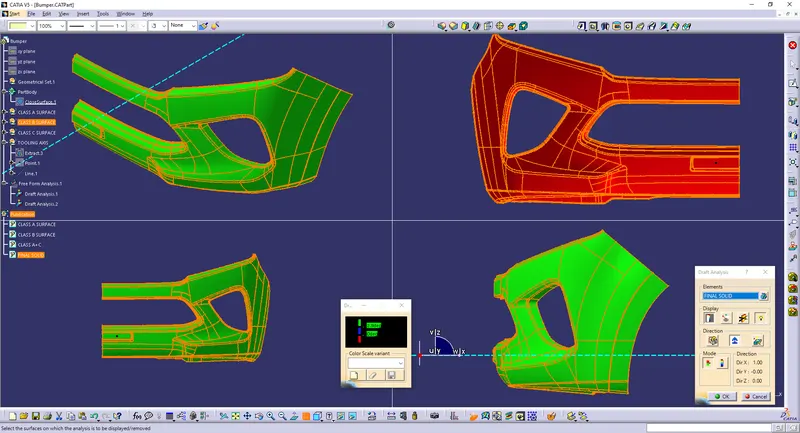
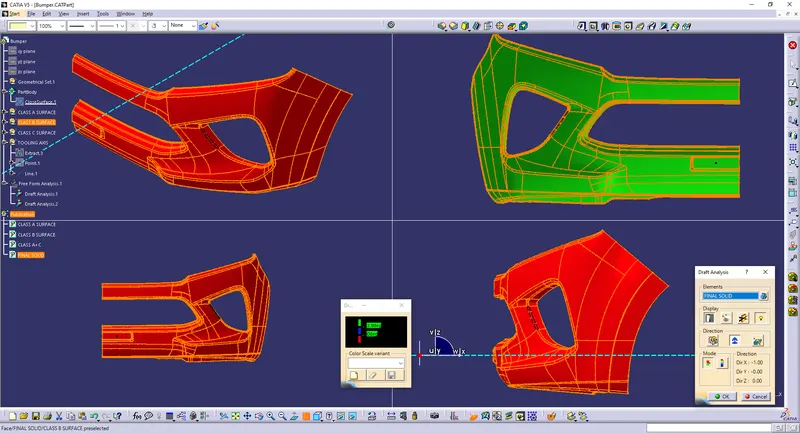
Draft Analysis is made on both sides "3"
Challenges:
During offsetting the untrim or Extrapolated region,the wrong surface is created and it's difficult to sort out on which side the offset must be.
Trimming the excess area, affects the original surface.
Learning:
Tools such as
Untrim
Fill
Sweep
Extrapolate
Tooling axis
Draft Analysis
Conclusion
The required part Bumper is designed meeting the requirement of 3 mm and the draft was analysed
What type of plastic is used on car exterior?
Polypropylene. Polypropylene is used the most frequently of any plastic in automotive manufacturing. Being a thermoplastic polymer, it can easily be formed into almost any shape. It has excellent chemical and heat resistance and is generally resistant to impact.
What material is car bumper made of?
Bumpers of most modern automobiles have been made of a combination of polycarbonate (PC) and acrylonitrile butadiene styrene (ABS) called PC/ABS.
How do I know if my bumper is plastic or fiberglass?
Look for the ID mark on the back of the bumper cover. There should be a 2-3 letter ID that you can look up. Use the Definitions section below as a reference guide. Lightly grind the plastic to see if it smears or powders.
What is polyurethane used for in cars?
The most common uses of polyurethane in the automotive industry are in the manufacture of high-resilience foam seating, rigid foam insulation panels, B-pillars, headliners, suspension insulators, bumpers and other interior parts of a car.
Why PP is used for bumpers?
It’s this quality that makes PP a viable alternative to plastics like Acetal. Also, when compared to other plastics, PP has a higher melting point, making it safe to use in conjunction with hot temperatures. In the automotive industry, PP’s commonly used for bumpers, chemical tanks, cable insulation, and gas cans.