Week 8 - Challenge 2 - Switch Bezel Design
AIM
- To design switch bezel as per automotive OEM Standard.
- Create B Class and C Class and tooling axis.
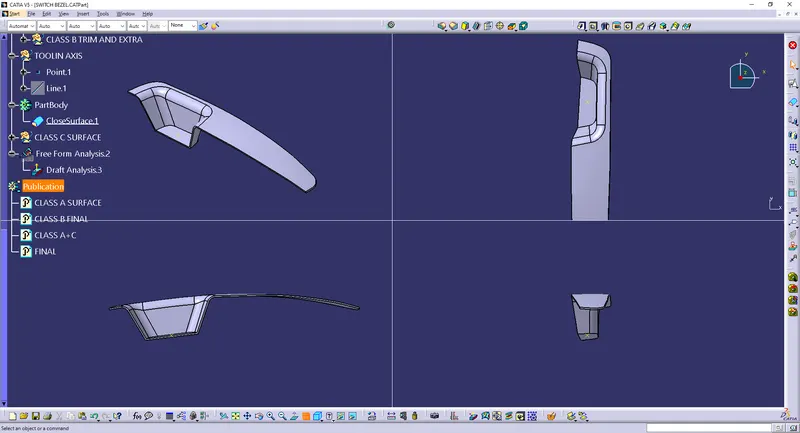
- Converting close surface into the solid inside part workbench and provide the thickness of 2.5mm.
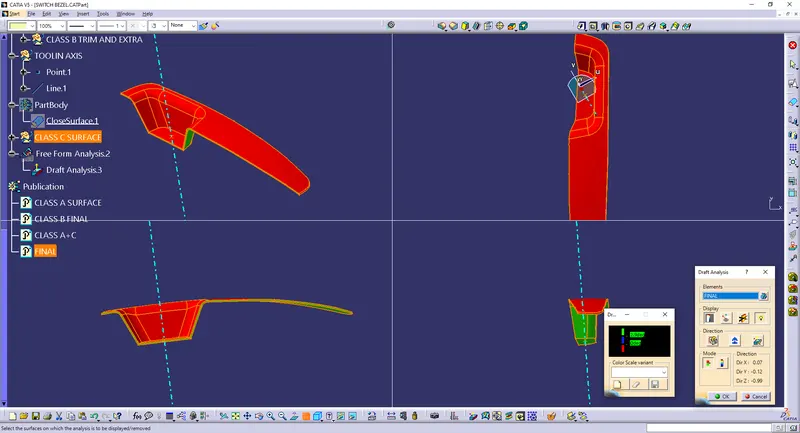
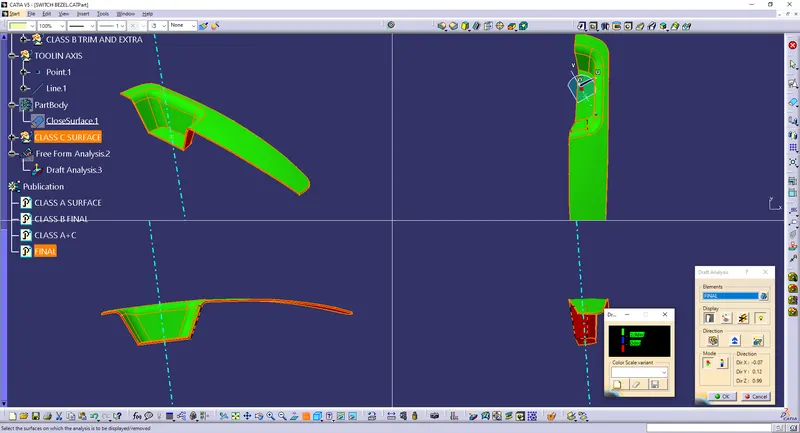
- Performing draft analysis to verify the creation of the Tooling axis and C Class surface.
TOOLING AXIS
- It is defined as the direction in which the molds opens or core and cavity, with the help of tooling axis created along x and Y axes are used for creating the Main Tooling axis by using bisecting method
- Considering the Ejection from the cavity of the mould after manufacturing the interior trim (switch bezel) must have the nominal 3-degree draft angle.
- Hence the tooling direction is created by considering the above factor and bisecting method is used.
- The base surface of the class – A was extracted and a point at the centre is created and an axis system was inserted to the point with the current feature is disabled.
- Then, using project intersection along yz plane is created and the two inclined lines were drawn inside the positioned sketch.
DRAFT ANALYSIS:
The draft analysis technique is used to analyze whether our part model created in CAD is manufacturable based on the draft condition applied. Here the part should get easily removed from the panel dies (in case of Sheet metal part) or Mold (in case of plastic).
No parts can be ejected from the tool if it is having a straight 90-degree profile from its base surface. A small draft angle is provided to each and every area of the component in order to get easy removal of the component from the tool.
Here we are providing a direction in which components should eject in order to get easy removal of components from the tool. In other words, it also lets us know whether the model is having a draft angle and how much is the draft angle from the tool direction.
What is the class-A surface?
Class ‘A’ surfaces are primarily used in the automotive environment and refer to those surfaces which are visible in a product. In other words: A - class surfaces are those aesthetic/free-form surfaces, which are visible to us (interior/exterior), and have an optimal aesthetic shape and high surface quality.
Here, one should understand the difference between the internal or external and visible or hidden surface. The surfaces or regions which are visible nowadays are considered for Class-A modelling. It is one of the reasons why the importance of Class-A modelling is increasing day by day. Majority of the time this term is used in Plastic Part designs.
Quality Requirements for Class-A surfaces
The baseline requirements for Class-A are the same for production-quality surfacing in all industries to build tight tolerances for G0, G1, and G2 continuity. It's important to note that there are no absolute rules for tolerances or continuity levels. A skilled Class A modeller should be able to judge which settings will result in the right quality for car production
What is class-B surface?
Class B surface is something that is not always visible i.e. the underside of a fascia that you would have to bend down to see. A Class C surface is the back side of a part of a surface that is permanently covered by another part. BIW is stuff like the body side etc..
IMAGES:
MATERIALS TO BE USED:
Acrylonitrile Butadiene Styrene
ABS is similar to PVC in that the final product offers a sleek finish. Steering wheel covers and dashboards are often made of ABS plastic. It's also well-suited to heavy-duty applications, so it can be used for automotive body parts, too. Plastic used in cars, like ABS, helps the body absorb and redistribute energy during an impact, keeping passengers safe.
ABS plastic is one of the most suitable engineering plastic for automotive applications. Lightweight and great mechanical properties make it viable for manufacturing different automobile parts.
As the automobile industry is rapidly developing and transitioning to lightweight vehicles, ABS plastic will always be in demand.
Here are a few products made up of ABS –
- Steering wheel covers
- Dashboard components
- Door liners handle
- Instrument panels
- Pillar trim
- Seat belt components
- GOOD AESTHETIC FINISH