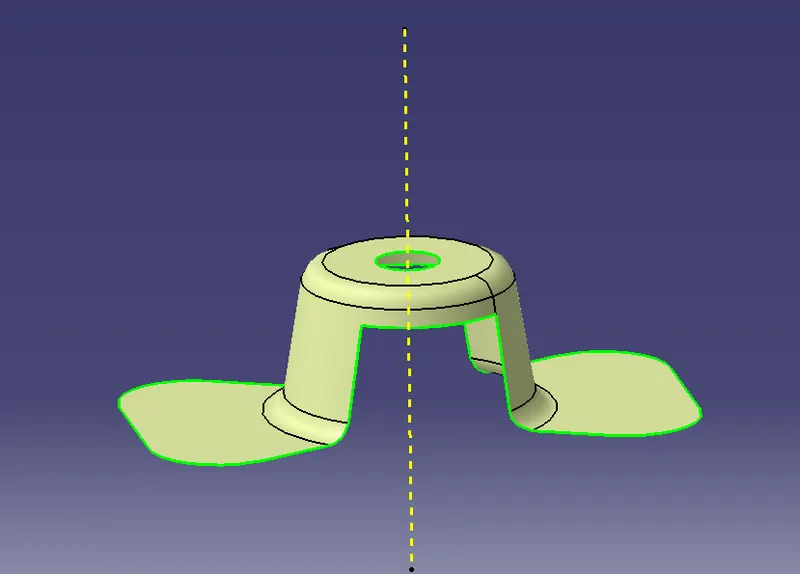
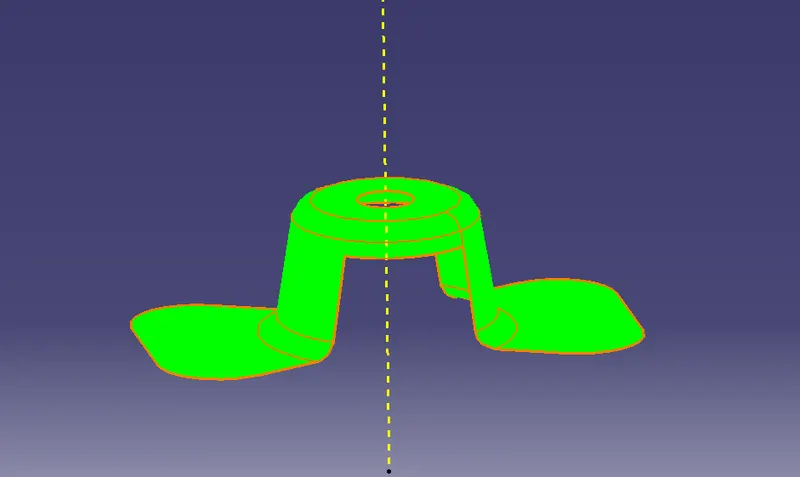
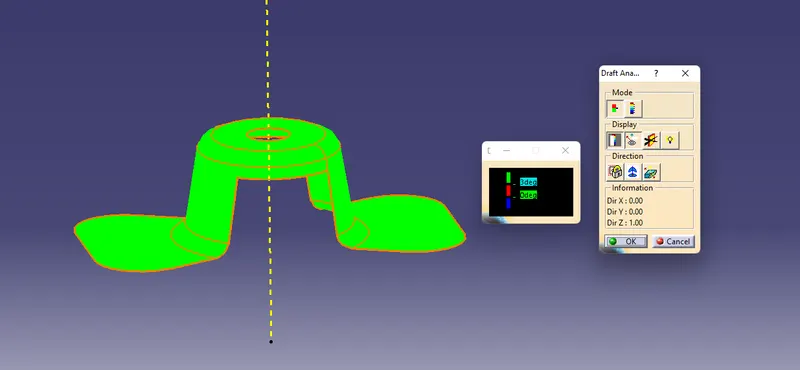
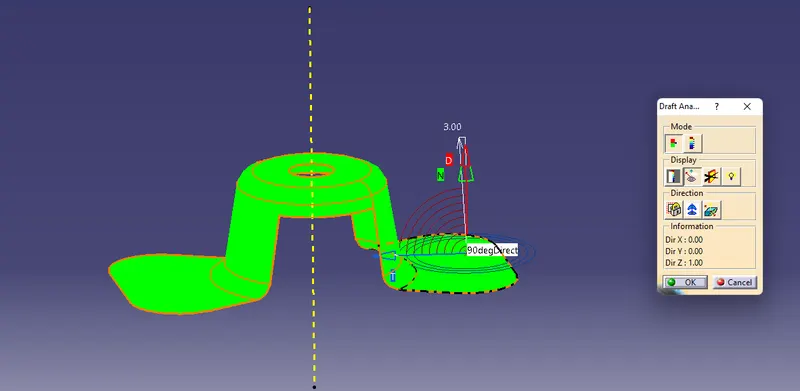
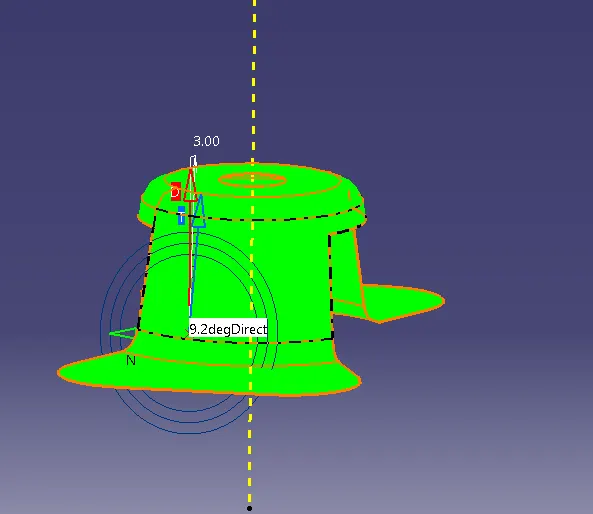
Week 8 - Challenge 1 - Draft Analysis on a Fan Cover
Challenge 1 - Draft Analysis on a Fan Cover
In engineering, the draft is the amount of taper for molded or cast parts perpendicular to the parting line. It can be measured in degrees or mm/mm (in/in).
Consider the fabrication of a hollow plastic box, without a lid. Once the plastic has hardened around the mold, the mold must be removed. As the plastic hardens, it may contract slightly. By tapering the sides of the mold by an appropriate "draft angle", for instance, 2° (two degrees), the mold will be easier to remove. This is a practice that is used, in applicable cases, when working with fiberglass.
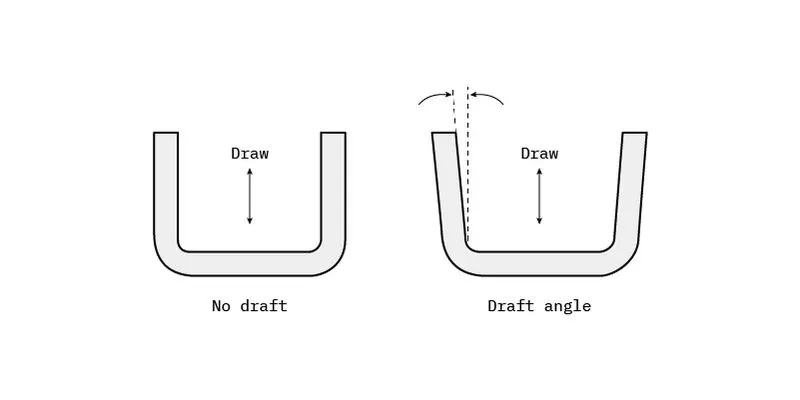
If the mold is to be removed from the top, the box should taper in towards the bottom, such that measuring the bottom internal dimension will yield a smaller length and width than measuring the top from which the mold is extracted.
By specifying the opening length and width, a draft angle, and a depth, it is not necessary to specify the dimensions for the internal surface, as these may be calculated from the above.
The manufacture of a part that incorporates zero or negative angles may require a mold that can be separated into two or more parts, in order to release the casting.
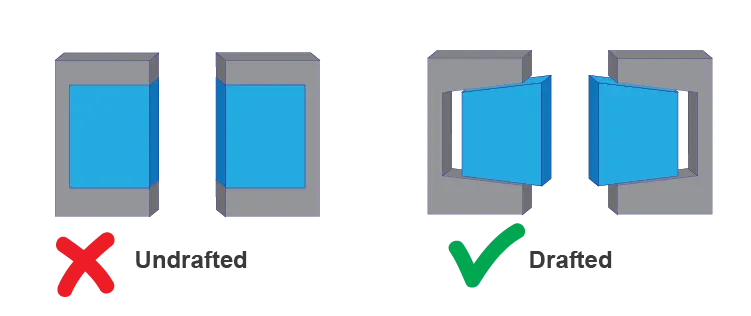
A draft angle is calculated as a degree measurement (or, less often, an inch or millimeter measurement) from the vertical axis of a mold, and it helps account for thermoplastic shrinkage, a practical reality of the injection molding process for most materials.
Now that we’ve established what a draft angle is, let’s discuss what it does — and why it’s important. By accounting for thermoplastic shrinkage during the cooling process, draft angles greatly reduce friction between the finished, cooled part and the side of the mold. Not only does this create a much easier release process, but it also offers several other benefits, depending on the design of the part:
- Reduces the chance of damage to the part due to friction during the release.
- Reduces wear and tear and chances of damage to the mold.
- Ensures a uniform, smooth, unscratched finish when required.
- Ensures the integrity and uniformity of other surface finishes and textures.
- Reduces overall cooling time by lessening or eliminating the need for unconventional ejection setups.
- Most, if not all, of these benefits, offer either direct or indirect overall production cost reductions.
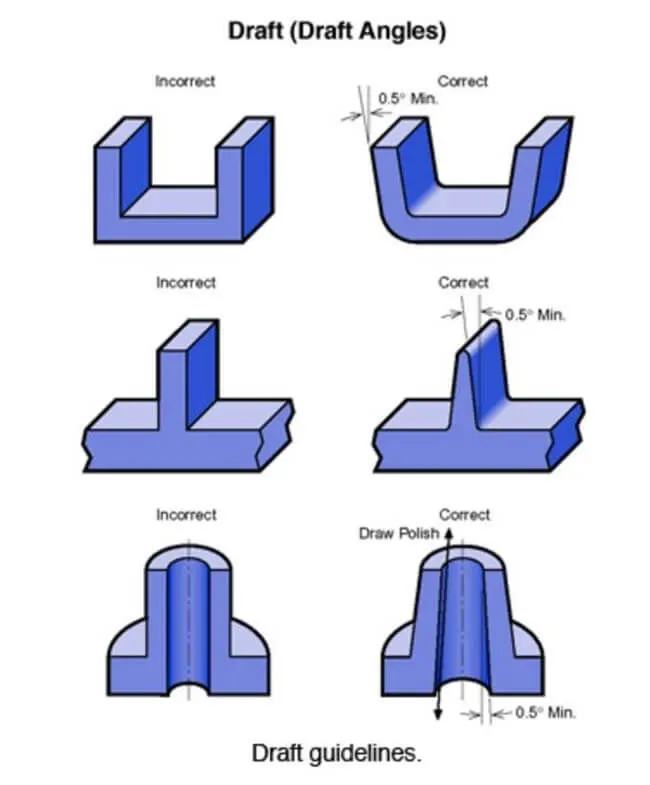
A few more things to remember about draft angles for injection molding:
- Draft angles are generally a requirement of injection molding design (though there are a select few soft materials, like nylon, that can get away with draft angles of zero).
- The draft should be a part of the design for manufacture, and all stakeholders and contributors should be aware of its need at the outset of the design process. This includes product designers, design engineers, and of course, the customer. This allows considerations for design requirements to be taken into account.
- Any draft is always better than no draft.
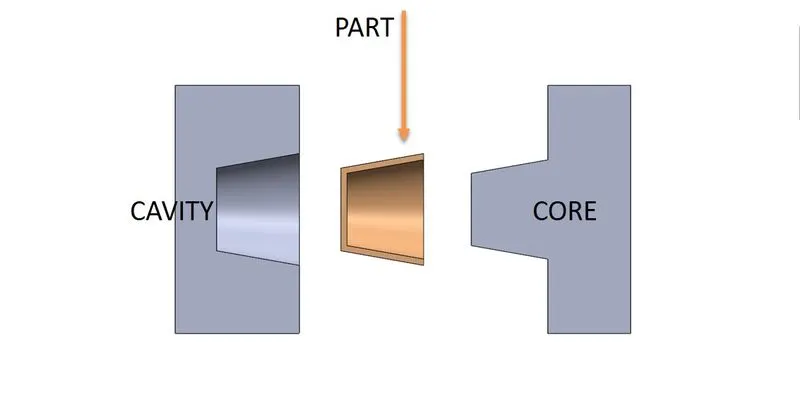
How Draft angle injection molding
1) A draft angle of 1½ to 2 degrees is required for most parts
This rule of thumb applies to parts with mold depths of up to 2 inches. At this size, a draft as low as 1½ degrees will allow for an easy, non-damaging release from the mold when the expected shrinkage of the thermoplastic material occurs.
2) Draft should average about an additional degree for each inch of depth
For deeper or larger parts, more draft is required to account for the additional surface area (and potential for friction upon mold release).
3) Draft should occur toward the “top” of the mold
In other words, the draft angle should follow the direction of the mold moving up or away as it separates. If you imagine a hollow box with drafted walls, the open-top would be slightly wider than the bottom when the draft is applied correctly.
4) Textured parts require more draft — sometimes much more
For parts where intricate textures or other raised or recessed surface features are designed,
the draft should be added to the initial optimal 1½ to 2 degrees at the rate of another 1½ degrees per thousandth-inch (0.001”) of surface depth.
5) All components of a piece should be drafted
For complex geometries or parts with several tension-easing features like ribs, gussets, or louvers (all integral components of good part design), ideally, all of these features — essentially, any area of contact with the mold — should incorporate a draft angle.
6) For metal-on-metal molding functions, more draft is required
This does not refer to injection molding metal, but rather to mold designs where one metal mold component makes direct contact with another.
Typically, 3 degrees of the draft will be required to ensure that the mold can separate properly.
7) Again: Any draft is better than no draft
This point is important to remember (and repeat), especially if designers are highly resistant to incorporating drafts. If a product design discussion does reach this extreme point, it is still beneficial for the engineer to advocate for some degree of the draft, no matter how small. It is unlikely in most design cases that a perfectly straight, zero-degree draft angle is required.
8) Draft is a requirement — not a suggestion — for successful part production
Another point that benefits from mentioning twice: Draft is not a “nice-to-have” feature of design to manufacturing. It’s an important component of a well-designed part and an efficient, high-quality production process. A lack of draft angles can (and likely will) lead to an unacceptable number of rejected parts, and can damage expensive molds. Longer cooling times and complex part ejection requirements can slow production down to an unmanageable and unprofitable speed. In short, just about any other solution is preferable to forgoing draft angles in your injection molded parts.
It’s also important to remember that draft angles are just one component of an effectively designed injection molded piece. Design for manufacture is one of the easiest ways to improve the quality and efficiency of your injection molding process, and it never hurts to stay up to speed on all injection molding best practices. As injection molding specialists here at RevPart, we’re happy to share our expertise with you as we incorporate those best practices into our service.