Week 7 State of charge estimation
AIM:
1.Simulate the 3 test cases from harness dashboard and write a detailed report on the results
2.What is coulomb counting? Refer to the above model and explain how BMS implements coulomb counting for SOC estimation ?
Ans(1): Now,at first we have to simulate 3 test cases from harness dashboard. We need to, select the harness dashboard from project file which we downloaded with the reference link https://in.mathworks.com/matlabcentral/fileexchange/72865-design-and-test-lithium-ion-battery-management-algorithms . The battery model harness dash board is represented below.
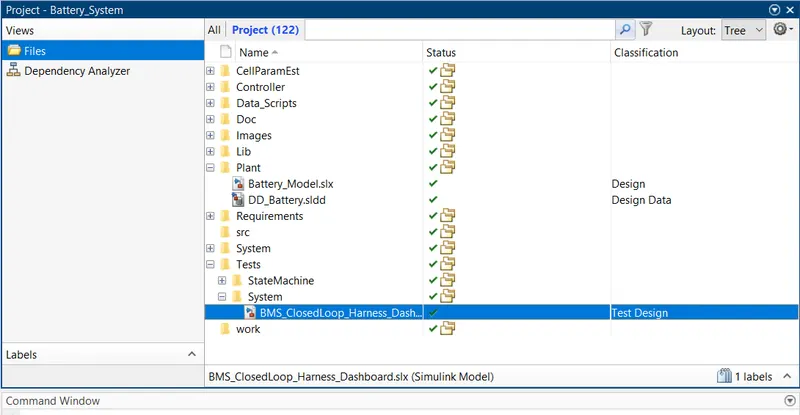
- Here we start the Battery spstem project model then we open the test model:
Now open the BMS_Closedloop_Harness_Dashboard simulink model:
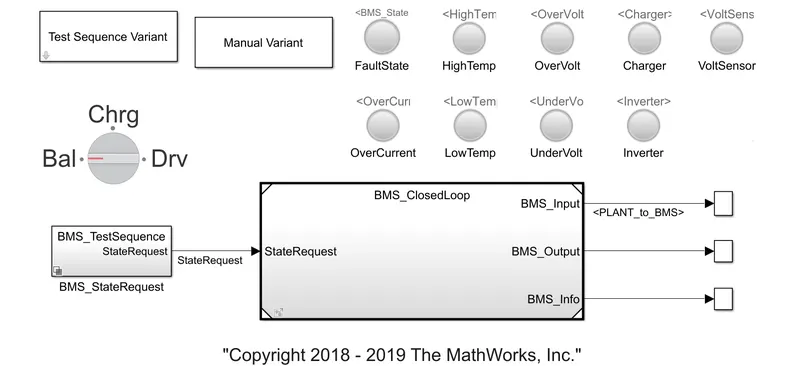
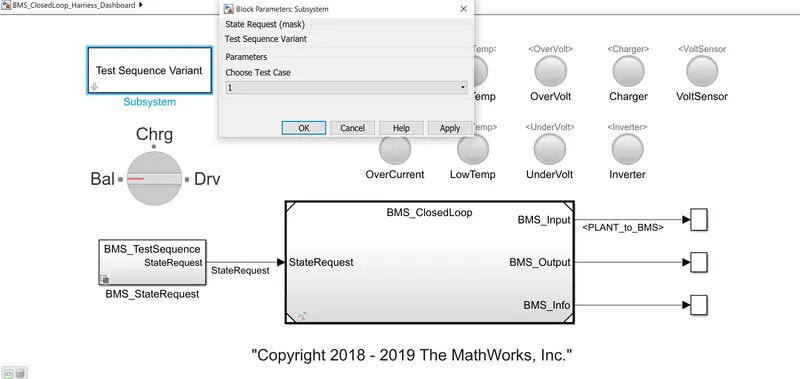
Now we select the Test Sequence variant for testing the varius condition,here we select test sequence variant as 1.
- After simulation we get the this below:
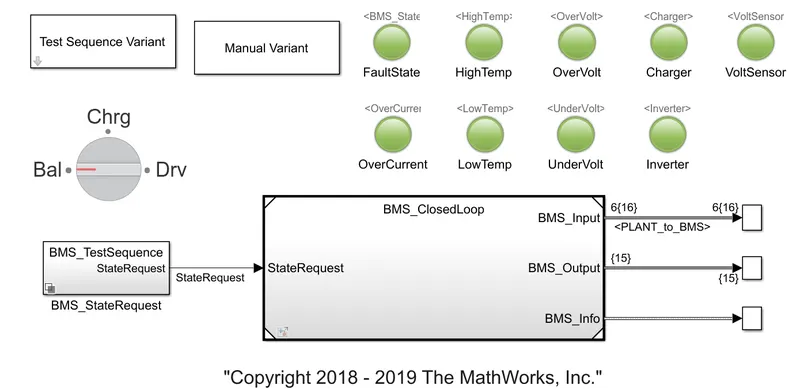
- Here we can see that the light of all the process i.e,fault state,high temp,over voltage,charger,voltage sensor,over current, low temperature,under voltage, inverter all are showing green.
- So it means for the first test condition all is working good.
Scope result first test condition:
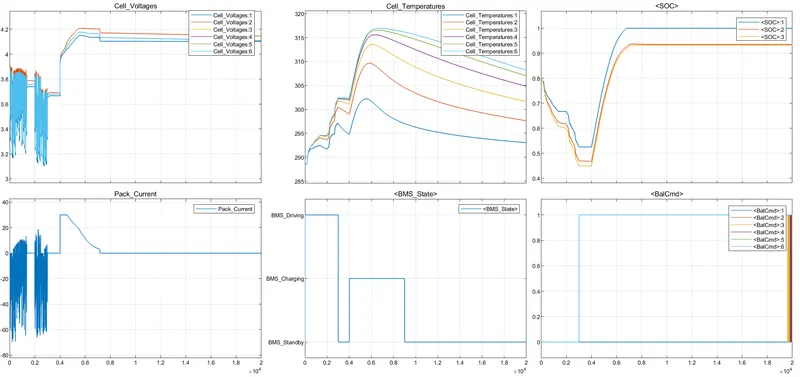
- Here from the scope result we can see the first graph is about the Voltage of 6 cells variation with respect to time.So here up to 3000 sec the voltage of all the cells are varying between 3.1v to 3.1v most of the cells have aproxx same curve that why we can't see the huge difference and after the 3000 sec it goes aproxx const upto 4000sec and than sudden constant increasing upto 4v because it is charging with constant current (cc) method and then it is increasing slowly but not constant having some difference and it is charging in constant voltage(cv) mode and after 6500sec it is balancing that's why it is sgoing constant on between 4.1v and 4.2v.
- Second is pack current so it is fluctuating as per the drive cycle load and after the 3000sec it is going constant upto 4000 as told earlier in cc mode and then it is going down because in slow current and have cv mode charging after that it is going 0 cause their is no use of current while balancing.
- Third is cell temperature varing while the charging and discheging,their is huge variation in all cell temperature,the tamperature is varying while charging and discharging then after the completion of charging the cell temperature is reducing.
- Forth is Bms state so upto 3000sec it is in driving mode and then in standby mode upto 4000sec and apto 9000sec it is in charging mode and after that in again in standby mode.
- Fifth is of soc level of battery upto 3000sec it is increaging and decreasing,increasing when regen braking or decreasing whiole driving and then in standby mode,after that the all cell soc icreases to 90% and some is below that so balanging is happening after that and remains constant.
- Sixth is of balance command so at the charging time 3000sec it goes to 1 and than remains constant and some cell is at 0.
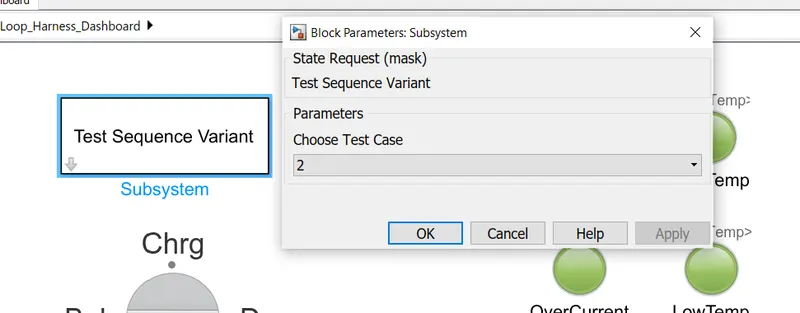
Now we select the test sequence to 2 as shown below:
The results after running simulation is shown below:
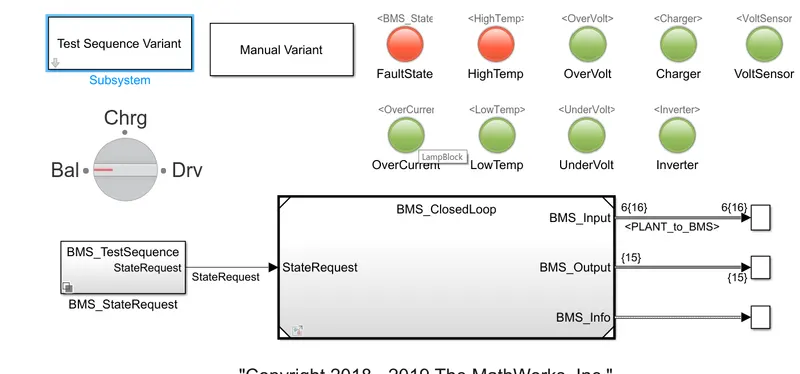
Here we can see that their is 2 error while running simulation fault state and high temperature rest is green so no error in rest.
Scope result of 2nd test sequence:
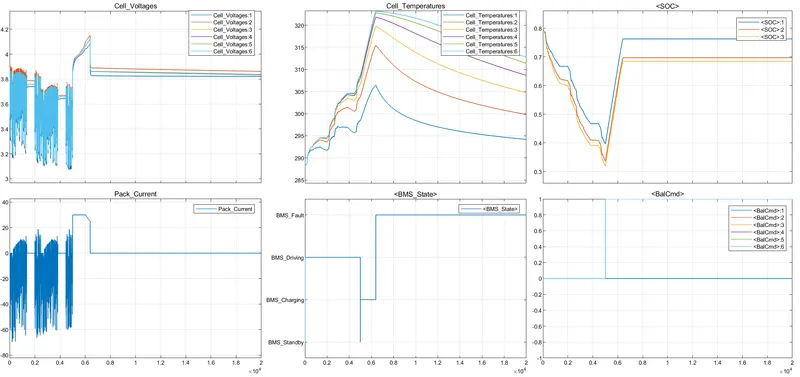
- Here we observe that the vehicle is runing and also charging discharhging happens at upto 5000sec and also the temperature is increasing and decreasing and every cell has different temperature then it start charging after 5000sec and you can see in soc graph it charges from 35% to 75% and then it goes constant because there is a fault situation as you see that in bms state aproxx after 6000sec the state is gone in bms fault. And the pack current goes variying in positive and negative that shows of regen braking and then it goes 0.
Now we select the test sequence to 3 as shown below:
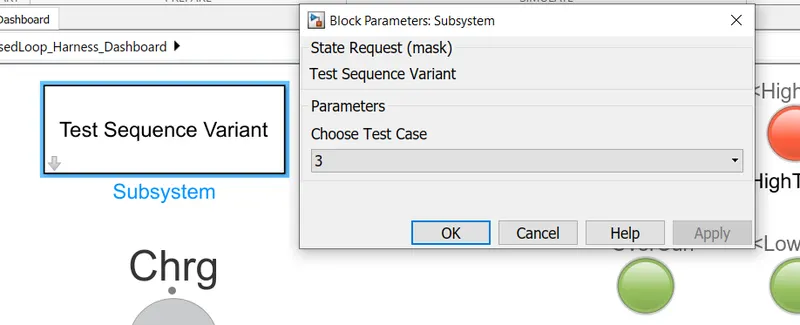
The results after running simulation is shown below:
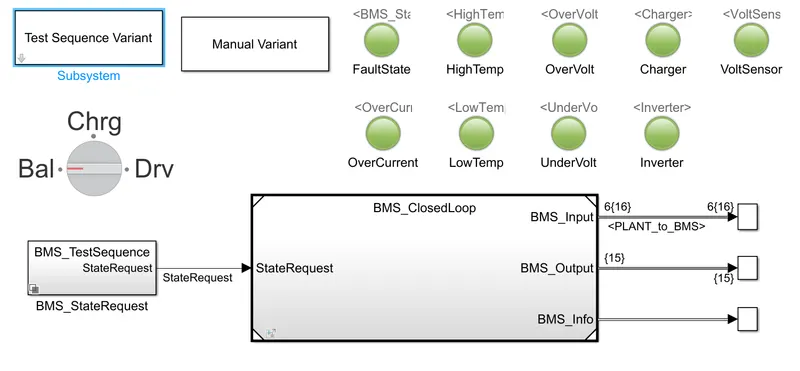
- Here we can see that the light of all the process i.e,fault state,high temp,over voltage,charger,voltage sensor,over current, low temperature,under voltage, inverter all are showing green.
- Third test condition is going good no fault.
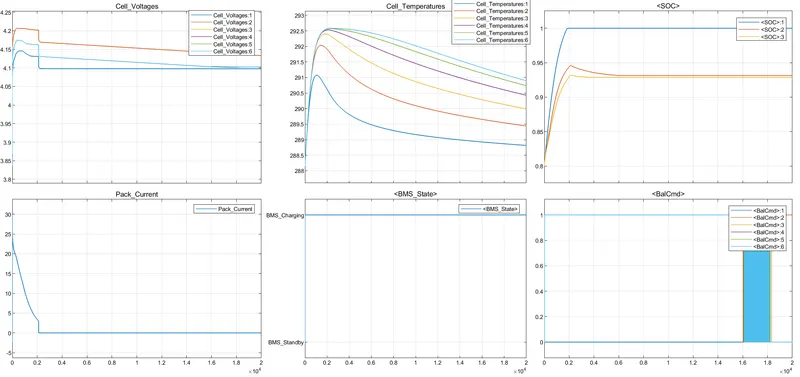
- Here the soc level is increasing from 80 to 100% and then remains in standby mode.
- the cell temperature is inreasing while increasing and when after chrging it is standby then the temperature is decreasses.
- pack current is also increasing while charging and after charging is comes to zero
- Bms state is also in charging only.
2.What is coulomb counting? Refer to the above model and explain how BMS implements coulomb counting for SOC estimation ?
Ans:
- The Coulomb counting method measures the discharging current of a battery and integrates the discharging current over time in order to estimate SOC .
- Coulomb counting method is done to estimate the , which is estimated from the discharging current, , and previously estimated SOC values, .
- SOC is calculated by the following equation:

But there are several factors that affect the accuracy of Coulomb counting method including temperature, battery history, discharge current, and cycle life
Modified coulomb counting method:
- To improve the Coulomb counting method, a new technique called modified Coulomb counting method is proposed. The modified Coulomb counting method uses the corrected current to improve the accuracy of estimation.
- The corrected current is the function of discharging current. There is a quadratic relationship between the corrected current and discharging current of battery. By practice of experimental data, corrected current is calculated by the following form:

where , and are constant values obtained from the practice experimental data.
- In modified Coulomb counting method, SOC is calculated by the following equation:

The experimental results show that the accuracy of the modified Coulomb counting method is superior to the conventional Coulomb counting method.
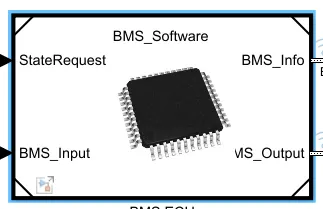
From the given model by Mathworks as shown below of BMS Closed Loop model, when seen inside the BMS ECU,
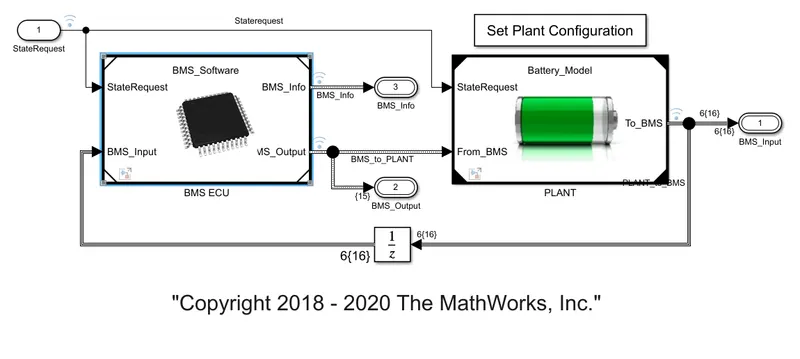
Go throught his block given below:
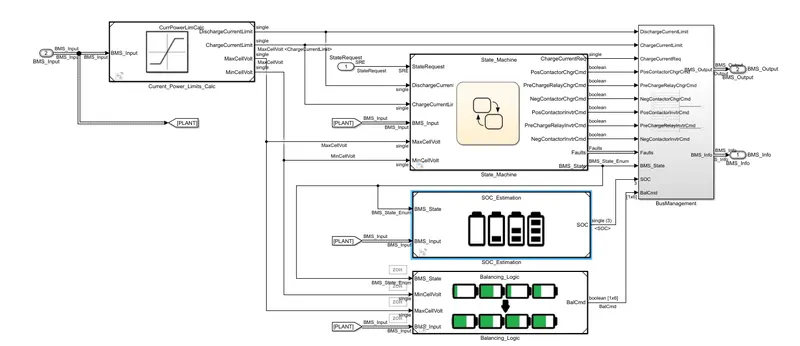
after opening here we have to go through soc estimation block:
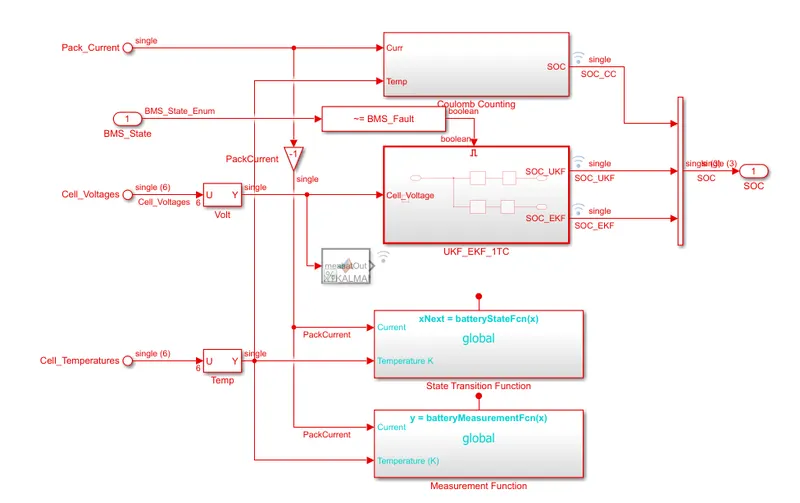
After opening soc estimation we have to go through the coulomb counting block first block as shown above:
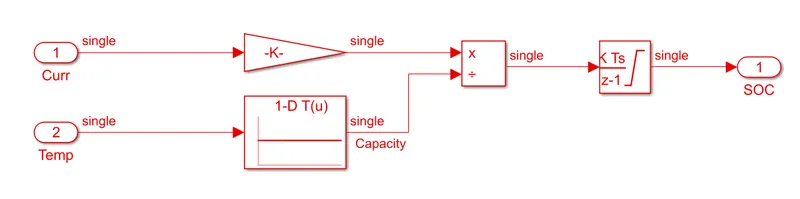
- Here it shows the coulombs counting block which is integrtion of current over a period of time.It is done here by discrete-time integrator block.
- The current is being integrated over a period of time and along with considering the temperature.
- The main advantage of coulomb counting is that of its simplicity and low computational cost.