Week 7 State of charge estimation
What is coulomb counting? How BMS implements coulomb counting for SOC estimation?
State of Charge Estimation Problem
One of key component of battery management system is accurate state of charge (SOC) estimation because SOC reflect battery performance. Due to battery is storage of chemical energy and this chemical energy is not directly accessed, is SOC estimation very difficult.
The most important function of the BMS is to provide an estimate of the SoC. In vehicle applications, SoC acts as a constraint on how the energy management system optimizes the overall performance in terms of fuel economy and drivability. Knowing the SoC is very important in determining the best operating strategy of the vehicle.
In general, the SOC of a battery is defined as the ratio of its current capacity (𝑄(𝑡)) to the nominal capacity (𝑄n). The nominal capacity is given by the manufacturer and represents the maximum amount of charge that can be stored in the battery. The SOC can be defined as follows:
SOC (t) = Q(t)/Qn ------------------------------- (1)
SOC estimation methods
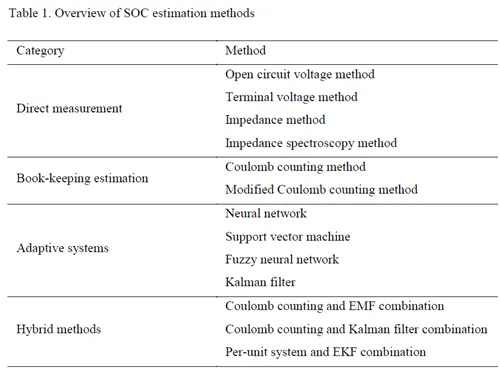
Book-Keeping methods The Book-keeping estimation method uses battery discharging current data as input. This method permits to include some internal battery effects as self-discharge, capacity-loss, and discharging efficiency. Two kinds of book-keeping estimation methods have been employed: Coulomb counting method and modified Coulomb counting method.
Coulomb counting method
The Coulomb counting method measures the discharging current of a battery and integrates the discharging current over time in order to estimate SOC. Coulomb counting method is done to estimate the SOC(𝑡), which is estimated from the discharging current, 𝐼(bat), and initial SOC value, SOC(𝑡0), Qn is the rated capacity of battery. SOC is calculated by the following equation:

But there are several factors that affect the accuracy of Coulomb counting method including temperature, battery history, discharge current, and cycle life.
The classic Coulomb counting method (current integration) requires an initial condition which, if given incorrectly, results in incorrect estimation by the same amount. The only time that the correct SoC is known is when the battery is fully charged or discharged. In operation of the vehicle, these two conditions are rarely encountered. Also, such methods require that the current measurement is perfect, but no current sensor is immune from noise, component-to-component variations and other effects. Therefore small errors always exist in every measurement and these errors may cause the estimates to wander away from the true value. Thus, Coulomb counting is not a preferred method for SoC estimation when a battery must be operated for long time without full charge or discharge. Nevertheless, if the initial condition is known and the battery is operated for a relatively short period of time, then this method does provide a reliable measurement. This is important because in order to design any SoC estimator, a true measurement must exist for purposes of comparison.
One way of making up for the shortcomings of Coulomb counting is to introduce periodic resets to the current integration. Obviously, if the battery is fully charged or discharged, then a reset should be done. But in vehicle operations, batteries are never fully discharged because that can significantly shorten the life of the battery. Also in electric vehicle and HEV applications, full charge never happens because that also adversely affects the life of the battery. Another way to reset the current integration operation is to use the battery’s open circuit voltage (OCV). The fully relaxed OCV of the battery has an approximate one-to-one relationship with the SoC. Therefore, by measuring this voltage the SoC can be found via the inverse relationship between SoC and OCV. However, the relaxed OCV can only be measured when the internal battery chemistry has reached equilibrium. This can take several hours depending on the chemistry of the battery. Because the OCV-to-SoC curve is very flat in a large region (usually between 40 to 85% SoC), if an unsettled OCV is used, then a large error in SoC is incurred, which would not accomplish the goal of resetting the current integration. So despite the fact that this method is an improvement to the current integration scheme, it is still not very robust.
Implementation of Coulomb counting method in BMS
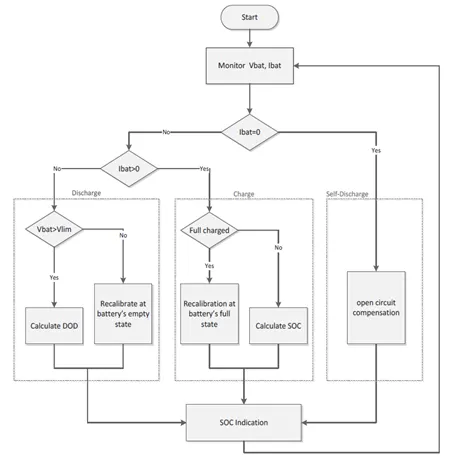
Figure 1: Flowchart of SOC implementation
The flowchart given in Fig.1 explains the algorithm used to manage the battery monitoring by switching from a battery operating mode to another in accordance with the transitions conditions.
The estimation of the SOC of a Li-Ion battery in this method is based on monitoring both the voltage and the current. The operation mode of the battery is recognized by the direction of current through the battery system. When the battery is in open circuit mode, I(bat) = 0. The information needed to carry monitoring are the measurement of the battery voltage, the current flowing through it and the operating temperature. Coulomb counter ΔQ is used to track the SOC when the battery is charged or discharged. The amount of charges ΔQ in an operating period τ is obtained by a temporal integration of a measured charging/discharging current like expressed in (3).

This variance ΔQ that will be used in the following equations is negative if the battery is in discharge, positive if in charge.
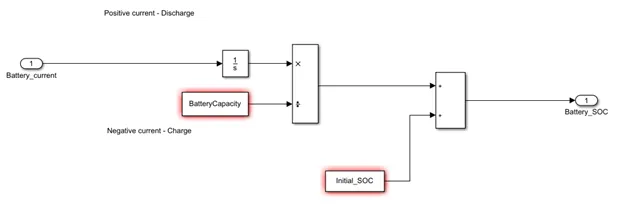
Figure 2: Simulink implementation of Coulomb counting SOC estimation
The above figure shows the implementation of Coulomb counting SOC estimation of battery in BMS. Initial SOC has to be estimated accurately during charging/ discharging conditions. Battery current is sensed using current sensor and calculation as per equation (2) will give the value of SOC.