Week 1 Understanding Different Battery Chemistry
Lithium-ion batteries are commonly used for portable electronics and electric vehicles and are growing in popularity for military and aerospace applications. There are different materials used for cathode and anode in Li-Ion battery. Most Li-ion batteries use a negative electrode principally made from carbon (e.g., graphite) or lithium titanate (Li4Ti5O12), with some novel materials under development, namely, Li metal and Li(Si) alloys. The electrolyte used varies based on the choice of electrode materials, but is typically composed of a mixture of lithium salts (e.g., LiPF6) and an organic solvent (e.g., diethyl carbonate) to allow for ion transfer.
The technological limitations of the various materials are driven by their function, as detailed below. The electrolyte must offer the highest possible lithium ion transport under use conditions. The batteries must operate in the general environment, -30 deg C for a vehicle that has been parked for a period of time in extreme cold, to +60 deg C for a battery that has heated as a consequence of the combination of environmental conditions and heat generated by charging. The separator must likewise offer the highest possible lithium ion conduction under the same operational conditions and must offer the ability for a rapid thermal shutdown if significant overheating occurs to prevent a thermal runaway process. A suitable combination of negative and positive electrode materials must exist that leads to a cost-effective high capacity battery.
The anode cathode reactions of all the LIBs are given below.
|
Type |
Cathode |
Anode |
Cathode Reaction |
Anode Reaction |
Overall Reaction |
|
LCO |
LiCoO2 |
Graphite |
CoO2 + Li+ + e- LiCoO2 |
LiC6 C6 + Li+ + e- |
LiC6 +CoO2 C6 + LiCoO2 |
|
LMO |
Li2Mn2O4 |
Graphite |
Li1-xMn1-x3+Mn1+x4+O4 + xLi+ + xe- LiMn3+Mn4+O4 |
xLiC6 + Mn2+ xC6 + xLi+ + Mn0 + xe- |
Li1-xMn1-x3+Mn1+x4+O4 +2LiC6 + Mn2+ LiMn3+Mn4+O4 + xC6 + Mn0 |
|
NMC |
LiNiMnCoO2 |
Graphite |
Li2/3Ni1/34+Co1/34+Mn1/34+O2 + 1/3Li+ + 4/3e- LiNi1/32+Co1/33+Mn1/34+O2 |
LiC6 C6 + Li+ + e- |
Li2/3Ni1/34+Co1/34+Mn1/34+O2+ LiC6 LiNi1/32+Co1/33+Mn1/34+O2 + C6 |
|
LFP |
LiFePO4 |
Graphite |
FePO4 + Li+ + e- LiFePO4 |
LiC6 C6 + Li+ + e- |
LiC6 +FePO4 C6 + LiFePO4 |
|
NCA |
LiNiCoAlO2 |
Graphite |
LiPF6 LiF + PF5 PF5 + 4H2O 5HF + PO4 (Electrolyte decomposition) |
LiC6 C6 + Li+ + e- |
Exact reaction is not available. |
|
LTO |
LiFePO4 |
Li4Ti5O12 |
4FePO4 + 4Li+ + 4e- 4LiFePO4 |
Li7Ti5O12 + LiC6 Li4Ti5O12 + 4Li+ + 4e- + C6 |
LiC6 + Li7Ti5O12 +4FePO4 C6 + Li4Ti5O12 + 4LiFePO4 |
- Lithium Cobalt Oxide (LiCoO2) - LCO
Lithium Cobalt Oxide: LiCoO2 cathode (~60% Co), graphite anode
The lithium cobalt oxide battery has been the battery of choice for most personal electronics (laptops, cameras, tablets, etc.) due to their high energy density, long life cycle and ease of manufacturing. Lithium cobalt batteries are very reactive and therefore suffer from poor thermal stability and must be monitored during operation to ensure safe use. The limited availability of cobalt also makes it more expensive and difficult to be a viable option for use in EVs.
Like other cobalt-blended Li-ion, Li-cobalt has a graphite anode that limits the cycle life by a changing solid electrolyte interface (SEI), thickening on the anode and lithium plating while fast charging and charging at low temperature.
The cathode has a layered structure. During discharge the lithium ions move from the anode to the cathode; on charge the flow is from cathode to anode.
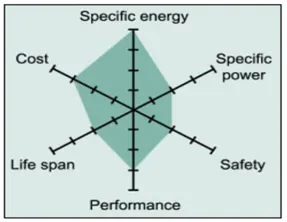
Figure 1: Performance of LCO battery
From the above figure, we can understand that even though it excels at specific energy, it has moderate safety, lifespan and specific power.
The anode cathode reactions are as shown below.
The Positive electrode (Cathode) half reaction is
CoO2 + Li+ + e- LiCoO2
The negative electrode half reaction is
LiC6 C6 + Li+ + e-
The overall reaction is
LiC6 +CoO2 C6 + LiCoO2
LCO batteries are sensitive to overcharging/ discharging. It leads to the formation of Lithium Oxide as shown in the following reaction.
Li+ + e- +LiCoO2 Li2O +CoO
The specifications of LCO cell is given in the table below.
|
Voltages |
3.6V nominal; 3-4.2V/cell |
|
Specific Energy (capacity) |
150-200Wh/kg |
|
Charge (C-rate) |
0.7-1C up to 4.2V |
|
Discharge (C-rate) |
1C |
|
Cycle life |
500–1000, related to depth of discharge, load, temperature |
|
Thermal runaway |
150°C (302°F). Full charge promotes thermal runaway |
|
Applications |
Mobile phones , Laptops, Cameras |
- Lithium Manganese Oxide (LiMn2O4) — LMO
LiMn2O4 cathode. graphite anode
The architecture forms a three-dimensional spinel structure that improves ion flow on the electrode, which results in lower internal resistance and improved current handling. Low internal cell resistance enables fast charging and high-current discharging. Li-manganese can be discharged at currents of 20–30 A with moderate heat buildup in an 18,650 package. This chemistry provides better thermal stability than the lithium cobalt oxide battery but results in approximately 33% lower capacity and a lower life span.
Most Li-manganese batteries blend with lithium manganese cobalt oxide (NMC) to improve the
specific energy and prolong the life span. The LMO-NMC has been used by multiple EV manufacturers.
The cathode crystalline formation of lithium manganese oxide has a three-dimensional framework structure that appears after initial formation. Spinel provides low resistance but has a more moderate specific energy than cobalt.
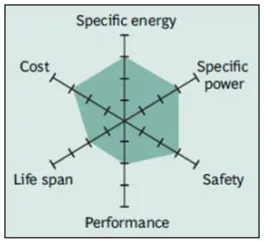
Figure 2 : Performance of pure Li-Manganese battery
|
From the above figure we can understand that Li-manganese have moderate life span and performance. But newer technologies offer improvements in specific power, safety and life span. |
Most Li-manganese batteries blend with lithium nickel manganese cobalt oxide (NMC) to improve the specific energy and prolong the life span. This combination brings out the best in each system, and the LMO (NMC) is chosen for most electric vehicles, such as the Nissan Leaf, Chevy Volt and BMW i3. The LMO part of the battery, which can be about 30 percent, provides high current boost on acceleration; the NMC part gives the long driving range.
The anode cathode reactions are as shown below.
The Positive electrode (Cathode) half reaction is
Li1-xMn1-x3+Mn1+x4+O4 + xLi+ + xe- LiMn3+Mn4+O4
The negative electrode half reaction is
xLiC6 + Mn2+ xC6 + xLi+ + Mn0 + xe-
The overall reaction is
Li1-xMn1-x3+Mn1+x4+O4 +2LiC6 + Mn2+ LiMn3+Mn4+O4 + xC6 + Mn0
The specifications of LMO is as given below
|
Voltages |
3.7V nominal; 3-4.2V/cell |
|
Specific Energy (capacity) |
100-150Wh/kg |
|
Charge (C-rate) |
0.7-1C typical, 3C maximum, Charges to 4.2V |
|
Discharge (C-rate) |
1C, 10C possible with some cells |
|
Cycle life |
300 – 700, related to depth of discharge, load, temperature |
|
Thermal runaway |
250°C (482°F). Full charge promotes thermal runaway |
|
Applications |
Power tools, medical devices, electric powertrains |
3. Lithium Nickel Manganese Cobalt Oxide (LiNiMnCoO2) — NMC
LiNiMnCoO2 cathode. graphite anode
NMC Li-ion systems is a cathode combination of nickel-manganese-cobalt. Nickel is known for its high specific energy but poor stability; manganese has the benefit of forming a spinel structure to achieve low internal resistance but offers a low specific energy. Combining the metals enhances each other strengths. NMC is the battery of choice for power tools, e-bikes and other electric power trains. The cathode combination is typically one-third nickel, one-third manganese and one-third cobalt, also known as 1-1-1. This offers a unique blend that also lowers the raw material cost due to reduced cobalt content. Another successful combination is NCM with 5 parts nickel, 3 parts cobalt and 2 parts manganese (5-3-2). Other combinations using various amounts of cathode materials are possible.
The oxidation states of Ni, Co, and Mn in as-made Li[Ni1/3Co1/3Mn1/3]O2 are +2, +3, and +4, respectively. First principle calculations suggest that Ni2+ is ultimately oxidized to Ni4+ during extraction of the first two-thirds of the lithium during electrochemical charging in lithium cells, and oxidation of Co3+ to Co4+ occurs only during removal of the last one-third (i.e., at high cell potentials). Mn remains inactive throughout normal operating cell voltages. The redox activity of Ni during the extraction of lithium from Li[Ni1/3Co1/3Mn1/3]O2 has been verified by in situ X-ray absorption spectroscopic (XAS) studies. The above contain equal amounts of Ni and Mn.
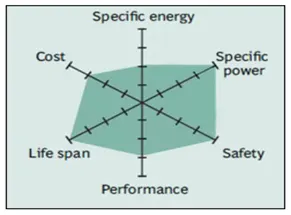
Figure 3: Performance of NMC
The anode cathode reactions are as shown below.
The Positive electrode (Cathode) half reaction is
Li2/3Ni1/34+Co1/34+Mn1/34+O2 + 1/3Li+ + 4/3e- LiNi1/32+Co1/33+Mn1/34+O2
The negative electrode half reaction is
LiC6 C6 + Li+ + e-
The overall reaction is
Li2/3Ni1/34+Co1/34+Mn1/34+O2+ LiC6 LiNi1/32+Co1/33+Mn1/34+O2 + C6
The specifications of LMO is as given below
|
Voltages |
3.7V nominal; 3-4.2V/cell |
|
Specific Energy (capacity) |
100-150Wh/kg |
|
Charge (C-rate) |
0.7-1C typical, 3C maximum, Charges to 4.2V |
|
Discharge (C-rate) |
1C, 10C possible with some cells |
|
Cycle life |
300 – 700, related to depth of discharge, load, temperature |
|
Thermal runaway |
250°C (482°F). Full charge promotes thermal runaway |
|
Applications |
Power tools, medical devices, electric powertrains |
4. Lithium Iron Phosphate (LiFePO4) — LFP
LiFePO4 cathode, graphite anode
Li-phosphate is more tolerant to full charge conditions and is less stressed than other lithium-ion systems if kept at high voltage for a prolonged time. As a trade-off, its lower nominal voltage of 3.2V/cell reduces the specific energy below that of cobalt-blended lithium-ion. With most batteries, cold temperature reduces performance and elevated storage temperature shortens the service life, and Li-phosphate is no exception. Li-phosphate has a higher self-discharge than other Li-ion batteries, which can cause balancing issues with aging. This can be mitigated by buying high quality cells and/or using sophisticated control electronics, both of which increase the cost of the pack. Cleanliness in manufacturing is of importance for longevity.
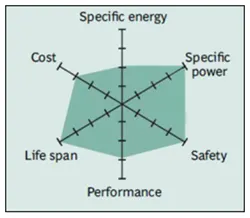
Figure 4: Performance of LFP battery
Li-phosphate has excellent safety and long life span but moderate specific energy and elevated self-discharge.
The anode cathode reactions are as shown below.
The Positive electrode (Cathode) half reaction is
FePO4 + Li+ + e- LiFePO4
The negative electrode half reaction is
LiC6 C6 + Li+ + e-
The overall reaction is
LiC6 +FePO4 C6 + LiFePO4
The specifications of LFP is as given below
|
Voltages |
3.2, 3.3 V nominal; 2.5-3.65 V/cell |
|
Specific Energy (capacity) |
90-120Wh/kg |
|
Charge (C-rate) |
1C typical, 3C maximum, Charges to 3.65V |
|
Discharge (C-rate) |
1C, 25C possible with some cells |
|
Cycle life |
2000 related to depth of discharge, load, temperature |
|
Thermal runaway |
270°C (518°F). Very safe even if fully charged |
|
Applications |
Portable and stationary needing high load currents and endurance |
5. Lithium Nickel Cobalt Aluminium Oxide (LiNiCoAlO2) — NCA
LiNiCoAlO2 cathode (~9% Co), graphite anode
The lithium nickel cobalt aluminium oxides (NCA) are a group of substances comprising metal oxides. Some of them are important due to their application in lithium ion batteries. NCAs are used as active material on the positive pole (which is the cathode when the battery is discharged). NCAs are mixed oxides comprising the cations of the chemical elements lithium, nickel, cobalt and aluminum. The most important representatives have the general formula LiNixCoyAlzO2 with x + y + z = 1.
Advantages of NCA are Slow reaction with electrolytes, High capacity, High voltage and Excellent high rate performance
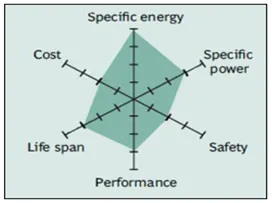
Figure 5: Performance of NCA battery
From the above performance analysis, NCA has high energy and power densities, as well as good life span which make it suitable for EV powertrains. High cost and marginal safety are negatives. Currently, Tesla uses the Panasonic Li[Ni0.84Co0.12Al0.04]O2 cathode in its Model S and Model X.
NCA is a promising cathode material due to its excellent structural stability and high capacity. However, the cycle and rate performance of NCA materials still limit its large-scale application. The layered rock salt cathode material affects the electrochemical performance due to structural defects. The poor thermal stability of Ni3+ causes the reduction of Ni3+ to Ni2+. With the release of Li+ , some Ni2+ ions could easily occupy the vacancy of Li+ ions during the charging process because the Ni2+ radius (0.69 Å) is similar to the Li+ radius (0.76 Å) [29], which may cause lithium nickel-mixing effects and generate irreversible phases to result in material capacity loss. On the other hand, Ni3+ and Ni4+ in the high oxidation state are extremely unstable under high-temperature conditions, and they easily react with the HF released by the electrolyte to cause the material structure to change or even collapse, thus affecting the specific capacity and cycle performance of the NCA material. Given these shortcomings, it is necessary to modify the NCA material, and the main modification methods can be summarized and described as surface coating and bulk phase doping.
Carbon coating is a feasible measure to improve the ionic conductivity and cycle performance of NCA materials under different rates by increasing the electrical conductivity and changing the transmission mechanism. The amorphous carbon coating may cause more unfavorable Ni2+ content and exacerbate the Li+ /Ni2+ intermixing degree, resulting in the degradation of battery performance of NCA cathode material. The reason can be attributed to the reduction of Ni3+ to Ni2+ by the in situ carbonization of the carbon source.
Oxide Coating - As far as we know, oxides, such as Al2O3, MgO, TiO2 , ZnO, ZrO2, SiO2, CeO2, and RuO2 can be widely used to modify the surface of NCA materials due to excellent electronic conductivity and good compatibility with electrolytes.
Phosphate Coating- Surface modification by phosphate has received widespread attention in recent years. The principle of phosphate-coated positive electrode material is the same as that of oxide coating, in which the phosphate has better ion transportability and thermal stability that can better improve the rate performance of the material. The commonly used phosphates are AlPO4 [55], Li3PO4 ,Ni3(PO4)2, Co3(PO4)2.
Fluoride Coating- Fluoride is also one of the most widely used materials in the coating modification of lithium-ion battery cathode materials. The electrolyte LiPF6 will decompose continuously during battery operation to produce highly corrosive hydrofluoric acid (HF), which causes the dissolution of transition metals in NCA cathode materials. The decomposition of LiPF6 generates LiF and PF5. The LiF is deposited on the surface of the active material, and it has a low Li+ and electron permeability. Meanwhile, the PF5 reacts with the trace amount of water in the electrolyte to form HF, which causes corrosion to the electrode material and further enhances the instability of the interface between electrode and electrolyte.
The overall reactions are as shown below. LiPF6 is the electrolyte.
LiPF6 LiF + PF5
PF5 + 4H2O 5HF + PO4
The LiF is deposited on the surface of the active material, and it has a low Li+ and electron permeability.
LiF Li+ +e- +F-
C6 + Li+ + e- LiC6
The specifications of NCA is as given below
|
Voltages |
3.6V nominal; 3-4.2V/cell |
|
Specific Energy (capacity) |
200-260Wh/kg |
|
Charge (C-rate) |
0.7 Charges to 4.2V |
|
Discharge (C-rate) |
1C, 10C possible with some cells |
|
Cycle life |
500, related to depth of discharge, load, temperature |
|
Thermal runaway |
150°C (302°F). Full charge promotes thermal runaway |
|
Applications |
Medical devices, industrial, electric powertrain (Tesla) |
6. Lithium Titanate (Li2TiO3) — LTO
Cathode can be LFP or NMC; Li2TiO3 (titanate) anode
Li-titanate replaces the graphite in the anode of a typical lithium-ion battery and the material forms into a spinel structure. The cathode can be lithium manganese oxide or LFP. Li-titanate has a nominal cell voltage of 2.40V, can be fast charged and delivers a high discharge current of 10C, or 10 times the rated capacity. The cycle count is said to be higher than that of a regular Li-ion. Li-titanate is safe, has excellent low-temperature discharge characteristics and obtains a capacity of 80 percent at –30°C (–22°F).
LTO (commonly Li4Ti5O12) has advantages over the conventional cobalt-blended Li-ion with graphite anode by attaining zero-strain property, no SEI film formation and no lithium plating when fast charging and charging at low temperature. Thermal stability under high temperature is also better than other Li-ion systems; however, the battery is expensive. At only 65Wh/kg, the specific energy is low, rivalling that of NiCd. Li-titanate charges to 2.80V/cell, and the end of discharge is 1.80V/cell. Figure 13 illustrates the characteristics of the Li-titanate battery. Typical uses are electric powertrains, UPS and solar-powered street lighting.
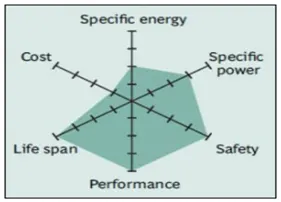
Figure 6: Performance of LTO battery
Li-titanate excels in safety, low-temperature performance and life span. Efforts are being made to improve the specific energy and lower cost.
The anode cathode reactions are as shown below.
The Positive electrode (Cathode) half reaction is
4FePO4 + 4Li+ + 4e- 4LiFePO4
The negative electrode half reaction is
Li7Ti5O12 + LiC6 Li4Ti5O12 + 4Li+ + 4e- + C6
The overall reaction is
LiC6 + Li7Ti5O12 +4FePO4 C6 + Li4Ti5O12 + 4LiFePO4
The specifications of LTO is as given below
|
Voltages |
2.40V nominal; 1.8-2.85V/cell |
|
Specific Energy (capacity) |
50 - 80Wh/kg |
|
Charge (C-rate) |
1C typical, 5C maximum, Charges to 2.85V |
|
Discharge (C-rate) |
10C possible |
|
Cycle life |
3000 – 7000, related to depth of discharge, load, temperature |
|
Thermal runaway |
One of the safest Li-Ion batteries |
|
Applications |
UPS, electric powertrain (Mitsubishi i-MiEV, Honda Fit EV), |