Week 7: Shock tube simulation project
Aim: Setup a transient shock tube simulation; produce pressure, temperature plots, and mesh plots.
Introduction and theory:
The shock tube is an instrument used to replicate and direct blast waves at a sensor or a model in order to simulate actual explosions and their effects, usually on a smaller scale. Shock tubes (and related impulse facilities such as shock tunnels, expansion tubes, and expansion tunnels) can also be used to study aerodynamic flow under a wide range of temperatures and pressures that are difficult to obtain in other types of testing facilities. Shock tubes are also used to investigate compressible flow phenomena and gas-phase combustion reactions. More recently, shock tubes have been used in biomedical research to study how biological specimens are affected by blast waves.
A shock wave inside a shock tube may be generated by a small explosion (blast-driven) or by the buildup of high pressures which cause diaphragm(s) to burst and a shock wave to propagate down the shock tube (compressed-gas driven).
A simple shock tube is a tube, rectangular or circular in cross-section, usually constructed of metal, in which gas at low pressure and gas at high pressure is separated using some form of a diaphragm.
The low-pressure gas, referred to as the driven gas, is subjected to the shock wave. The high-pressure gas is known as the driver gas. The corresponding sections of the tube are likewise called the driver and driven sections. The driver gas is usually chosen to have a low molecular weight, (e.g., helium or hydrogen) for safety reasons, with a high speed of sound, but maybe slightly diluted to 'tailor' interface conditions across the shock. To obtain the strongest shocks the pressure of the driven gas is well below atmospheric pressure (a partial vacuum is induced in the driven section before detonation).
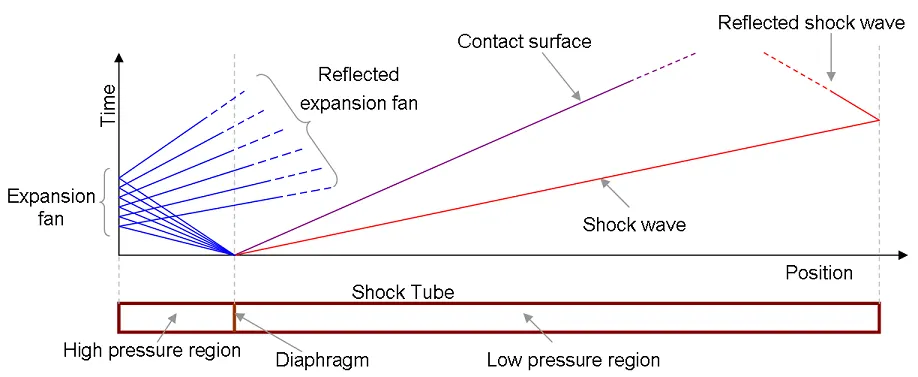
The test begins with the bursting of the diaphragm.[9] Several methods are commonly used to burst the diaphragm.
- A mechanically-driven plunger is sometimes used to pierce it or an explosive charge may be used to burst it.
- Another method is to use diaphragms of plastic or metals to define specific bursting pressures. Plastics are used for the lowest burst pressures, aluminum and copper for somewhat higher levels, and mild steel and stainless steel for the highest burst pressures.[10] These diaphragms are frequently scored in a cross-shaped pattern to a calibrated depth to ensure that they rupture evenly, contouring the petals so that the full section of the tube remains open during the test time.
- Yet another method of rupturing the diaphragm utilizes a mixture of combustible gases, with an initiator designed to produce a detonation within it, producing a sudden and sharp increase in what may or may not be a pressurized driver. This blast wave increases the temperature and pressure of the driven gas and induces a flow in the direction of the shock wave but at a lower velocity than the lead wave.
The bursting diaphragm produces a series of pressure waves, each increasing the speed of sound behind them so that they compress into a shock propagating through the driven gas. This shock wave increases the temperature and pressure of the driven gas and induces a flow in the direction of the shock wave but at a lower velocity than the lead wave. Simultaneously, a rarefaction wave, often referred to as the Prandtl-Meyer wave, travels back into the driver gas.
Case Setup:
1. In converge, we are selecting a Time-based application for this project.
2. For materials, we are selecting a predefined mixture as Air which has Oxygen and nitrogen as species of this mixture.
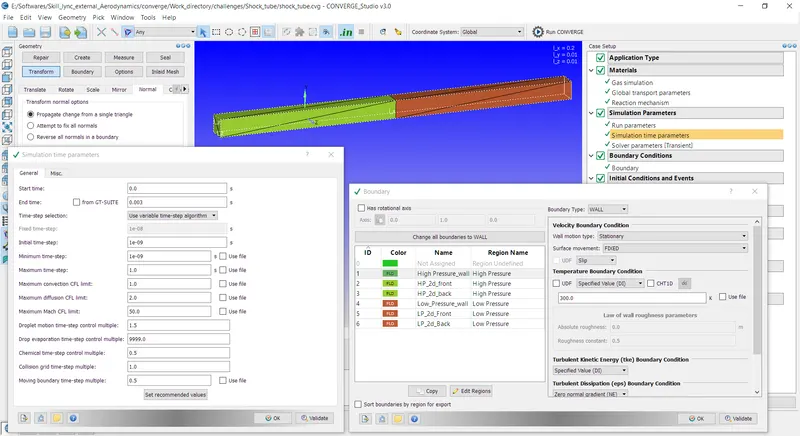
3. In this project, turbulence models are included as RNG k-epsilon. This project was running for the maximum limit of 0.003 secs and after every 0.0001 secs restart files and result snapshot was recorded.
4. The solver parameters were defaulted to Navier stokes equation-based PISO solver.
5. This particular project is an example of transient-state simulation.
6. The channel is assigned different boundary conditions:
1. High-pressure wall)
2. low-pressure wall)
3.. 2D sliced walls (front and back)
7. After setting up the grid size, variables for post-processing were selected. (velocity, mass flow, pressure, density, temperature)
8. After exporting input files, using CYGWIN (command prompt) was used to simulate the project setup.
9. Output files were later converted using CONVERGE studio for post-processing in ParaView.
Simulation time parameters and Boundaries:
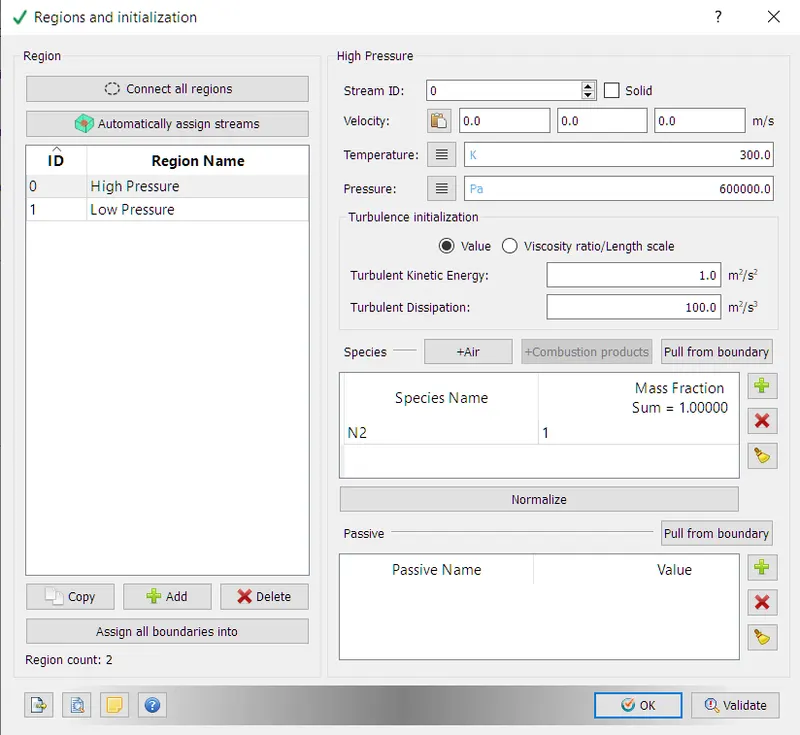
Regions Definitions:
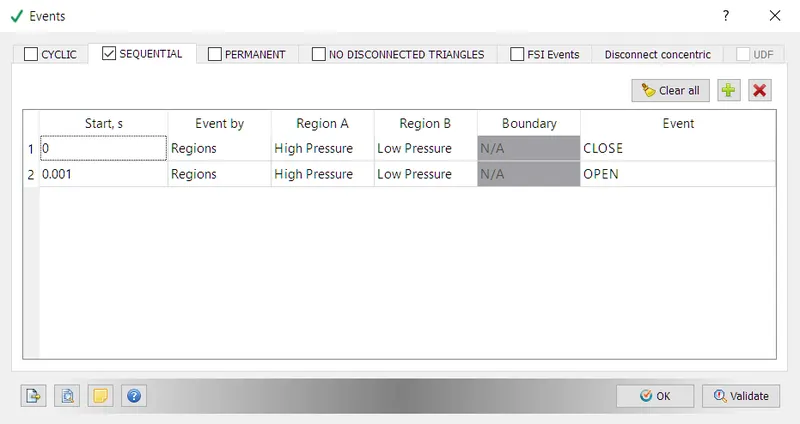
Events Description:
Adaptive Mesh refinement:
Results:
Pressure history Plot
Temperature History Plot
Cell count Plot:
Animation:
Summary of Results:
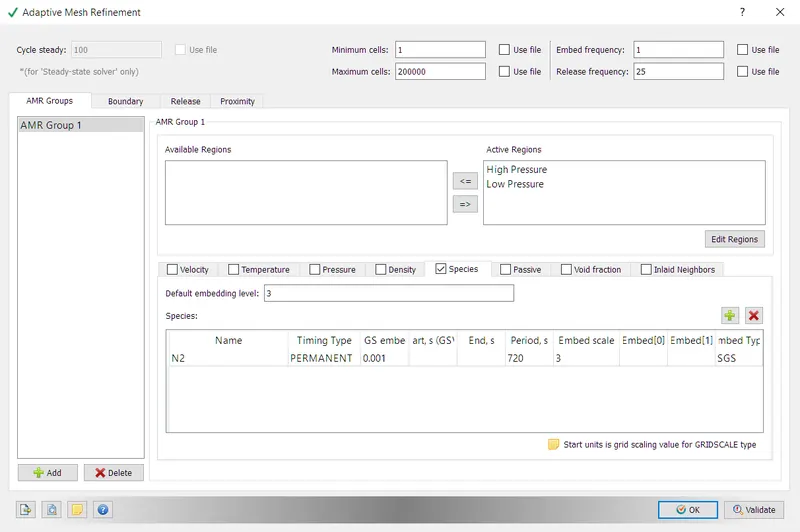
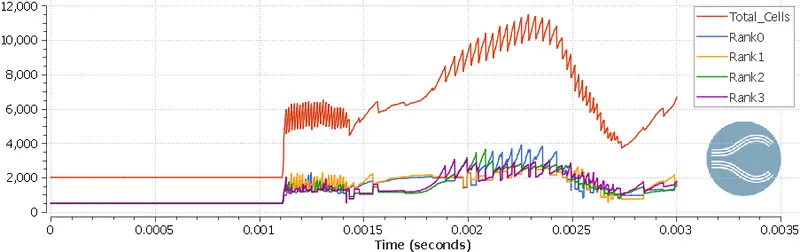
1. The process of generation of shock and expansion waves continues till the pressure difference in the domain dies out, therefore AMR keeps on refining
the mesh in the wavefront until the rate of change of concentration of N2 is below the SGS value.
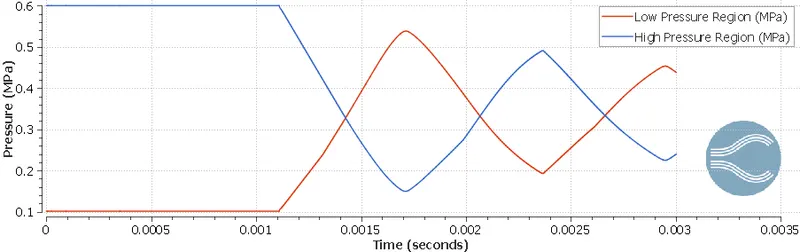
2. To observe the pressure difference to damp, we need to run the simulation for a longer duration. The diaphragm breaks at 0.001s (activated by events). As soon as, it breaks, the pressure in the High-pressure region reduces and increases the pressure on the Low-pressure region, this sudden increase in pressure in the Low-pressure region causes the shock in the Low-pressure region and corresponds to expansion waves due to a decrease in pressure, flow in the High-pressure region.
3. The shock waves are reflected when the gases in the Low-pressure region are compressed and the pressure in the Low-pressure region is higher than the
Shock front. This sinusoidal behavior of damping is observed until the pressure difference becomes zero.
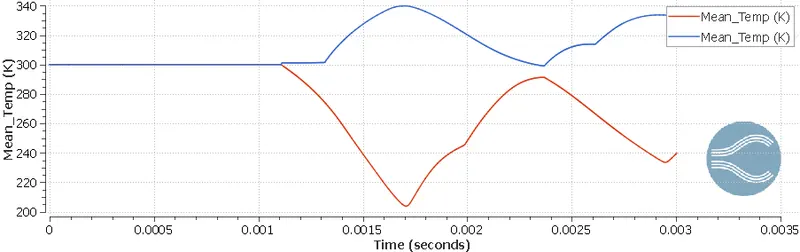
4. The density variation, follows the same pattern as the pressure, as both of them are directly related to the ideal gas equation. Moreover, the shock increases the temperature, and the expansion wave decreases the temperature.
Conclusion:
A case has been set up in CONVERGE to perform Shock Tube Simulation, pressure and temperature plots have been explored. During this simulation in CONVERGE, we saw the purpose of the concept called "Events".