Week 7-Long Piston With Cam
OBJECTIVE:
- To perform a transient analysis on a piston and cam mechanism model.
- To run the analysis with Frictionless contact, Frictional with 0.1 and 0.2 as the frictional contact for a total of 3 cases.
Required Results and Deliverables:
- Equivalent Stress, Directional Deformation and Equivalent Elastic Strain and compare them for all the three cases. Give an inference as to why the results vary between cases.
Procedure:
Step 1: Engineering Data
- For this analysis we will be using Static Structural as material which can be found in engineering data.
Step 2: Geometry
- Right click on geometry and Import the Long_piston_cam_Skill_Lync.x_t extension file
- Rename the Static Structural tab as Long Piston with cam.
- Update the Static Structural tab and proceed to model.
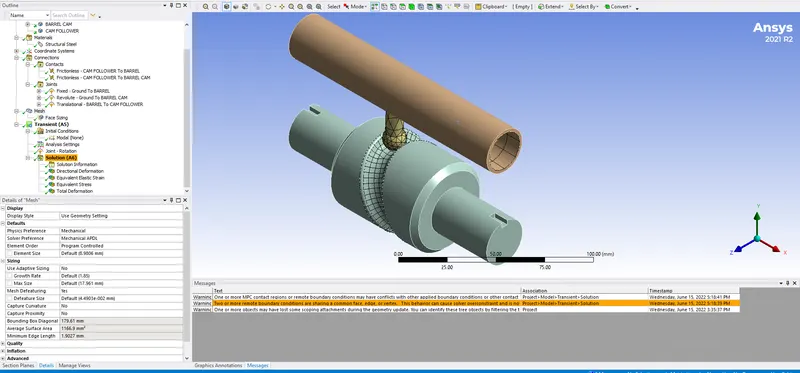
Step 3: Model and Meshing
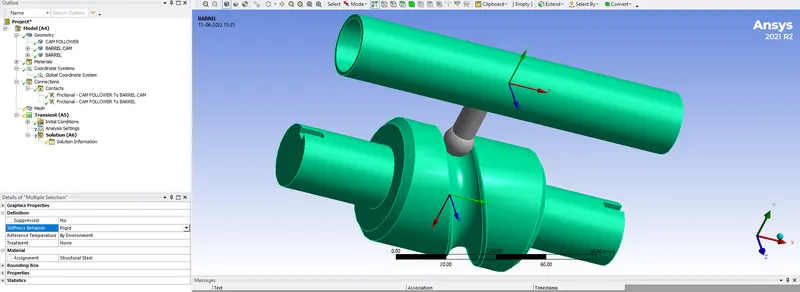
- Open Model and under geometry assign names according to convenience for understanding.
- Assign rigid as stiffnes behaviour to both the bodies (barrel and barrel cam). This way the solver will consider them as point masses.
Step 4: Connections
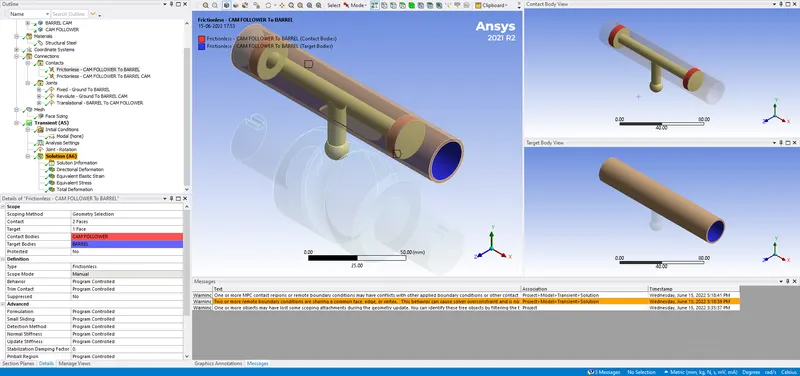
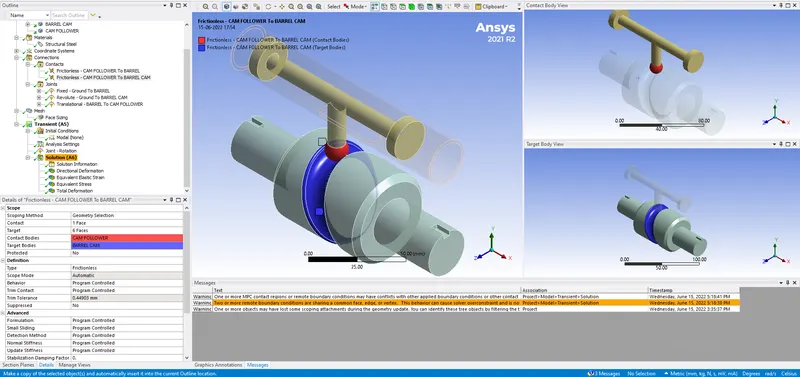
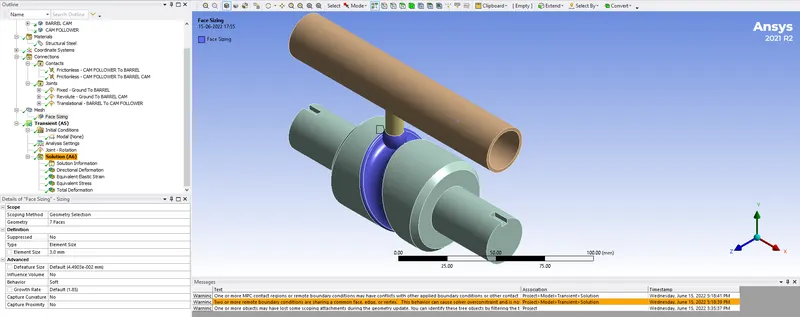
- Contacts:- Define the Buckle and clip faces as frictional type and assign a Frictionless contact, frictional contact with coefficient of 0.1,0.2 for CASE 1,2 and 3 respectively. No change in rest settings.
Step 5: Setup
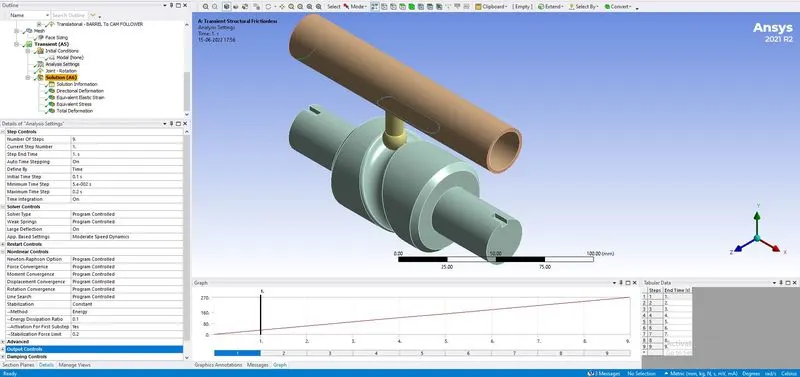
- In analysis settings we are going to simulate this case in 9 steps.
- Enter 9 as the number of steps and select all the steps simultaneously and switch on the large deflection in solver controls.
- Turn on auto time stepping defined by time,0.1 as initial time step,5e-02 as minimum time step and 0.2 as maximum for first step and 0.3 for steps 2-9.
- In nonlinear controls change stabilization to constant with energy dissipation ratio of 0.1 and activation for first substep as Yes. Change solver type as program controlled.
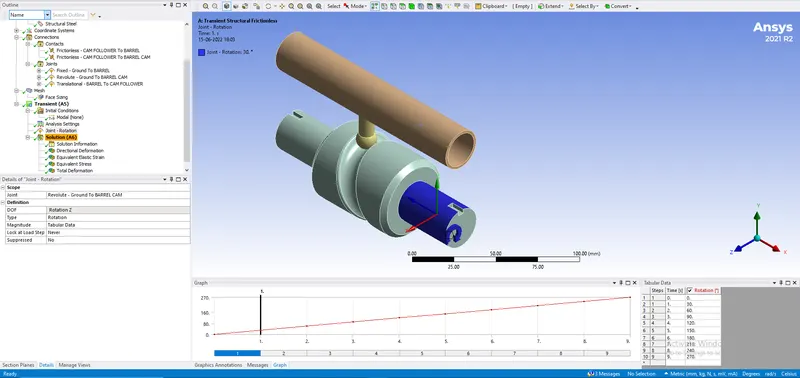
- Insert rotational joint type to defined revolute joint.(Ground to Barrel Cam)
Step 6: Solution
- Insert results for Equivalent Stress, Equivalent Strain, Total Deformation, Directional deformation for geometry in focus.
- Parametric study has been carried out for cases with frictional coefficient of 0.1 and 0.2.
Results:
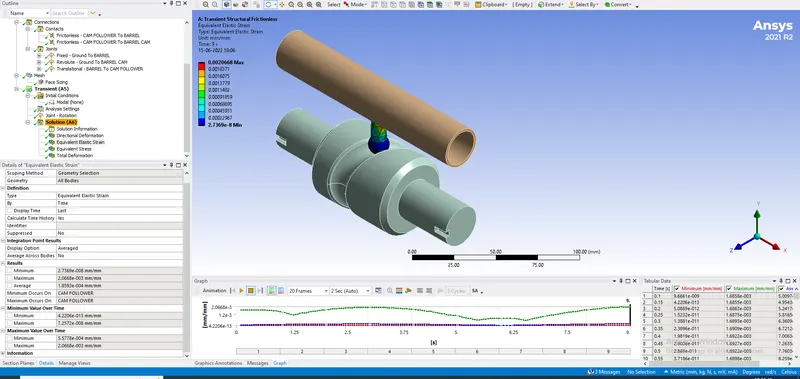
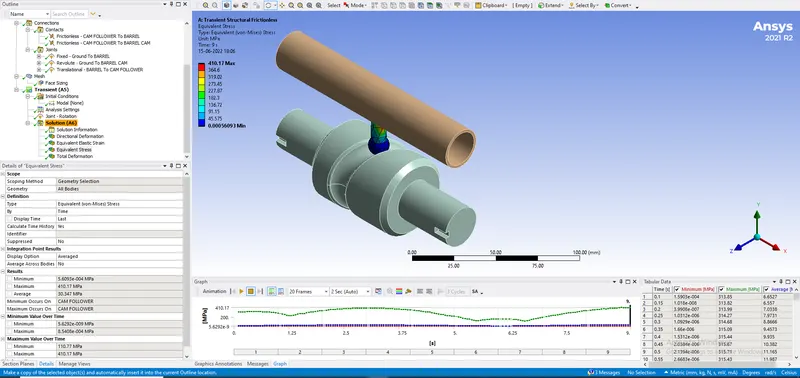
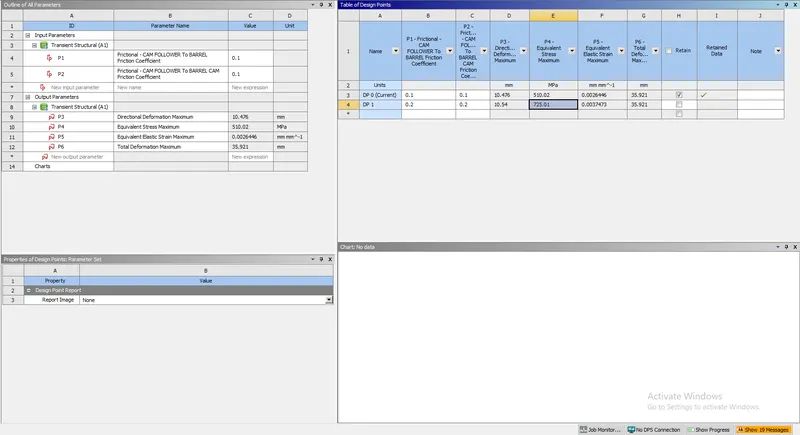
| CASE# | Contact Type | Equivalent Stress | Directional Deformation | Equivalent Elastic Strain |
| Units | MPa | mm | mm/mm | |
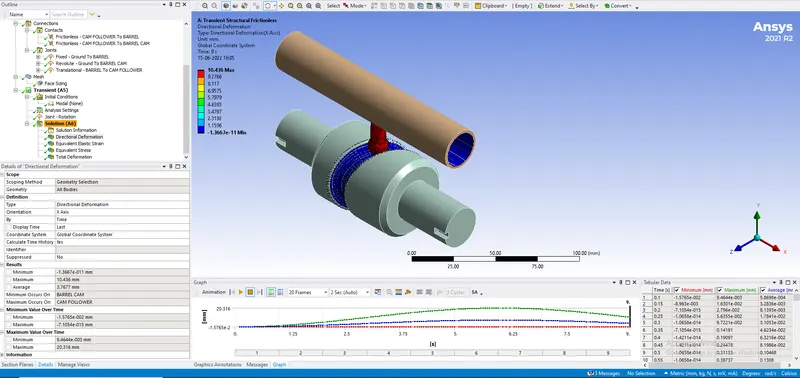
| Case 1 | Frictionless | 410.17 | 10.436 | 0.0020668 |
| Case 2 | Frictional- 0.1 | 510.02 | 10.476 | 0.0026446 |
| Case 3 | Frictional- 0.2 | 725.01 | 10.539 | 0.0037472 |
Inference: As we assign a frictional contact to the contact surface in focus we see that stress increase due to frictional resistance between contacts. As a result the Equivalent stress values are 410.17 Mpa, 510.02 Mpa and 725.01 Mpa for frictionless, Frictional conatct with 0.1, Frictional conatct with 0.2 respectively. A similar trend is seen in equivalent strain. The directional deformation is not much affected and stays between 5% of values in case of frictionless motion.