Week-7 : Converting a detailed engine model to a FRM model
1. Explore tutorial number 9 and write a detailed report.
In tutorial 9, step by step conversion is shown from 4Cyl Turbo charged Diesel Engine detailed GT model to FRM model using FRM Converter approach.
For FRM convertor approach as name itself suggest it converts existing model to FRM model which means we first need to have detailed (and caliberated) model. Before going for FRM convertor approach first we need to run existing detailed model and need to have results of it. In FRM approach main goal is to create simplified fast running model whose results are checked against pre-defined tolarance wrt to detailed model. There are two ways of increasing 1D model running speed, one by reducing time step (i.e. by reducing/combining volumes to be calculated, reducing discritization of individual component) and second approach is by reducing number of calculations per time step.
Using FRM tag we can see and visualize what all parts can be combined into single parts as selected by software itself based on courant number and all such sets. Also while building FRM model one has to set "Accuracy Checking" to set RLT/Parameters/Outputs whose deviation will be checked against set tolarance (as compared to detailed model). This will allow to understand user if FRM model is giving acceptable results or not. After that there is step of 'Model Reduction' where user choose which one of the all available FRM tags to implemented in FRM model and for what perpose i.e. for accuracy or for speed. In step wise simplification/conversion it is better to first simplify for accuracy rather than speed. One after other all tags can be implemented by checking accuracy after each tag implementation.
Once with all first hand simplification if accuracy comes out to be acceptable then user should decide on attempting simplify for Speed. Though it is clear that final goal of any FRM model is to have a fast running yet fairly accurate model.
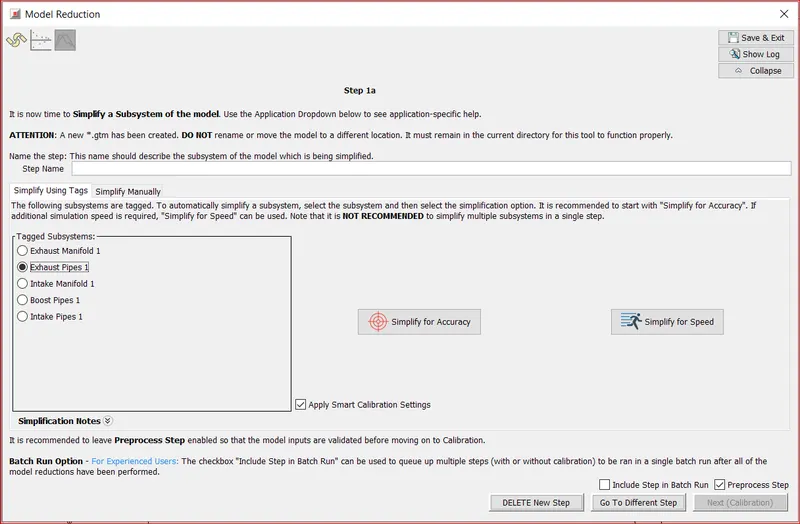
Below Image shows pop-up window of Model Reduction in which subsystem tag selction and basis of simplification (accuracy or speed) is defined.
In tutorial 9,
In step 1, fully resolved model is shown where each and every thing is modeled in detail as shown in below image.
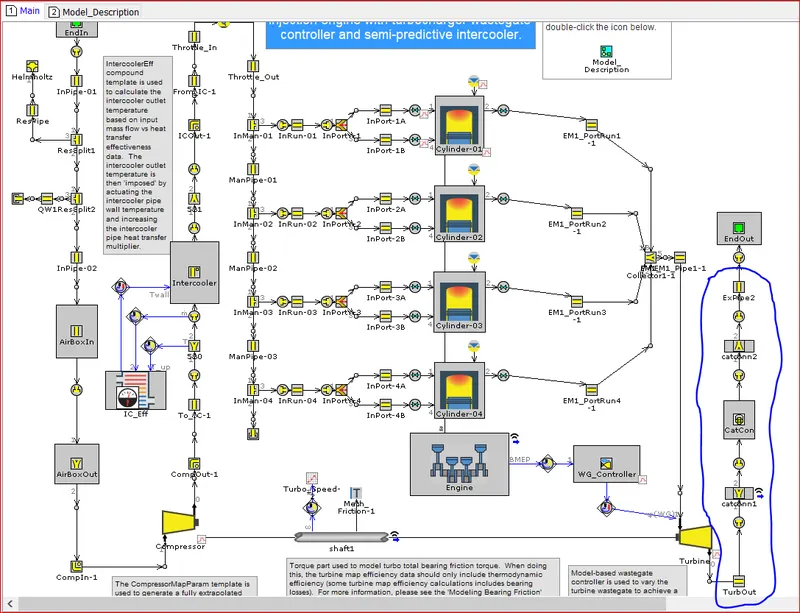
In step 2, Exhaust Pipes 1 tag is implemented with 'Simplify for Accuracy' hence simplifying two catalyst (after turbo) and corresponding pipe and orifice connections into single catalyst as shown in above and below image.
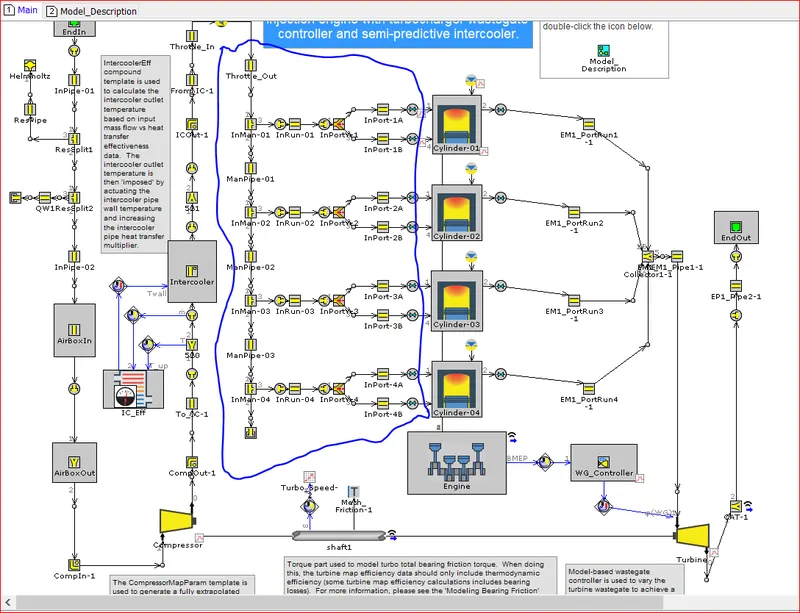
In step 3, Intake Manifold 1 tag is implemented with 'Simplify for Accuracy' hence simplifying dual valve per cyclinder, corresponding intake port and runner and runner-manifold junctions into single junction single valve per cylinder system, as shown in above and below image..
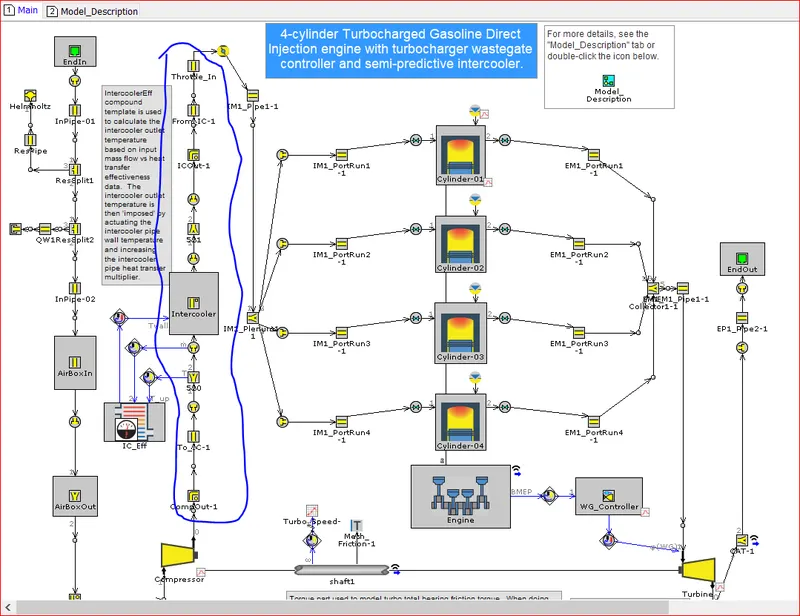
In step 4, Boost Pipes 1 tag is implemented with 'Simplify for Accuracy' hence simplifying system downstream compressor from intercooler, corresponding pipe, orifice and throttle body are simplified to only pipe connections, as shown in above and below image.
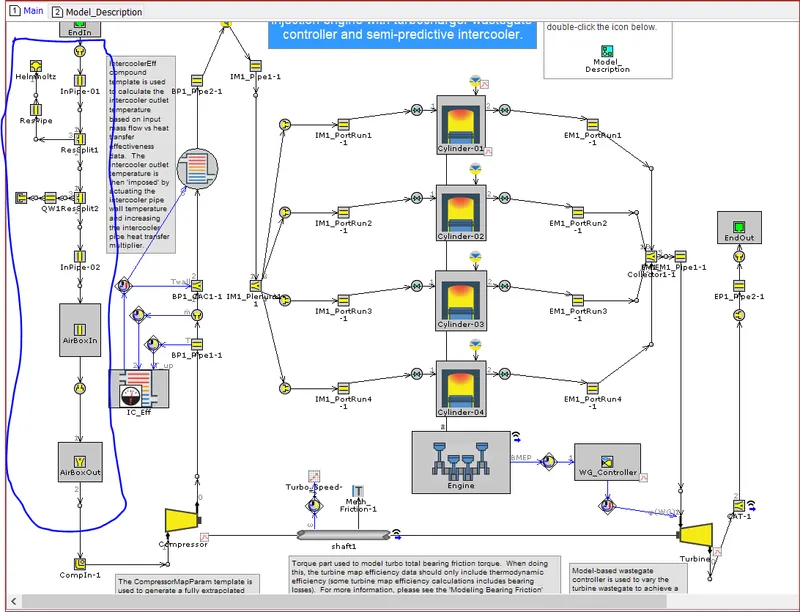
In step 5, Intake Pipes 1 tag is implemented with 'Simplify for Accuracy' hence simplifying system upstream compressor from helmholtz resonator, air filter and corresponding piping are simplified to only pipe connections, as shown in above and below image.
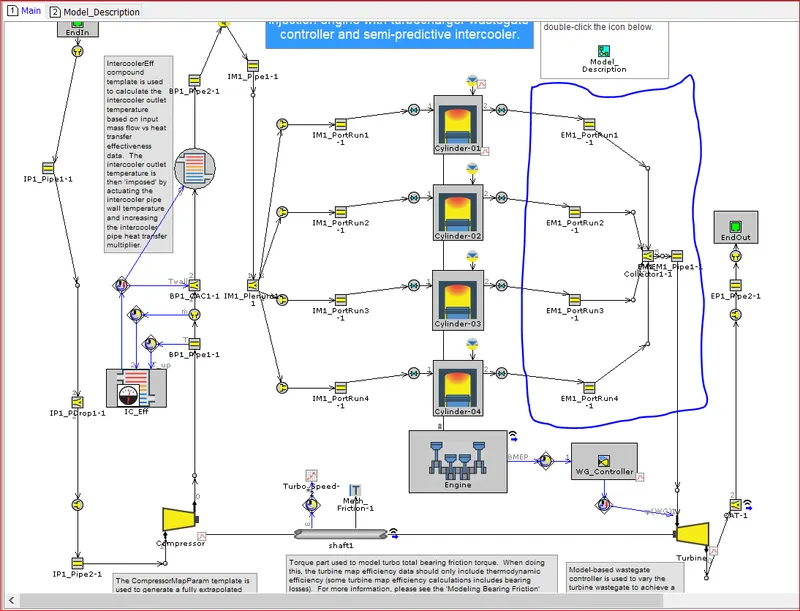
In step 6, Exhaust Manifold 1 tag is implemented with 'Simplify for Speed' hence simplifying exhaust port, exhaust manifold and corresponding pipe into single junction system, as shown in above and below image.
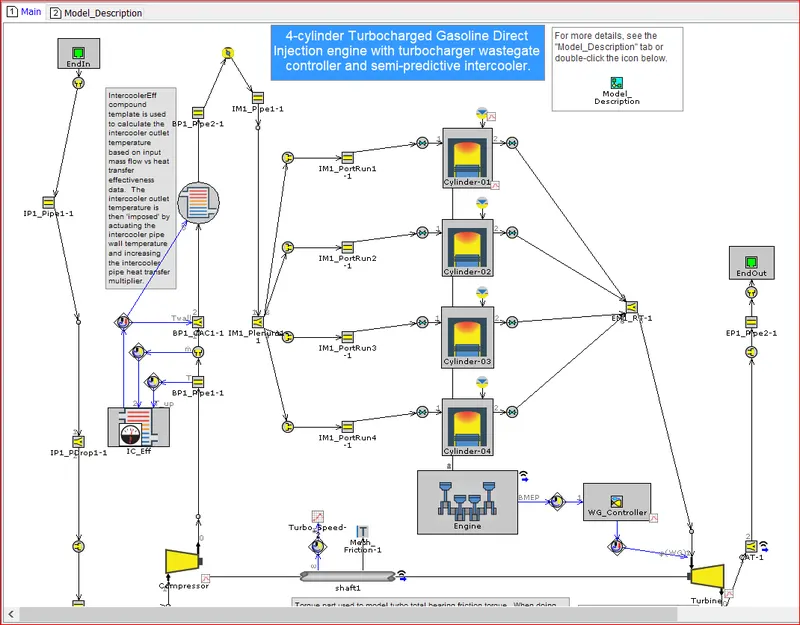
In step 7, Cylinder Slaving is carried to further improve speed as with that results of master cylinder is mapped on to all remaining cylinders.
In step 8, RT Solver is used to further improve speed by providing extensively designed fast solving models. RT Solver comes with some limitations due to which RLTs are ignored.
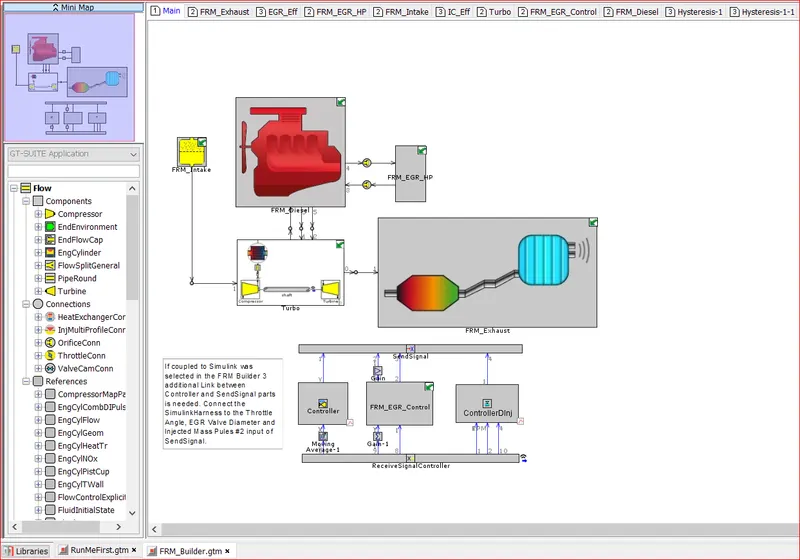
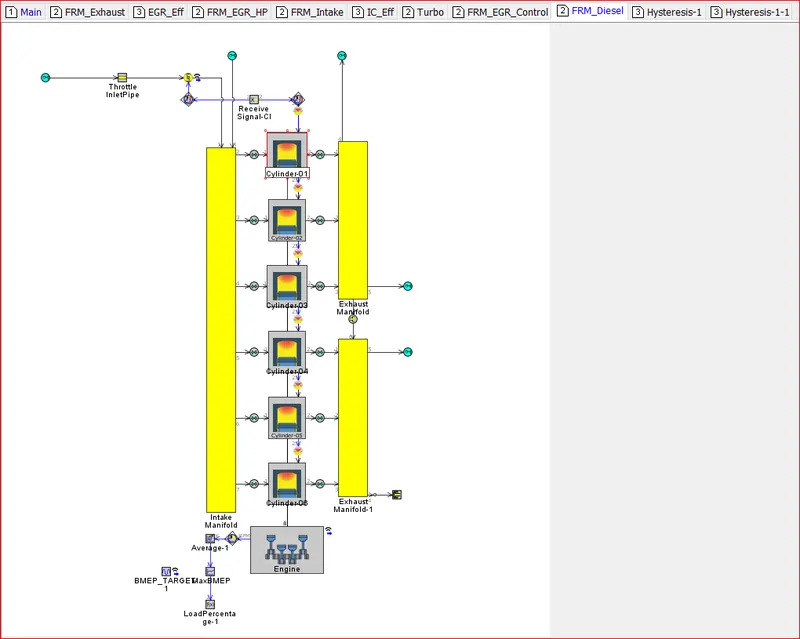
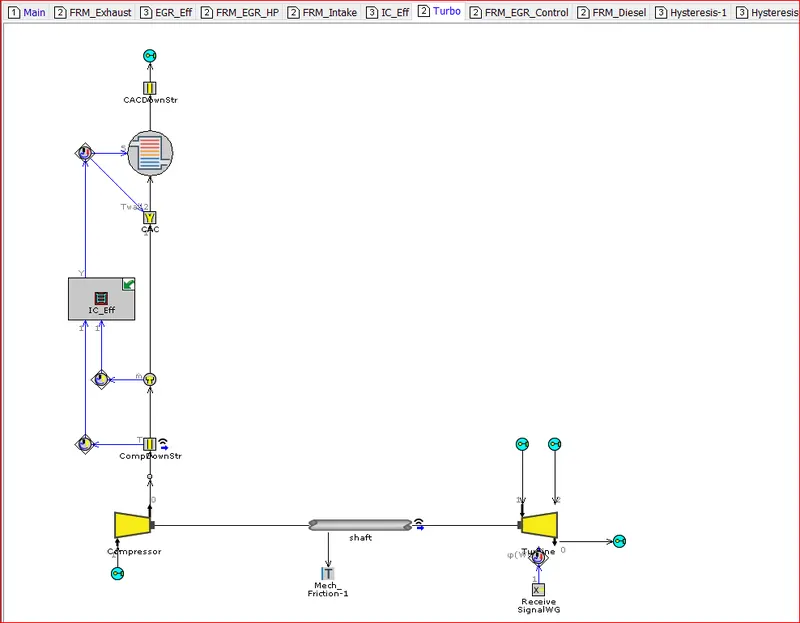
2. Build FRM Model for following configuration using FRM builder approach (50 marks)
- Bore 102 mm stroke 115 mm CR 17
- No of cylinder 6
- CI engine
- Twin Scroll Turbine
- GT Controller
3. Run all cases