Week-7 Challenge: EV Model using DC7 block & DC Motor Control
AIM:
To make an EV model using DC7 block
OBJECTIVE:
# To Run MATLAB demo Speed control of a DC motor using BJT H-bridge
# Comparing Four-Quadrant Chopper DC Drive (DC7) block with H-bridge model
# To make an EV model using DC7 block
Problem 1: To Run MATLAB demo Speed control of a DC motor using BJT H-bridge
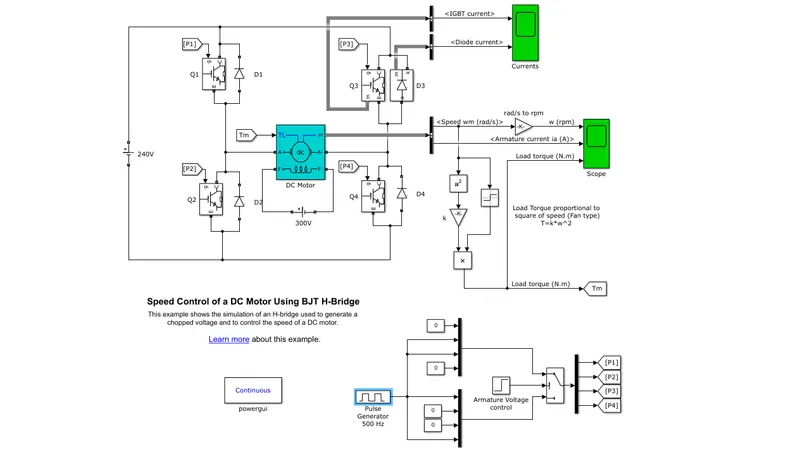
# The above speed control of a DC motor using the BJT H-bridge model is opened using Matlab.
# The armature means voltage can be varied from 0 to 240 V when the duty cycle (specified in the Pulse Generator block) is varied from 0 to 100%.
# The H-bridge consists of four BJT/Diode pairs (BJT simulated by IGBT models).
# Two transistors are switched simultaneously: Q1 and Q4 or Q2 and Q3. When Q1 and Q4 are fired, a positive voltage is applied to the motor, and diodes D2-D3 operate as free-wheeling diodes when Q1 and Q4 are switched off.
# When Q2 and Q3 are fired, a negative voltage is applied to the motor, and diodes D1-D4 operate as free-wheeling diodes when Q2 and Q3 are switched off.
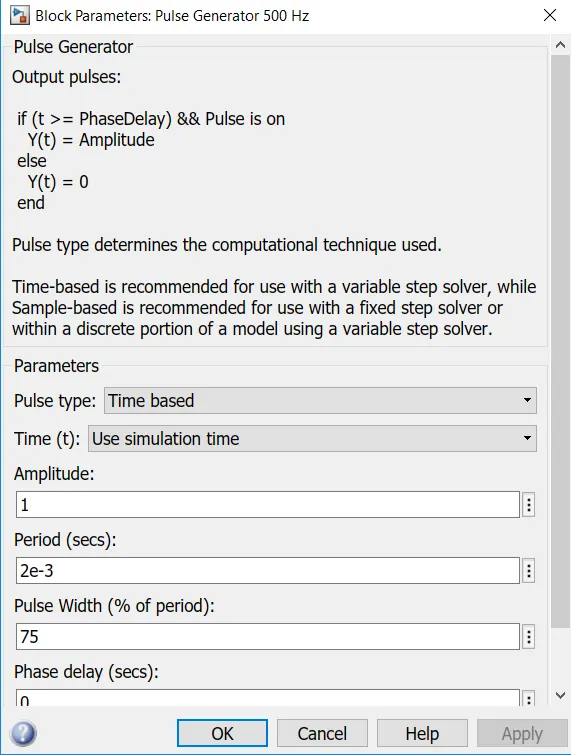
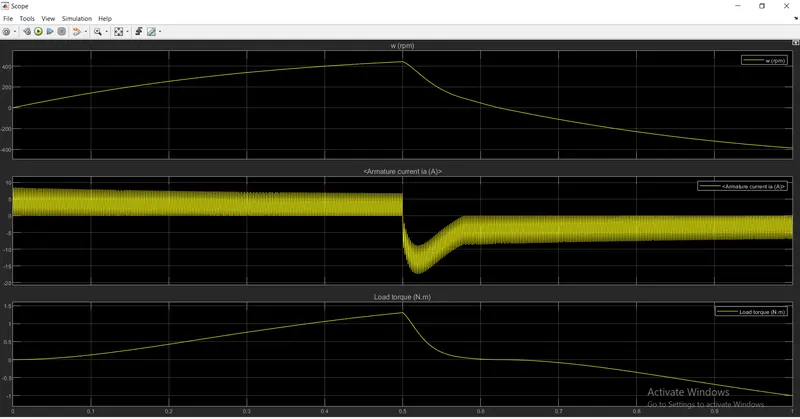
# The motor starts in a positive direction with a duty cycle of 75% (mean DC voltage of 180V). At t= 0.5 sec., the armature voltage is suddenly reversed and the motor runs in the negative direction.
# 'Scope' shows motor speed, armature current, and load torque and 'Currents' shows currents flowing in BJT Q3 and diode D3.
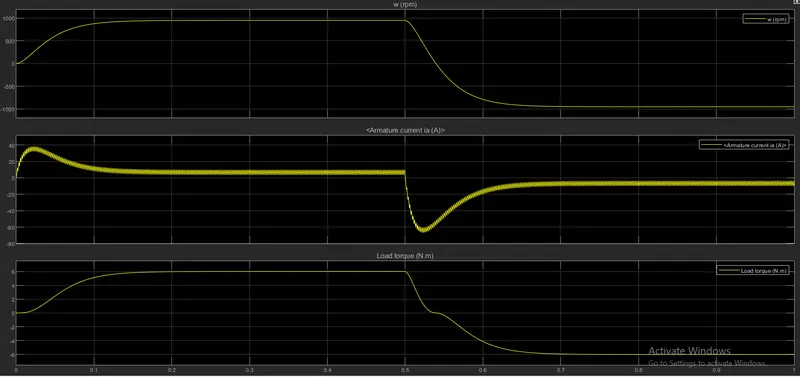
From the above second graph, the armature current shoots up suddenly when the motor rotates in the opposite direction.
# To Armature shoot up is due to back EMF.
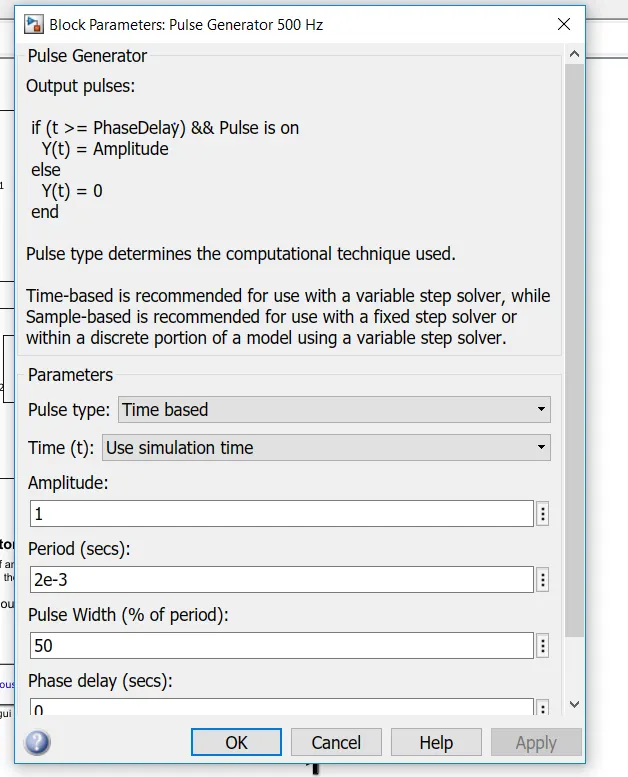
# To reduce the back EMF, the voltage should be reduced where the ON condition of the switch should be decreased.
# To change that duty cycle change with respect to the width of amplitude that is 50%
The above graph shows the armature current of motor runs smoothly in its operation.
Problem 2: Comparing Four-Quadrant Chopper DC Drive (DC7) block with H-bridge model
DC Drive(DC7):
# The Four-Quadrant Chopper DC Drive (DC7) block represents a four-quadrant, DC-supplied, chopper drive for DC motors
# This drive features closed-loop speed control with the four-quadrant operation
# The speed control loop outputs the reference armature current of the machine
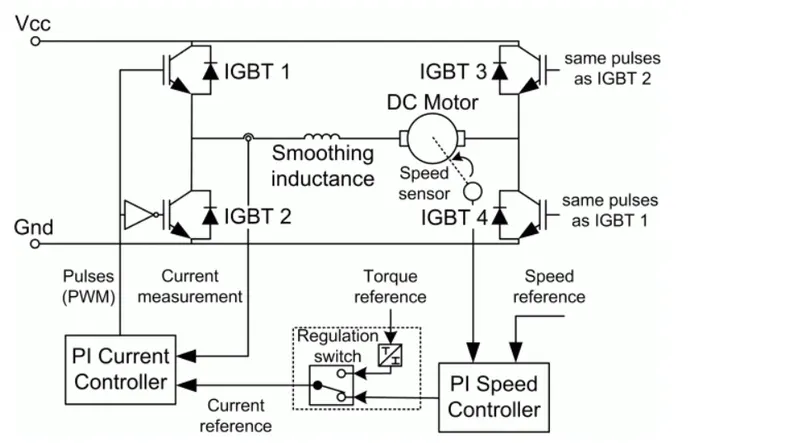
# Using a PI current controller, the chopper duty cycle corresponding to the commanded armature current is derived
# This duty cycle is then compared with a sawtooth carrier signal to obtain the required PWM signals for the chopper.
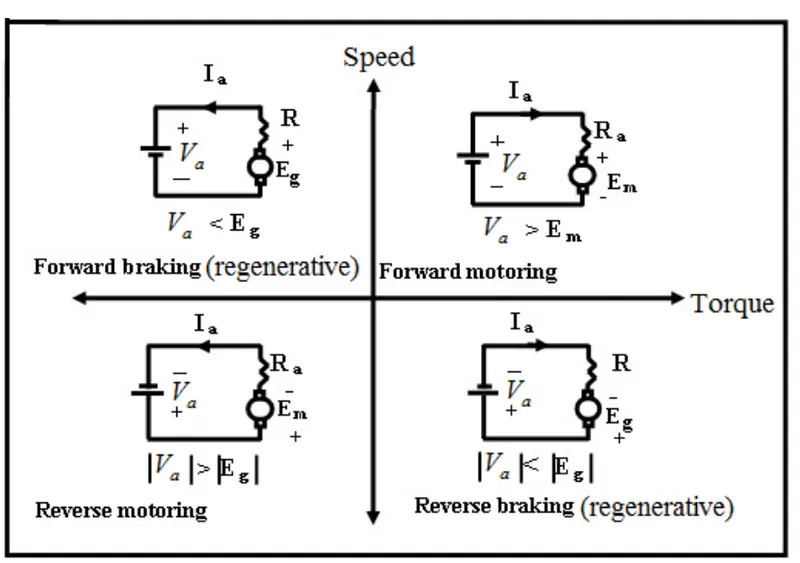
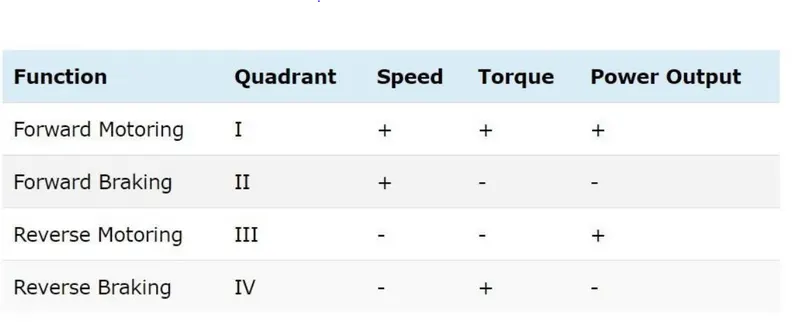
# The main advantage of this drive, compared with other DC drives, is that it can operate in all four quadrants (forward motoring, reverse regeneration, reverse motoring, and forward regeneration)
# In addition, due to the use of high switching frequency DC-DC converters, a lower armature current ripple (compared with thyristor-based DC drives) is obtained
# Four switching devices are required, which increases the complexity of the drive system.
Difference between H-bridge and DC7 block
# In H-Bridge we need to reverse the polarity of the current in order to change the rotation of the motor whereas in the DC7 block it uses the reference speed to change the direction of rotation.
# Due to the back emf, the current shoot up disturbances are high in H-Bridge.
# The H-Bridge operates only in two modes include Forward motoring and Reverse motoring whereas the DC 7 will work in Four operating conditions includes Forward Motoring, Forward Braking, Reverse Motoring, Reverse Braking.
Problem 3: To make an EV model using DC7 block
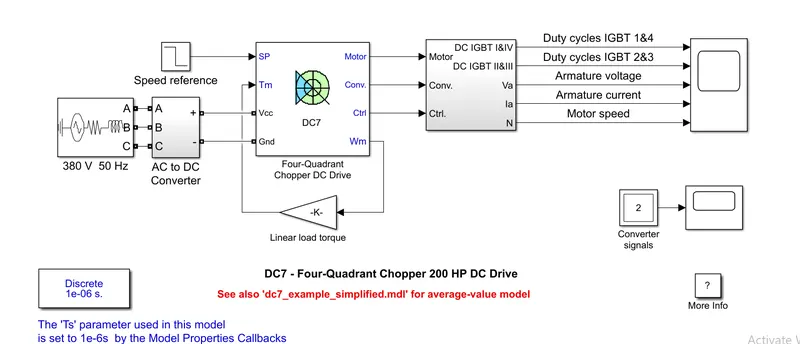
To make the EV MODEL Four Quadrant chopper 200HP DC Drive is used.
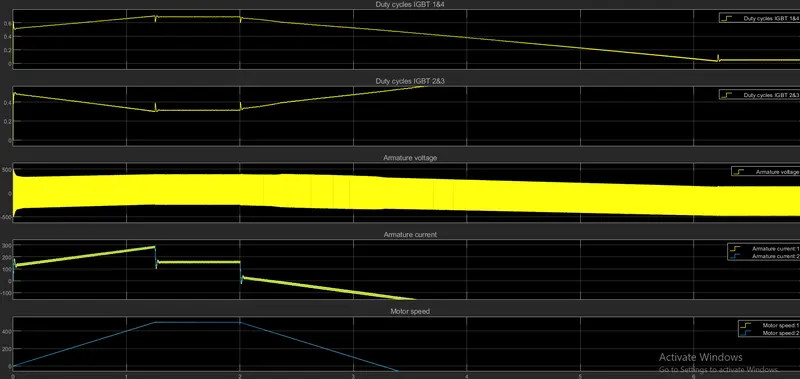
The above graph shows the default values given as input for Four Quadrant chopper 200HP DC drive
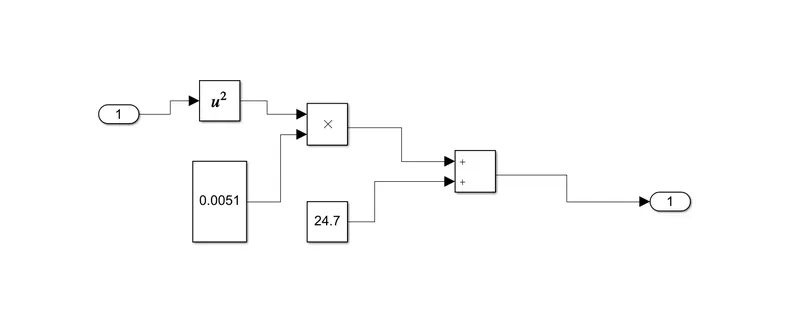
The Motor torque-speed characteristics equation is developed as a block
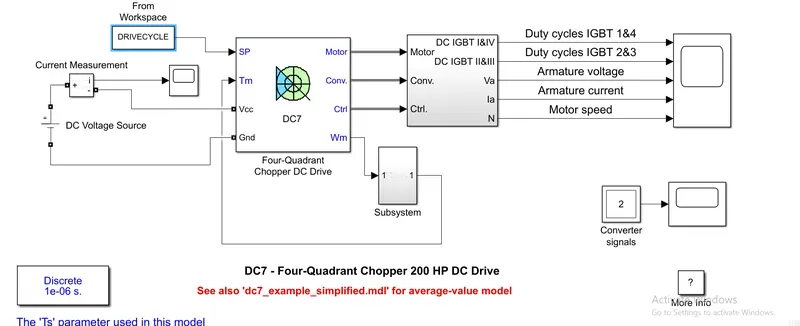
The model is recreated with giving drive cycle as input and a DC voltage source block is created for voltage supply for the EV
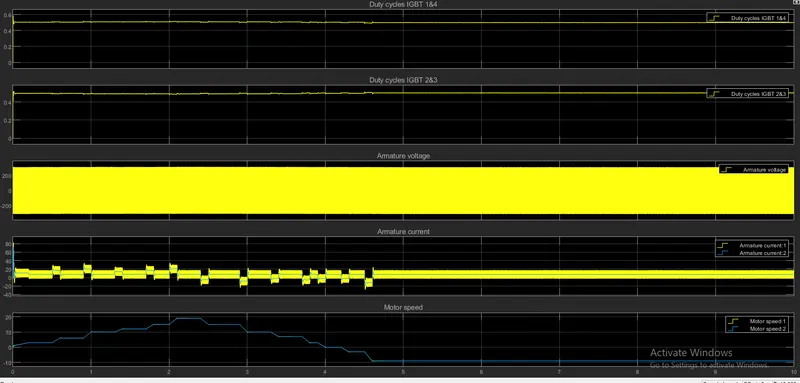
The resulting graph for a given input is shown above.
Where a constant voltage of 400 is given as input at which the speed of motor increases step by step and decreases step by step at the time the armature current increases with respect to motor speed and maintain some constant speed for some time and again shoots up with motor speed.