DC Motor Control
Speed control of a DC Motor using BJT H- bridge
Following Simulink model is an example showing Speed control of a DC Motor using BJT H- bridge.
Description: This example shows the simulation of an H-bridge used to generate a chopped voltage and to control the speed of a DC motor.
The Bipolar Junction Transistor (BJT) when used for power switching applications, operates as an IGBT. When it is conducting (BJT operating in the saturated region), a forward voltage Vf is developed between collector and emitter (in the range of 1 V). Therefore, the IGBT block can be used to model the BJT device.
The IGBT block does not simulate the gate current controlling the BJT or IGBT. The switch is controlled by a Simulink® signal (1/0). The DC motor uses the preset model (5 HP 24V 1750 rpm). It simulates a fan type load (where Load torque is proportional to square of speed). The armature mean voltage can be varied from 0 to 240 V when the duty cycle (specified in the Pulse Generator block) is varied from 0 to 100%.
The H-bridge consists of four BJT/Diode pairs (BJT simulated by IGBT models). Two transistors are switched simultaneously: Q1 and Q4 or Q2 and Q3. When Q1 and Q4 are fired, a positive voltage is applied to the motor and diodes D2-D3 operate as free-wheeling diodes when Q1 and Q4 are switched off. When Q2 and Q3 are fired, a negative voltage is applied to the motor and diodes D1-D4 operate as free-wheeling diodes when Q2 and Q3 are switched off.
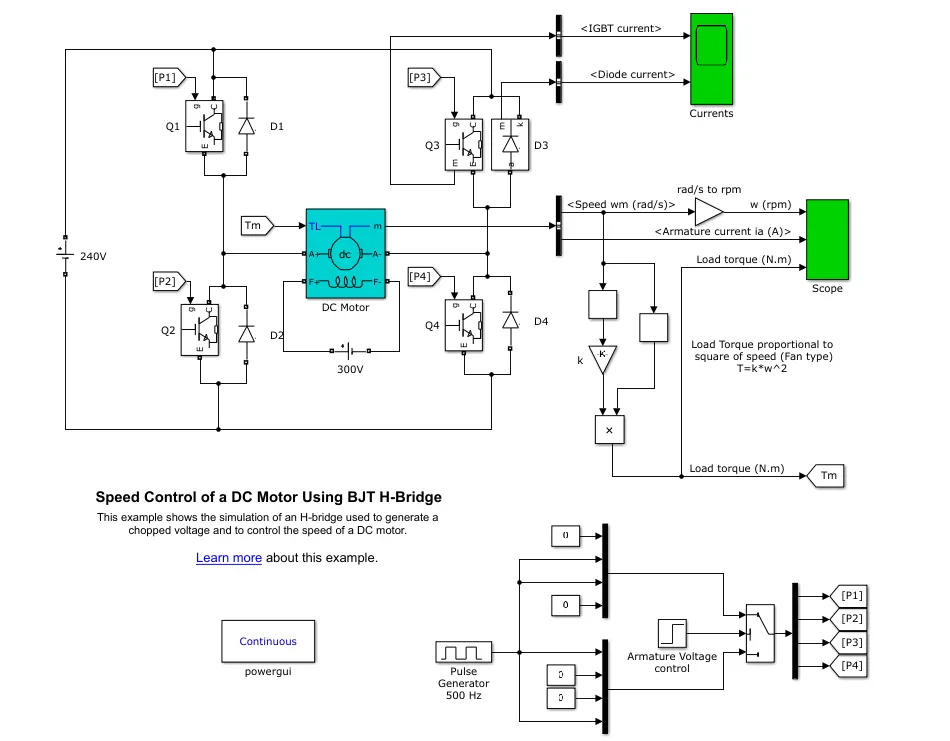
The motor starts in a positive direction with a duty cycle of 75% (mean DC voltage of 180V). At t= 0.5 sec., the armature voltage is suddenly reversed and the motor runs in a negative direction.
'Scope' shows motor speed, armature current, and load torque and 'Currents' shows currents flowing in BJT Q3 and diode D3
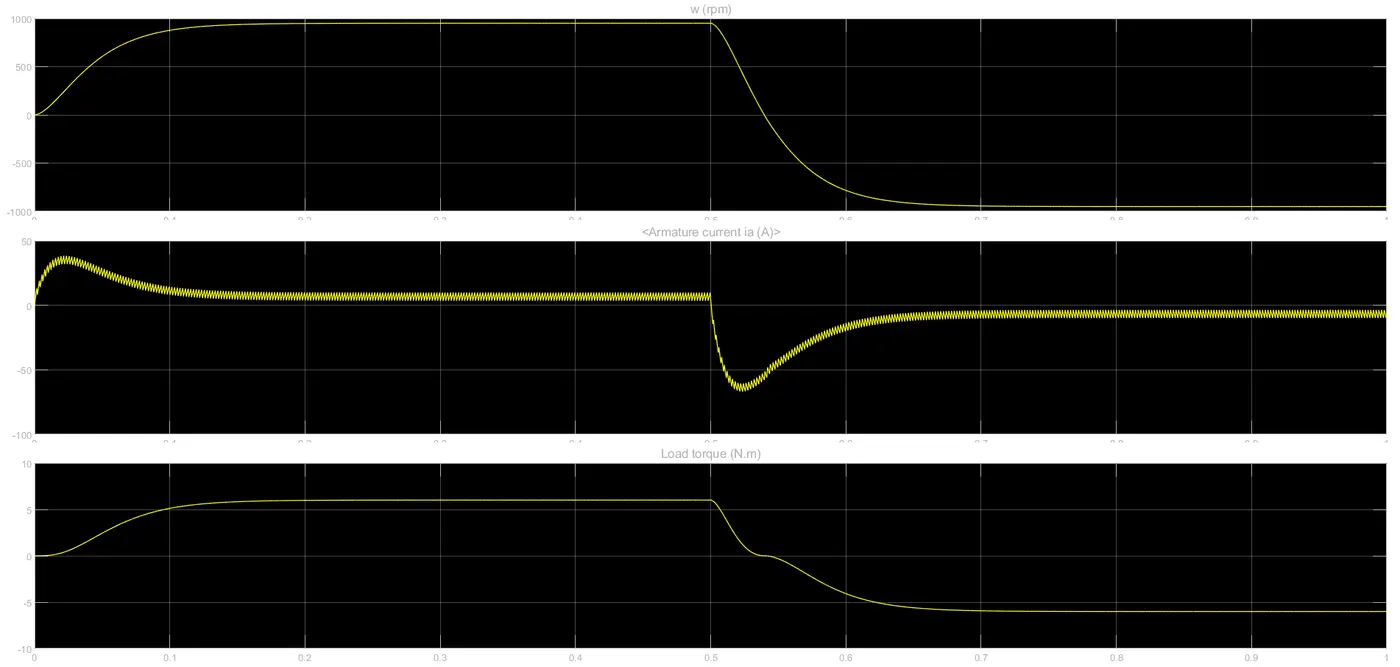
As can be seen in the above Armature current characteristics, it shoots in the negative direction when the voltage is reversed. To avoid this from happening, the duty cycle value is reduced to 40%. When the value is reduced below characteristic was obtained.
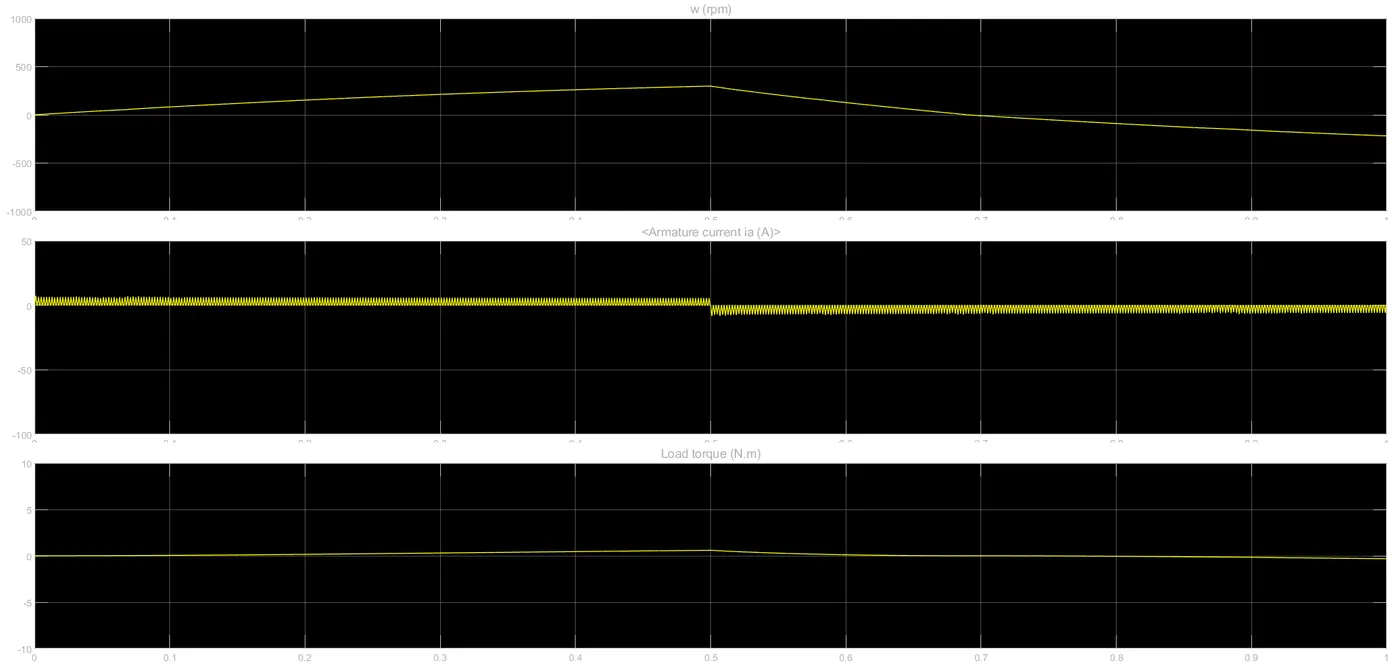
From the above results, it can be inferred that when the switching was done at a faster rate we are getting an almost constant value for current as compared to the former test where the switching was done at a slower rate.
Comparison between Four quadrant chopper and BJT H-Bridge
| S.No. | Four Quadrant Chopper | BJT H-Bridge |
| 1. |
1. Four-Quadrant Chopper can operate in all four modes (Forward Motoring Forward Braking, Reverse Motoring, and Reverse Braking). |
H-bridge can operate only in two modes (Forward and Reverse) |
| 2. | In Four-Quadrant Chopper Regenerative Braking is possible. | H-bridge Regenerative Braking is not possible. |
| 3. | in Four-Quadrant Chopper Two Pl regulator (Speed Regulator and Current Regulator is used to obtaining electromagnetic torque needed to reach the desired speed and control the armature current and stabilize the system | In the H-bridge model PI regulator is not used. |
| 4. |
Four quadrant Chopper is an electronic switch that is used to interrupt one signal under the control of another |
H-bridge is an electronic circuit that switches the polarity of the voltage applied to the load |
| 5. | Four-Quadrant Chopper circuit is used to refer to numerous type of electronic switching devices and circuits used in power control and signal applications | H-bridge circuit is often used in Robotics and other applications to allow de motor to run forward and backward |
| 6. | Four-Quadrant Chopper model gives better efficiency and high energy(power) storage than the H-bridge model | Less efficient than the former. |
EV Model using DC7 block
Construction:
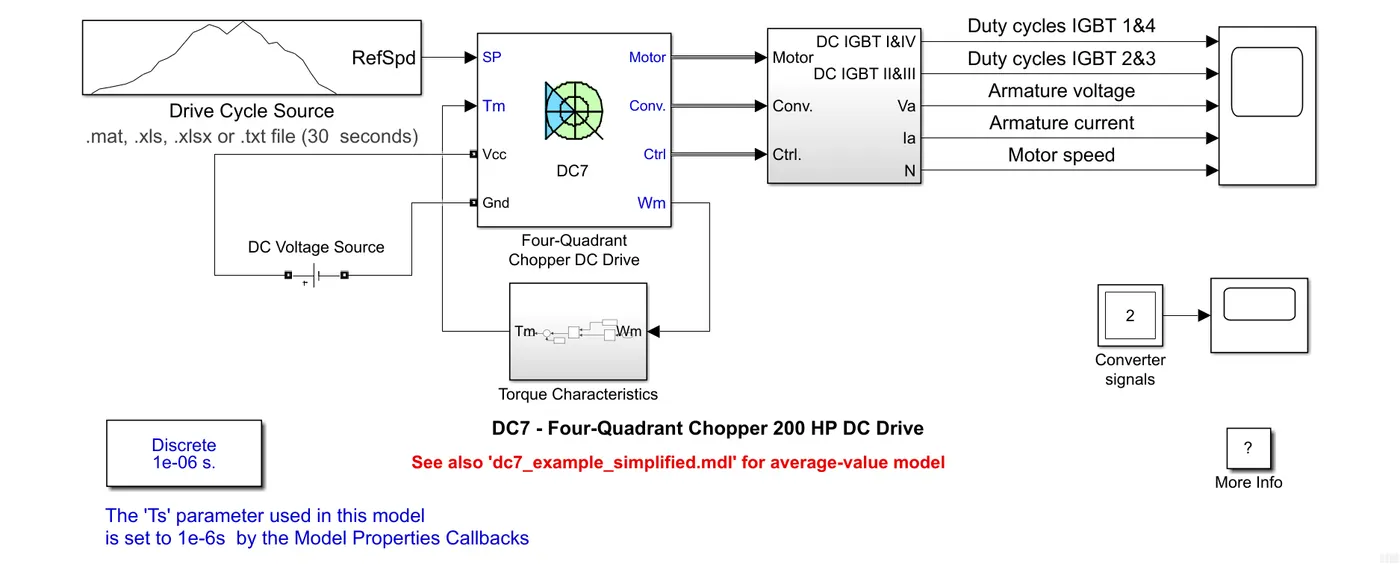
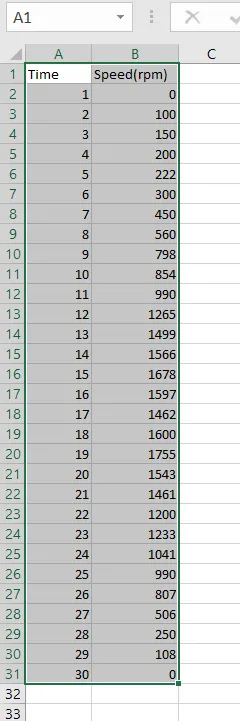
For this task, an EV is modeled using a DC7 block. In the above-shown model, a drive cycle source is used as the speed reference.
Data for the speed reference is shown below:
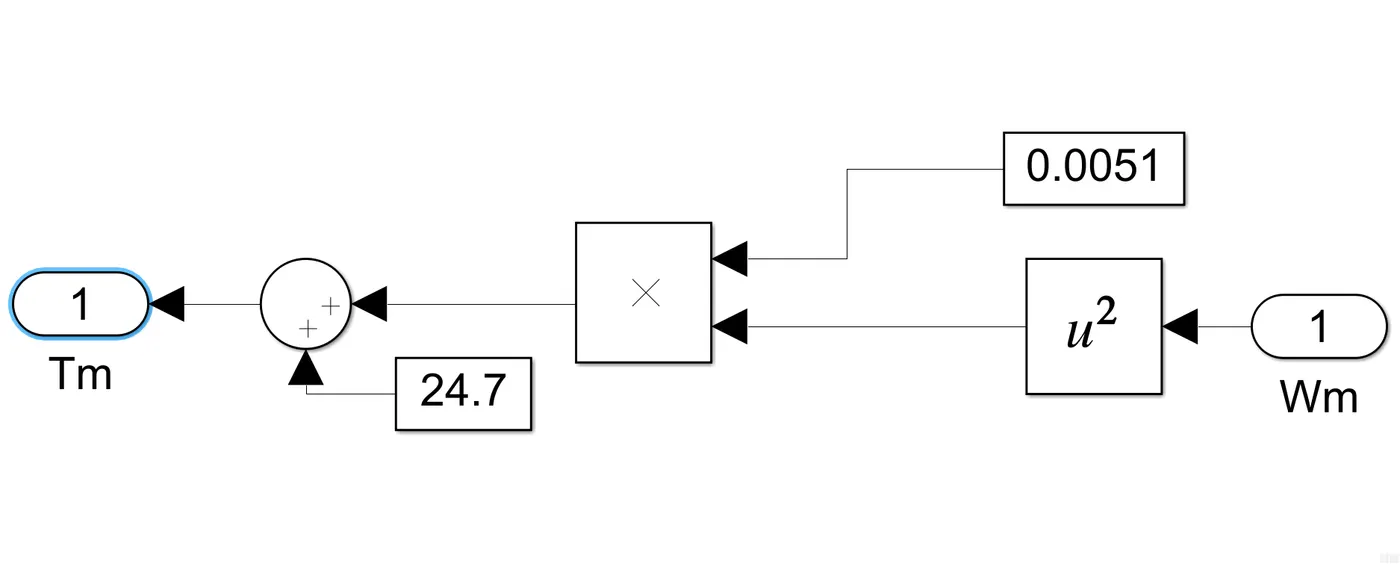
Also, the linear load torque is replaced by the following shown speed-torque characteristics:
`T_m =24.7+0.0051 omega_m^2`
Result:
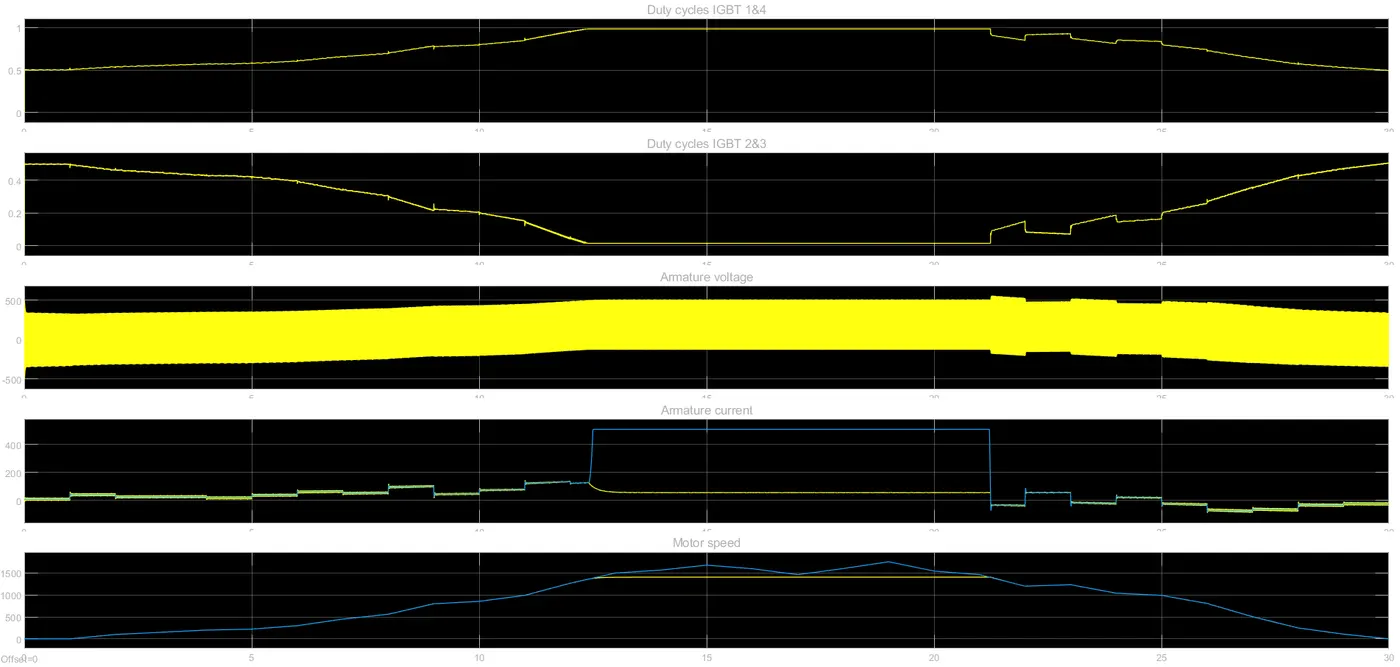
On simulating the above model following results were obtained:
Keywords: MATLAB, HEV, EV