Week 7 Challenge
1)How to fix no. of piles in the deep foundations in a flyover in Delhi, listing all the loads acting on it and making all the combinations as per IRC 6.
What are the different factors that can impact the number of piles and its depth.
How it is different in wall type abutment and pier (free and fix).
Ans:- Pile Foundation-
A Pile foundation ,a kind of deep foundation, can be defined as a slender column or long cylinder made of materials such as concrete or steel which are used to support the structure and transfer the load at desired depth either by end bearing or skin friction.
The two main types of piling are end bearing and friction piles:
- End bearing piles transmit loads directly to a deeper strong soil or rock layer some way below the surface.
- Friction piles transfer load by friction between the surrounding soil and the surface of the pile over its full length.
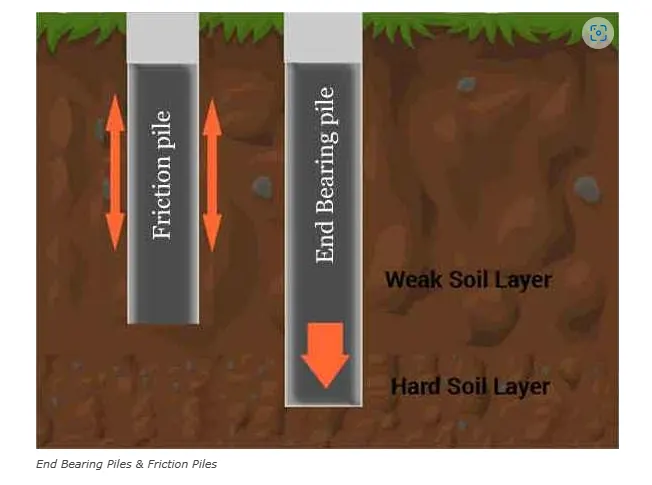
TYPES OF PILE FOUNDATION METHODOLOGY OF CONSTRUCTION
It’s important to note that the pile foundation and pile are two different things, yet they work in conjunction to ensure that piling can support strong loads. A pile foundation is typically defined as the series of columns that act as the base for structures, whereas the pile itself is the column or cylinder that aids in transferring the load to the lower subsoil.
Construction of pile foundations occurs in many different ways, with a variety of benefits and applications. However, all piles are bored or driven into the ground one way or another. There are a four main types of pile foundation, each with its own method of construction:
- Driven piles
- Bored piles
- Driven and cast-in-situ piles
- Aggregate piles
Read on to learn about these different pile foundation types, or use the links above to navigate to a particular type.
Driven piles
Driven piles are the classic type of pile foundation. They can be constructed with timber, a technique centuries old and still used across the globe. In the UK, timber piling is used mainly for coastal works, sea defence and jetties. Another option is precast concrete piles, reinforced to withstand driving stresses, they are usually pre-pressed with a square or octagonal section. Lastly, there are steel piles of tubular, box, or H section. Interlocking steel sheet piles are also widely used, predominantly for wall construction.
With each of these materials, the piles are driven into the soil, pushing an equal volume of soil sideways and compacting a zone around the pile, increasing its bearing capacity. For this increase in soil strength to take place, the pore water pressures must dissipate by rapid drainage. This type of piling is not suitable for saturated or silty soils as they drain slowly and can not be compacted in the same way.
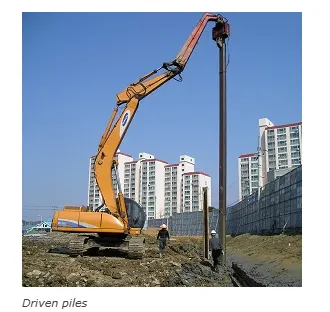
Bored piles
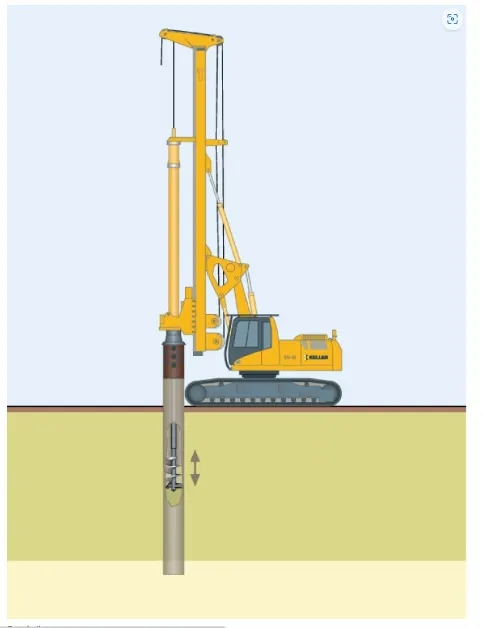
Bored piles, also known as replacement piles or drilled piles, are constructed when large holes are drilled in the ground and filled with concrete. Bored piles are very effective as they transfer the load above ground to the deep rock and soil layers below with minimal settlement, which is ideal for supporting structures such as bridges and flood protection.
For some bored piles, the bottom of the hole is widened or under-reamed, creating a bulb at the end. A steel reinforcement cage is lowered into the hole before the concrete is placed or dropped in after the concrete has been poured.
Within the category of bored pile foundations, the two commonly used subtypes are rotary bored piling and Continuous Flight Auger (CFA) piling:
- Rotary bored piling is used in cases where there are significant obstructions in the ground. A temporary casing is installed by the piling rig to provide support. ‘Pile arisings’ (ground and rock removed via boring process) are removed from inside the casing, then a steel reinforcement cage is installed. At this point, the hole is filled with concrete and the casing is removed.
- Continuous Flight Auger (CFA) piling does not require the use of temporary casing – it is the most versatile, effective and commonly used type of bored pile foundation in the UK. Once the hole has been bored, concrete is pumped in, then a steel reinforcement cage is inserted.
1)How to fix no. of piles in the deep foundations in a flyover in Delhi, listing all the loads acting on it and making all the combinations as per IRC 6.
Fixing the number of piles is the ratio of safe bearing capacity of the soil upon the pile capacity
Mathematically,
No. of piles=SBC/Pile capacity
Following are the situations which impact the deciding the number of piles and its depth:-
- When ground water table is high
- Heavy and non uniform loads from superstructure are imposed
- Other types of foundations are not feasible
- When the soil at the shallow depth is compressible
- Possibility of scouring
- SBC of soil and pile capacity
- Geotechnical investigation ( parameters of the soil)
- Pile parameter (size and c/c distance)
- Superimposed load from the superstructure
Following are the loads which acts on the structure with pile foundations:;-
- Dead load
- SIDL
- Vehicular Live Load
- Breaking Force
- Live Load surcharge
- Earth pressure (In abutment)
- Water Current Load.
- Wind Load.
- Temperature Load
- Earth quake load
- Barge Load
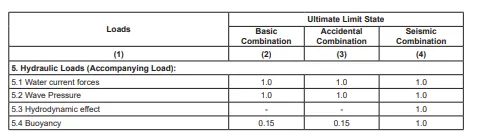
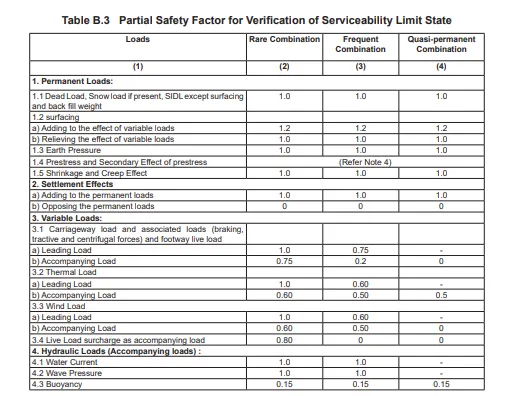
The load combination done using ULS and SLS method referring from IRC 6.
ULTIMATE LIMIT STATE
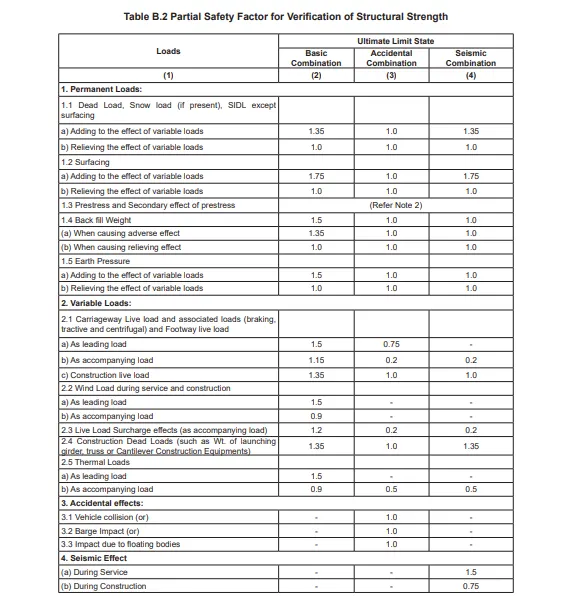
SERVICEABILITY LIMIT STATE
Following are the situations which impact the deciding the number of piles and its depth:-
- When ground water table is high
- Heavy and non uniform loads from superstructure are imposed
- Other types of foundations are not feasible
- When the soil at the shallow depth is compressible
- Possibility of scouring
- SBC of soil and pile capacity
- Geotechnical investigation ( parameters of the soil)
- Pile parameter (size and c/c distance)
- Superimposed load from the superstructure
How it is different in wall type abutment and pier (free and fix)
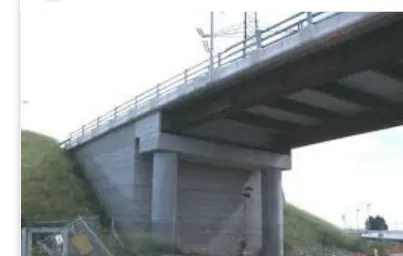
Fig- wall type abutment
In wall type abutment earth pressure is generally more which causes maximum overturning moment due to Active earth pressure
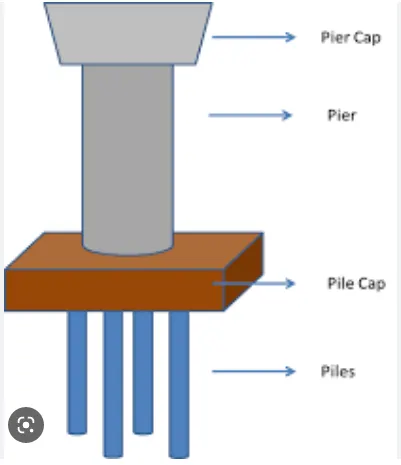
In case of pier there will be no over turning moment due to Earth Pressure
2)How to fix the diameter of well in the deep foundation in a river bridge in Delhi, listing all the loads acting on it and making all the combinations as per IRC 6.
What are the different factors that can impact the diameter of well and its depth.
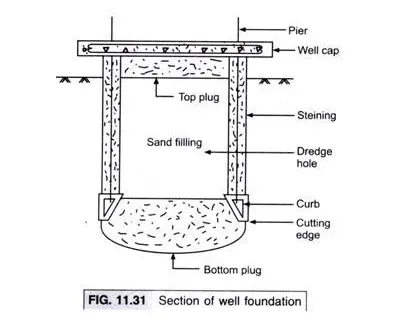
Well Foundations:-
Well foundation is a type of deep foundation which is generally provided below the water level for bridges. Cassions or well have been in use for foundations of bridges and other structures since Roman and Mughal periods.
The term ‘cassion’ is derived from the French word caisse which means box or chest.
Hence cassion means a box like structure, round or rectangular, which is sunk from the surface of either land or water to some desired depth.
The cassions are of three types:
(i) Box cassion:
It is open at the top and closed at the bottom and is made of timber, reinforced concrete or steel. This type of cassion is used where bearing stratum is available at shallow depth.
(ii) Open cassion (wells):
Open cassion is a box opened both at top and bottom. It is made up to either timber, concrete or steel. The open cassion is called well. Well foundation is the most common type of deep foundation used for bridges in India.
(iii) Pneumatic cassions has its lower end designed as a working chamber in which compressed air is forced to prevent the entry of water and thus excavation can be done in dry conditions.
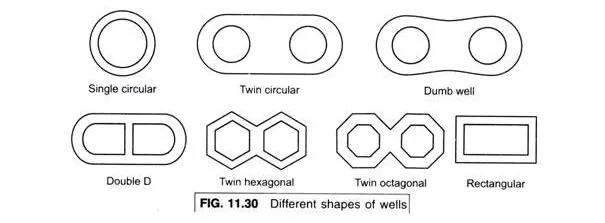
Shapes of Wells:
The common types of well shapes are:
(i) Single circular
(ii) Twin circular
(iii) Dumb well
(iv) Double-D
(v) Twin hexagonal
(vi) Twin octagonal
Forces Acting On a Well Foundation:
(i) Braking effort of the moving vehicle.
(ii) Force due to the resistance of bearings against movement due to temperature variations.
(iii) Force of water current
(iv) Seismic forces
(v) Wind force
(vi) Earth pressure.
Following are the loads which acts on the structure with well foundations:;-
- Dead load
- SIDL
- Vehicular Live Load
- Breaking Force
- Live Load surcharge
- Earth pressure (In abutment)
- Water Current Load.
- Wind Load.
- Temperature Load
- Earth quake load
- Barge Load
The load combination done using ULS and SLS method referring from IRC 6.
ULTIMATE LIMIT STATE
SERVICEABILITY LIMIT STATE
What are the different factors that can impact the diameter of well and its depth.
- Sinking process.
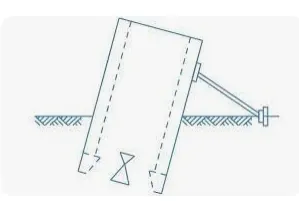
- Tilt and shift of well .
- Depth of Ground water table.
- Scouring depth.
- Soil parameters and properties
What is free standing length in a pile system and how to determine this.
Also list all the applicable code clauses from IRC and IS codes.
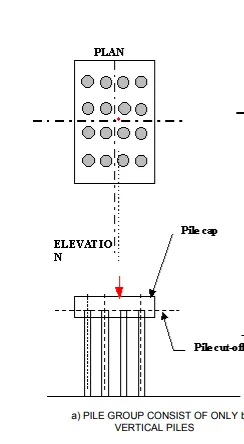
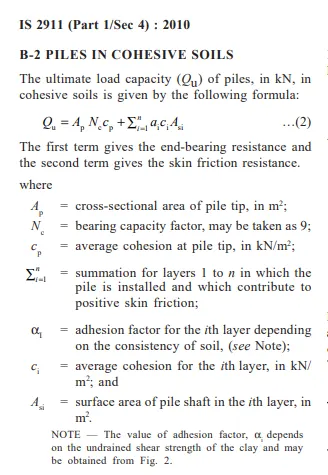
Piles are mostly installed in groups, it can be divided into two main types based on the connectivity of the pile cap with the underlying soil, freestanding groups, in which the pile cap is not in contact with underlying soil and piled foundations, in which the cap is in contact with the underlying soil . For both types of pile groups, it is naturally expected that piles interact and influence each other’s capacity.In case of raft in contact with underlying soil, the interaction between the raft-soil and the pile group depends upon several factors like the geometry of the raft, type of soil, pile length and spacing between piles. Understanding of this interaction is more complicated than the free-standing pile group as the raft in contact with the ground influences the confining pressure, making the interaction behavior more complicated. The complex interaction can become favorable like increase in the group capacity or unfavorable like causing additional settlement
Important clauses we is use in the Code are:
In IRC 78: Clause no 703 Details on (discharge and depth of scouring for foundation desing) is used to find free standing length in pile system.
In IRC 78: Clause no 706 - loads, forces, stability and stress in foundation design.
In IRC 78: Clause no 708 -detail about well foundation.
In IRC 78: Clause no 709 - detail about Pile foundation.
IS 2911 part 1- about pile foundation design and construction.
What will be the impact of free-standing length on the full length of the pile.
Roughly determine no. of piles on abutment of height 5 m and width of 12 m.
Vertical capacity – 250 tonnes
Horizontal capacity-35 tonnes
Given Data:-
Height of the Pile-5m
Width-12m
Vertical Capacity-250t
Horizontal Capacity-35t
No. of Piles on Abutment=Total load from structure / Veritical capacity
Let us assumme Total Load=5000T
No. of Piles on Abutment=5000/250=20 no. of piles
List out failures in deep foundations and their remedies as per the codal provisions.
What all construction parameters need to be taken care of before planning a deep foundation
Some common causes of the failure of the foundation and some remedial measures for such failures are the following:-
The main causes of failure of foundation are listed below:
- Unequal settlement of the sub-soil.
- Unequal settlement of the masonry.
- Horizontal movement in adjoining soil.
- Withdrawal of moisture from the sub-soil.
- Lateral pressure on the super-structure.
- Action of atmospheric agencies.
- Lateral escape of the soil from below the foundation
- Tilt and Shift Failure
- RCC Failure
- Pcc failure
- Pressure bulb
Remedies:-
- Foundation should be made to rest on hard base of rock or hard moorum.
- Safe bearing capacity of the sub-soil should not be allowed to be exceeded even under worst possible conditions.
- Loading on foundation should be maintained axial. If there is some eccentricity it should be less than b/6 of the wall, where 6 is the width of foundation. Intensity of maximum pressure should remain less than the safe bearing capacity of the sub-soil.
- Early repair such as encasement or replacement
- Removal of partial load
- Underpinning
- Protective works i.e. cofferdam, sheet pilling to be done around the foundation.
- Bottom plug sink & top plugging in case of well.