Week 6 Challenge-FVM Fundamentals 101
Aim : FVM Fundamentals 101
1. Derive the expression for the ∂f∂x∂�∂� for a forward difference of second order
The Taylor expansion of `f _(i + 1)` is given by:
`f _(i + 1) = f _(i) + f ' _(i) Δ x + f ' ' _(i) Δ x^ 2/ (2 !) + f ' ' ' _(i) Δ x^ 3 /(3 !)` + ... (1)
Similarly, the Taylor expansion of `f _(i - 1)` is given by:
`f _(i - 1) = f _(i) - f ' _(i) Δ x + f ' ' _(i) Δ x^ 2/ (2 !) - f ' ' ' _(i) Δ x^ 3 /(3 !)` + ... (2)
Now subtracting Eqn(1) with Eqn(2) and neglecting the higher-order terms, we get:
`f_( i + 1) − f _(i − 1) = 2 f '_ i Δ x + O ( Δ x^ 3 )` (3)
Now, finally dividing Eqn(3) with `2 x` on both sides, we get,
`(f _(i + 1) − f _i )/(2 Δ x) = f ' i + O ( Δ x^ 2 )`
---------
2. Apply the finite volume formula to the equation `(∂ ρ ϕ) / (∂ t) + ∇ . ( ρ u ϕ ) = 0`
For Finite Volume Formulation , here we would be using Gauss Divergence theorem, which helps us convert volume integrals into surface integrals and vice versa
The given differential equation is of the form '(∂ ρ ϕ) / (∂ t)+ ∇. (ρ u ϕ) = 0' (1)
Applying Intergration on Eqn(1) on both sides, we get:
`∫ ( ∂ ρ ϕ ) /( ∂ t) + ∫ ∇ . ( ρ U ϕ ) = 0` (2)
Now, multiplying by dV on both sides, we get:
`∫ ( ∂ ρ ϕ ) /( ∂ t) dV + ∫ ∇ . ( ρ U ϕ ) dV = 0` (3)
Now, we can apply Gauss Divergence Theorem and re-write the Eqn(3) as,
`∂/ (∂ t) ∰ ρ ϕ d V + ∯ ρ Uϕ^ → d S^→ = 0` (4)
The above Eqn(4) is the required equation
---------
3. Write a note on the van Leer TVD scheme ((Hint: Use Sweby Diagram)
Total Variation Diminishing :
- Total Variation Diminishing (TVD) schemes are numerical methods used in computational fluid dynamics to solve hyperbolic partial differential equations
- TVD schemes are crucial for advection problems, offering stability without introducing numerical artifacts such as excessive diffusion or compression
- In OpenFOAM, convection schemes, including TVD, are based on Normalized Variable (NV) and TVD methods, emphasizing their significance in various simulations
Van-Leer TVD Scheme :
- It is the original limited advection scheme described by the limiter function
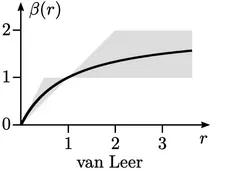
- `\beta = (r+\|r|)/(1+|r|)`
- Since `\beta -> 2` as `r -> \infty`, the van Leer scheme uses relatively strong downwind interpolation.