EV Drivetrain
AIM:
To find the duty ratio for acceleration operation and for the braking operation
Objective:
# To find the types of power converter circuits used in electric and hybrid vehicles
# To find the duty ratio for acceleration operation and for the braking operation
# To write about the view of the author perspective about the induction motor and DC brushless motor
Case 1: Types of power converter circuits are employed in electric and hybrid electric vehicle
Power converter: A power converter is an electrical circuit that changes the electric energy from one form into the desired form optimized for the specific load. A converter may do one or more functions and give an output that differs from the input.
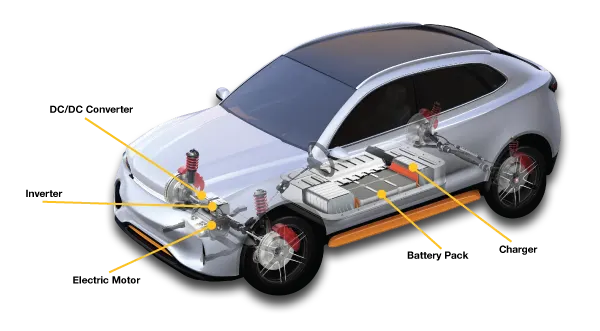
Power converter circuit in Electric car:
1. DC-DC converter
2. DC-AC inverter
# DC-AC inverter
An inverter is a device that converts DC power from the battery to AC power used in an electric vehicle motor. The inverter can change the speed at which the motor rotates by adjusting the frequency of the alternating current.
# DC-DC converter
DC-DC converters in an electric vehicle may be classified into unidirectional and bidirectional converters. Unidirectional DC-DC converters cater to various onboard loads such as sensors, controls, entertainment, utility, and safety equipment. They are also used in DC motor drives and electric traction. Bidirectional DC-DC converters find applications in places where battery charging, regenerative braking, and backup power are required.
Power converter circuit in Hybrid Electric car:
# DC-DC converter
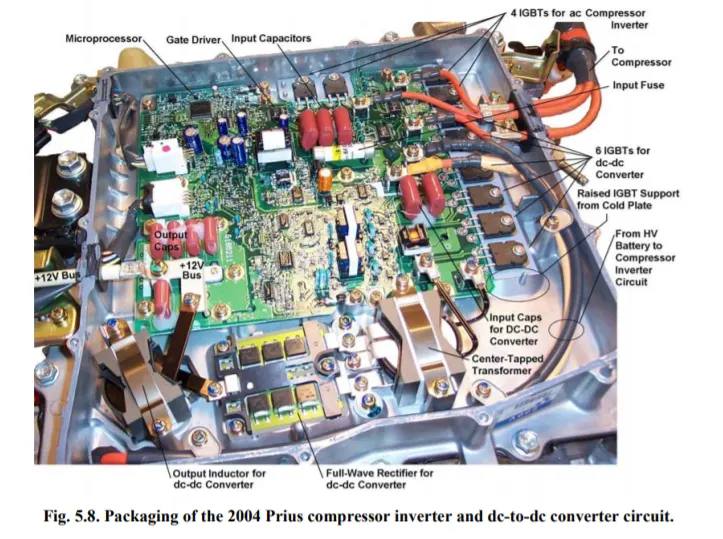
The inverter for powering the air-conditioning compressor, and the dc-to-dc converter that takes the 200–500V bus and provides 13.8V for charging the battery and powering accessories.
# DC-AC inverter
An inverter is a device that converts DC power from the battery to AC power used in an electric vehicle motor. The inverter can change the speed at which the motor rotates by adjusting the frequency of the alternating current.
Case 2: An Electric Vehicle's powertrain with 72V battery pack
Given:
# Electric vehicle powertrain with 72V battery
# d1 is acceleration operation duty ratio
# d2 is the braking operation duty ratio
# V = 72V
# I = 400A
# Resistance, Ra = 0.5 ohm
# `kphi`= 0.7 volt second
# Chopper switching frequency = 400HZ
Torque speed characteristics for avehicle is
`Tv=24.7+(0.00514)w^2`
To find:
The EV steady-state speed if the duty cycle is 70%
Soln:
Voltage of motor = voltage of armature * duty cycle = 72*0.7 = 50.4volts
`T= (V*km(phi))/(Ra)-(km(phi))/(Ra)*omega`
`T=(50.4*0.7)/0.5-(0.7^2)/0.5*omega` - equation 1
`Tv = 24.7+(0.0051)omega^2` - equation 2
Equating the 1& 2 equations
70.56-0.98omega = 0.0051omega^2+24.7
0.0051omega^2 + 0.98omega - 45.86 = 0
By using quadratic formula
`omega=(-b+-root2((b^2-4ac)/(2*a)))`
a=0.0051, b=0.98, c= -45.89
`omega=-231.08 (rad)/(sec)`
`omega=38.9 (rad)/(sec)`
We take the positive omega = 38.9 rad/sec due to motor rotates in positive direction.
Case 3: Induction Versus DC brushless motors by Wally Rippel, Tesla
From the author's perspective, he compares the DC brushless motor and induction motor performance and its build. He says that both the stator of the motor is the same only the rotors are different. The DC brushless motors rotor generates less heat comparing with the induction motor. But the power factor for the induction motor drive is 85% though the peak point energy efficiency for a DC brushless drive will be higher than for an induction drive.
peak efficiency is less than DC brushless, but average efficiency is equal for both the motors. Permanent magnets are expensive and also difficult to handle very large forces said by the author by comparing induction motors and he says induction motors are a cost advantage with this but Induction machines are more difficult to control. The control laws are more complex and difficult to understand. Achieving stability over the entire torque-speed range and over temperature is more difficult with induction than with DC brushless. This means added development costs, but likely little or no recurring costs. At final he says there is no winner and tells that DC brushless motor will dominate more in hybrid and plug-in hybrid vehicle more than pure electric vehicles.