Week-6 Challenge: EV Drivetrain
1. Which types of power converter circuits are employed in electric and hybrid electric veh
| s.no | Converter | Application |
| 1 | 3 phase inverter (DC - 3 phase AC) | 3 phase pmsm or bldc motor drive |
| 2 | Chopper (DC - DC) | For auxillary controls (head light, audio system, microcontroller) |
| 3 | Rectifier or controlled rectifier (AC - DC) | Battery charger for plugin Ev vehicles |
2. An Electric Vehicle's powertrain with 72V battery pack in shown in the diagram below. The duty ratio for acceleration operation is 'd1' and for the braking operation the duty ratio is 'd2'.
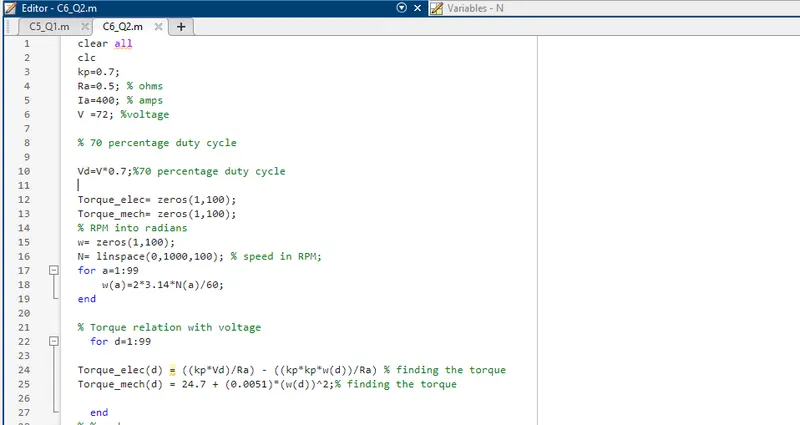
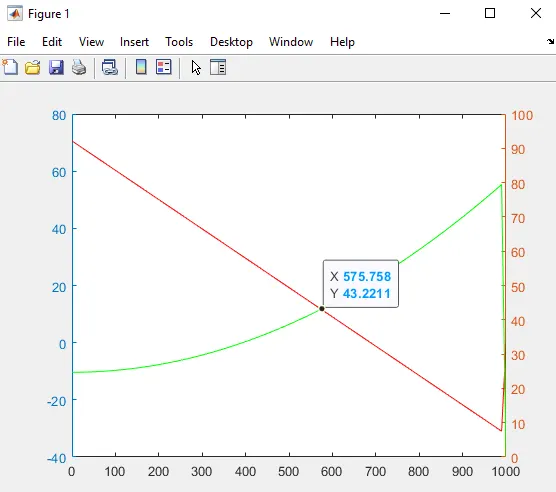
EV steady state speed if duty cycle is 70% is 575 RPM in motor
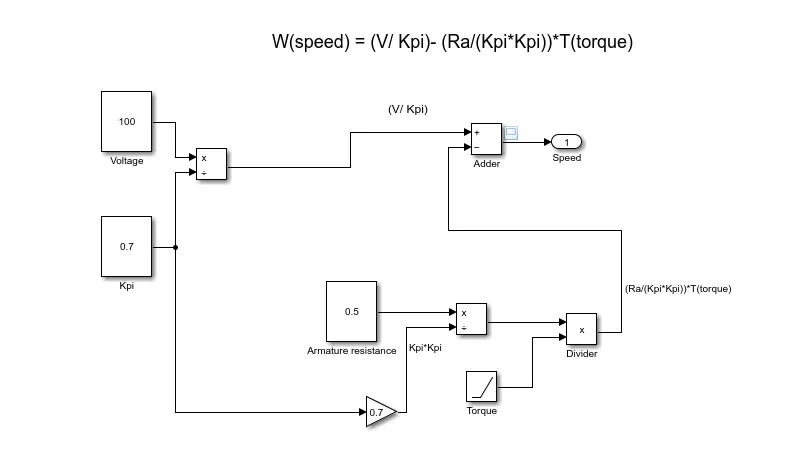
3. Develop a mathematical model of a DC Motor for the below equation using Simulink.
Torque i/p- Ramp input
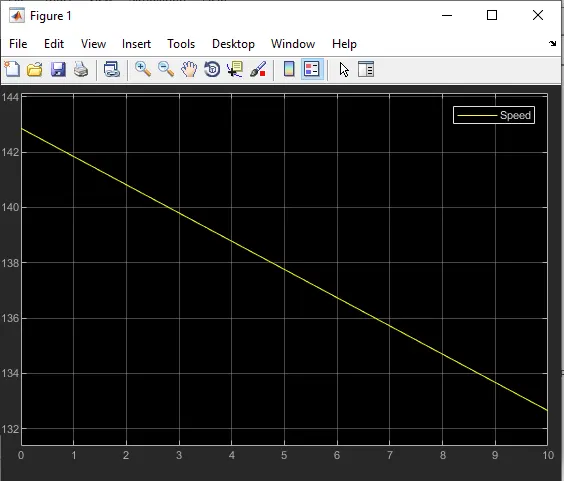
Result:
4. Refer to the blog on below topic:
Induction Versus DC brushless motors by Wally Rippel, Tesla
Explain in brief about author’s perspective.
- When author starts their carrier there were lead acid batteries, DC brush motors, and contactor controllers.
- Today this are changed by inverters ,lead acid battery and induction motors.
- the 3phase induction motor was introduced by tesla with woking in commercial voltage.
- The 3phase induction motor works on an induction principle.
- The author is comparing the 3 phase induction motor and Dc brushless motor
- Both motors have the same 3 phase distributed winding
- the change inboth are rotor.
- Induction motor rotor has no permanent it has a limited steel bar which are short circuited at the end
- when a 3phase voltage is given to the stator winding it produces a rotatingmagnetic field
- Due to induction principle the emf is generated inthe rotor bars
- Due to short circuit inthe rotor bars the current starts flowing which results inmagnetic field development
- Due to interaction of stator field and rotor field torque is developed in the rotor.
- 3 phase induction motor not requires inverter circuit. but it runs at constant speed.
- there will be speed diff between stator and rotor which is called as slip.
- slip is based on load.
- We can have V/F control in induction motor to maintain a torque.
- With the help of variable frequency drive we can control the speed of the induction motor
- With some closed loop algorithms using speed sensor we can maintain a torque.
- induction motor has low torque compared to DC motor.
- In bldc motor with out inverter it is not possible to run a motor
- Bldc motor need a inverter circuit
- Bldc motor have same stator configuration as induction motor.
- Bldc rotor have permanent magnet.
- Due to permanent magnet flux density is constant
- bldc have only stator curent no current flows in rotor due to this i^2r loss will be low.
- So that cooling system need will be minimized.
- We can maintain a high torque at low speed with the help of inverter circuit (voltage , current change)
- Due to simple construction and cost induction motor was prefered for High power applications.
- Induction machines are more difficult to control. The control laws are more complex and difficult to understand.
- In authors conclusion the BLDC will have a remarkable improvement in HEV and Pure EV vehicles.