Project-1: Powertrain for aircraft in runways
1. Search and list out the total weight of various types of aircrafts.
| s.no | Aircraft | Weight (KG) |
| 1 | Antonov An-225 | 640,000 |
| 2 | Scaled Composites Model 351 Stratolaunch | 589,670 |
| 3 | Boeing 747-8F | 447,700 |
| 4 | Boeing 747-8 | 443,613 |
| 5 | Boeing 747-400ER | 412,770 |
| 6 | Boeing 747-400 | 396,900 |
| 7 | Lockheed C-5 Galaxy | 381,000 |
2) Is there any difference between ground speed and air speed?
SOL: YES there is a difference between ground speed and air speed.
- To Understand the ground speed. consider you are travelling in a car and the speed is 60kmph in this scenario there is no decelaration period in vehicle in such a case you travel 60 km in an hour.
- But in aircraft it is not possible. why because when the altitude increases air pressure drops so that we need to travel at high speed.
- Consider the same car case in aircrafts the air speed is 10 kmph so to reach the 60 km in an hour the aircraft should travel at 70kmph speed.
3) Why is it not recommended to use aircraft engine power to move it on the ground at Airport?
- Air craft engine produces a larger noise so which will create a noise pollution in a particular zone.
- The Aircraft fuels are very costly compared to anyother fuel so that towing vehicles are used to move a aircraft in airports.
- There is not reverse gear in aircraft so parking with aircraft engine was not possible.
- The tyre wear and tear was reduced.
4. How an aircraft is pushed to runway when its ready to take off?
- An aircraft is typically pushed to the runway for takeoff using a device called a pushback tractor.
- The pushback tractor is a specialized vehicle that attaches to the nose gear of the aircraft and pushes it backwards away from the gate.
- This allows the aircraft to position itself on the runway for takeoff.
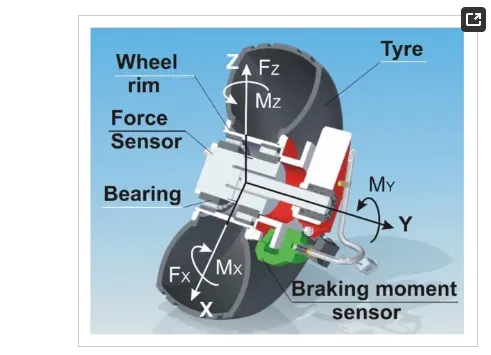
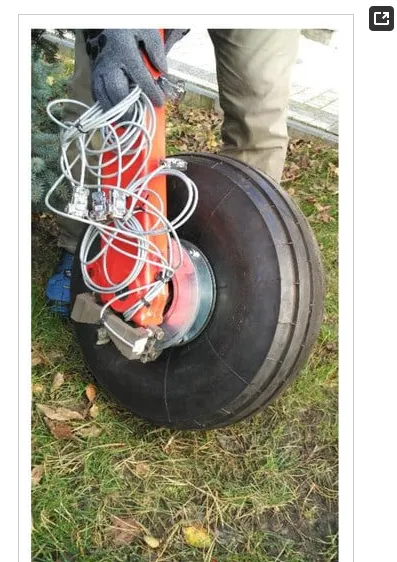
5) Learn about take off power, tyre design, rolling resistance, tyre pressure, brake forces when landing.

Rolling resistance: rolling resistance is a force which act between wheel and road by friction
Tyre pressure: when tyre pressure is decreased the contact area in wheel was increased so rolling resistance force also increase for decrease in tyre pressure.
Take off power: For light aircraft usually full power is used during takeoff. Large aircraft may use a reduced power for takeoff, where less than full power is applied in order to prolong engine life, reduce maintenance costs and reduce noise emissions.
Brake forces : Aircraft brakes stop a moving aircraft by converting its kinetic energy to heat energy by means of friction between rotating and stationary discs located in brake assemblies in the wheels.
Rolling resistance = Urr* mass * gravity
6. A. With necessary assumptions, calculate the force and power required to push / pull an aircraft by a towing vehicle.
SOL:
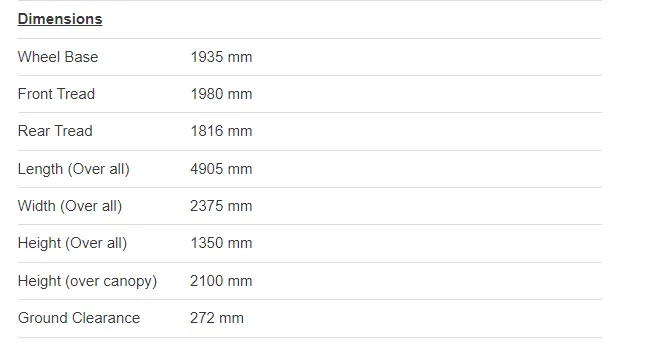
AIRCRAFT TOWING TRACTOR – MODEL BA10G40
 .
.
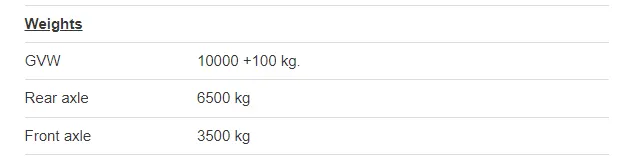
GVW m = 10100 KG
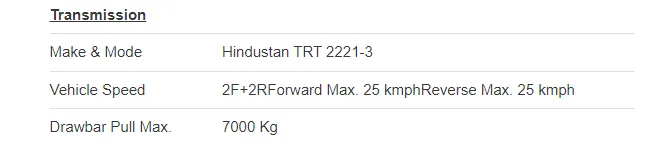
Max speed= 25kmph
velocity = kmph*(5/18)= 0.277 m/sec
velocity at 25kmph= 6.925 m/sec
Rolling resistance coefficient Urr= 0.015
Air drag coefficient Cd = 0.3
Air density = 0.015kg/m^3
Height = 2100 mm
Width = 2375 mm
Formulas needed:
- Rolling resistance force =Rolling resistance coefficient*mass* gravity
- Air drag = (1/2)*air density* area * airdrag coefficient*velocity*velocity
- Power =Frr*Fad*velocity
Frr= 0.015*10100*9.81
= 1486.215
Frr = 1486.215 N
Air drag force Fad = (1/2)*air density* area * airdrag coefficient*velocity*velocity
=(0.5*4987.15*0.015*0.3*47.955+
Fad = 538145 N
Power =(Fad+frr)*v
= (2024.36)*6.925
P= 14.018 KW
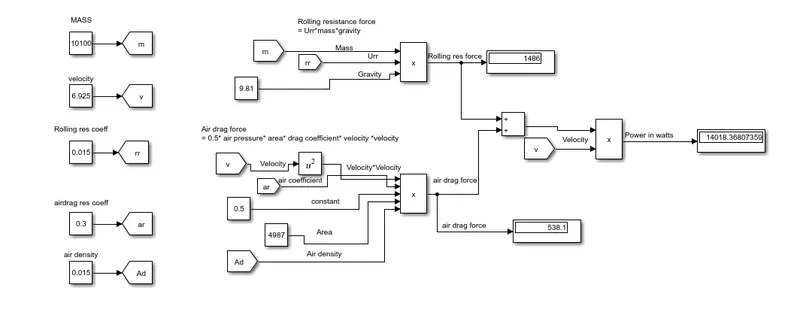
6 B. Develop the model for the calculated force and power using Simulink.
Iam attaching the matlab file for reference:
7. A. Design an electric powertrain with type of motor, it’s power rating, and energy requirement to fulfill aircraft towing application in Simulink. Estimate the duty cycle range to control the aircraft speed from zero to highest. Make all required assumptions. Prepare a table of assumed parameters. Draw a block diagram of powertrain.
Iam attaching the matlab file for reference:
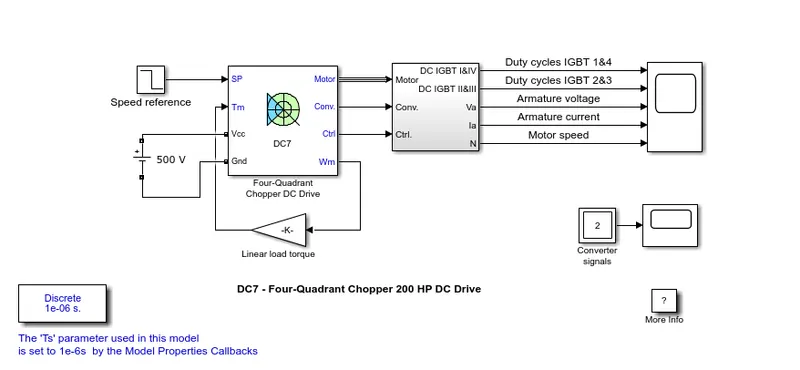
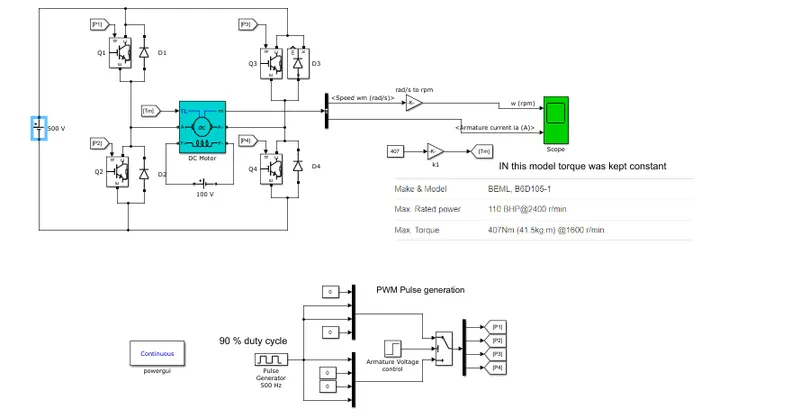
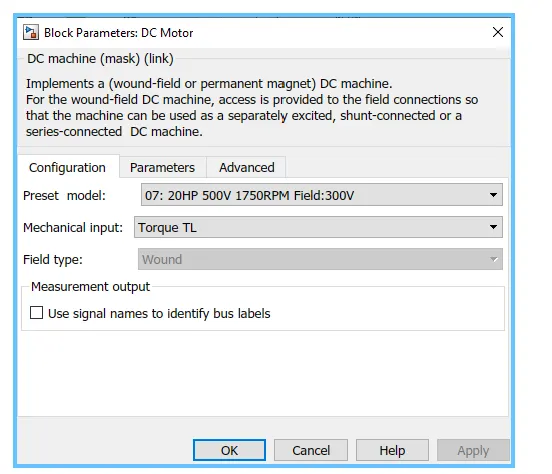
(Hint :DC7 Block)
SOL:
GVW m = 10100 KG
Max speed= 25kmph
velocity = kmph*(5/18)= 0.277 m/sec
velocity at 25kmph= 6.925 m/sec
Rolling resistance coefficient Urr= 0.015
Air drag coefficient Cd = 0.3
Air density = 0.015kg/m^3
Height = 2100 mm
Width = 2375 mm
Formulas needed:
- Rolling resistance force =Rolling resistance coefficient*mass* gravity
- Air drag = (1/2)*air density* area * airdrag coefficient*velocity*velocity
- Power =Frr*Fad*velocity
Frr= 0.015*10100*9.81
= 1486.215
Frr = 1486.215 N
Air drag force Fad = (1/2)*air density* area * airdrag coefficient*velocity*velocity
=(0.5*4987.15*0.015*0.3*47.955+
Fad = 538145 N
Power =(Fad+frr)*v
= (2024.36)*6.925
P= 14.018 KW
We calculated the vehicle power
Efficiency = output power / input power
efficieny for the transmission = 90%
input power = output power / efficiency
Input power = 14.018/0.9
Input power = 15.57 KW
Iam taking as 16KW motor for our requirement
TO find energy
Power = V*I
From the matlab model there is 500 volt 20hp motor.
Power = 16000
voltage = 500
I = 16000/500
I= 32AH.
From this 32 Ah battery energy is required to run the motor for 1 hour.
iam taking a Dc7 matlab file and motor control in hbridge using BJT. iam attaching both the files for refernce and results are attached with this.
B. Also, Design the parameters in excel sheet.
| Design the parameters in excel sheet. | ||
| Description | Value | Units |
| Kerb weight |
10100
|
kG |
| Pay load | KG | |
| Rolling resistance co-efficeient | 0.015 | |
| Air density | 0.015 | |
| Width |
4987
|
m |
| Height | m | |
| Air drag co-efficient | 0.3 | |
| Speed | 25 | kmph |
| Rolling Resistance | ||
| Kerb weight |
10100
|
kG |
| Pay load | KG | |
| Gravity | 9.81 | |
| Rolling resistance co-efficeient | 0.015 | |
| Rolling resistance force (Frr) | 1486.215 | N |
| Air Drag | ||
| Width |
4987
|
kG |
| Height | KG | |
| Speed | 25 | kmph |
| speed in (m/sec) | 6.944444444 | |
| Air density | 0.015 | |
| Air drag co-efficient | 0.3 | |
| Air Drag Force(Fad) | 541.1241319 | N |
| Fte =( Frr+Fad) | ||
| Tractive Force Fte | 2027.339132 | N |
| Total power Pte = (Fte*v) | ||
| Pte | 14.07874397 | KW |
| Energy Calculation | ||
| Output power | 14.078 | KW |
| Efficiency | 0.9 | |
| Input power | 15.5 | KW |
| Motor power iam taking it as | 16 | KW |
| voltage | 500 | V |
| Power | 16000 | Watts |
| Current | 32 | AH |
| 500 volt , 32 ah battery is needed to run a vehicle for one hour. | ||