Week-6 Challenge: EV Drivetrain
1.Which types of power converter circuits are employed in electric and hybrid electric vehicle?
Sol: AC to DC Converters (Rectifiers): An AC to DC converter or rectifier can convert AC voltage to DC voltage. Rectifiers periodically reverses directionof AC to DC (which flows in only one direction). The reverse operation is performed by the inverter. Rectifiers have many uses, but are often found serving as components of DC power supplies and high voltage direct current power transmission systems.
DC to AC Converters (Inverters): An Inverter, is a power electronic device or circuitry that changes direct current (DC) to alternating current (AC). The resulting AC frequency obtained depends on the particular device employed. Inverters do the opposite of “converters” which were originally large electromechanical devices converting AC to DC. The input voltage, output voltage and frequency, and overall power handling depend on the design of the specific device or circuitry. The inverter does not produce any power; the power is provided by the DC source.
DC to DC Converters (Chopper): A DC-to-DC converter is an electronic circuit or electromechanical device that converts a source of direct current (DC) from one voltage level to another. It is a type of electric power converter. Power levels range from very low (small batteries) to very high (high-voltage power transmission).
___________________________________________________________________________________
2. An Electric Vehicle's powertrain with 72V battery pack is shown in the diagram below. The duty ratio for acceleration operation is 'd1' and for the braking operation the duty ratio is 'd2'.
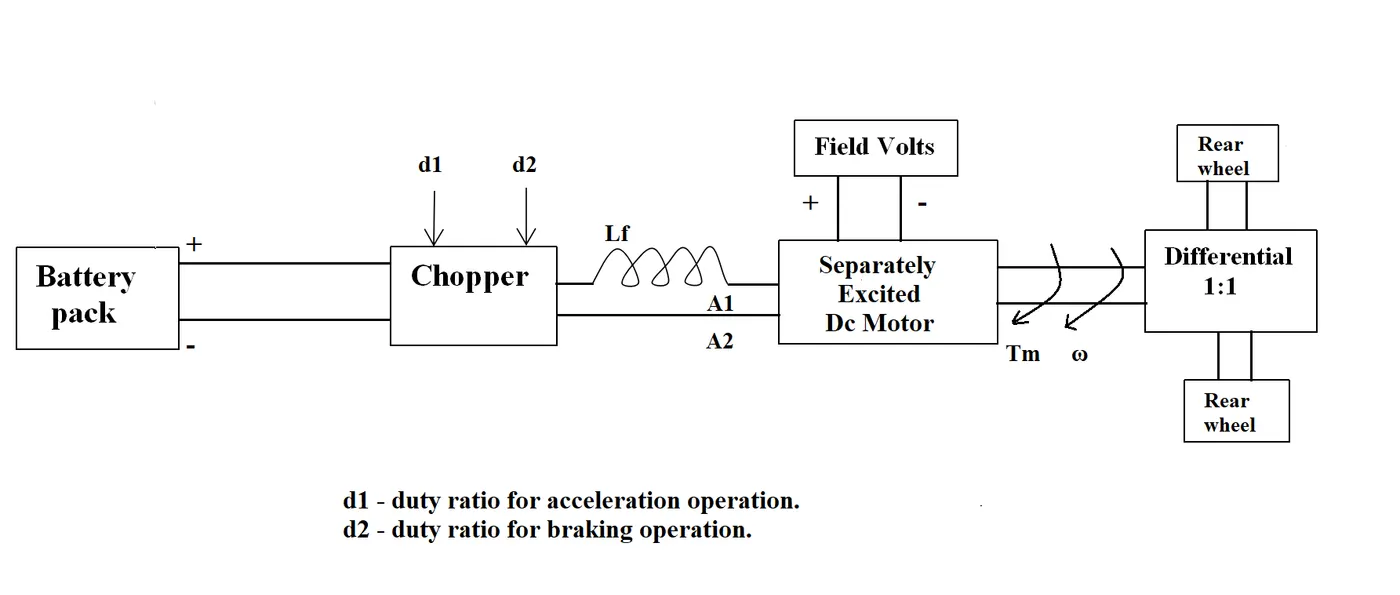
The other parameters of the electric vehicle is given below,
Motor and Controller Parameters:
Rated Armature voltage= 72 V
Rated armature current= 400 A
Ra= 0.5Ω, KΦ= 0.7 Volt second
Chopper Switching frequency= 400 Hz
The vehicle speed-torque characteristics are given by the below equation

What is EV steady state speed if duty cycle is 70%?
Sol: ATQ we know that, Ra = 0.5Ω, KΦ= 0.7 Volt second, rated armature voltage = 72V, Rated armature current = 400A
since the duty cycle is 0.7, the effective voltage to the motor is 72*0.7 = 50.4V.
since we know, T = (V.KΦ/Ra)-(KΦ^2.ω/Ra) ...(i)
also we know that Tv = 24.7 + (0.0051)ω^2 (given in question) ...(ii)
Comparing these two equations we get,
(V.KΦ/Ra)-(KΦ^2.ω/Ra) = 24.7 + (0.0051)ω^2
(50.4*0.7/0.5)-(0.7^2*ω/0.5) = 24.7 + (0.0051)ω^2
=> 0.0051ω^2+0.98ω-45.86=0
Solving the above equation we get,
ω = 38.95 rad/s
Hence the steady state speed of the EV if the duty cycle is 70% is 38.95 rad/s.
___________________________________________________________________________________
3. Refer to the blog on below topic:
Induction Versus DC brushless motors by Wally Rippel, Tesla
Explain in brief about author’s perspective.
Sol: Brushless DC Motor:
1) With brushless machines, the rotor includes two or more permanent magnets that generate a DC magnetic field.
2) Stator core involves current flowing within the windings to produce torque interaction b/w stator and rotor. It also requires inverter for operation.
3) Doesnot produce much heat and hence cooling is easier.
4) Has high peak efficiency point.
5) Easier to control for lower to medium performance ranges.
6) Speed is controlled by PWM method.
7) As motor size increases, magnetic losses increase and hence load efficiency drops.
AC Induction Motor:
1) Currents flowing in the stator windings produce a rotating magnetic field that enters the rotor.
2) These motors donot have magnets and also donot require inverters for operation but integrating it with one gives a smoother operation.
3) Has heating issues and hence efficiency depreciation.
4) Comparitively lower efficiency point when compared to brushless DC motor.
5) Achieving stability over the entire torque-speed range is more difficult with induction than with DC brushless motors.
6) Speed is controlled by altering RMS speed by altering frequency of fed in voltage.
7) Average efficiency is better than DC Brushless motor.
___________________________________________________________________________________