Week-6 Challenge: EV Drivetrain
Question 1:
Which types of power converter circuits are employed in electric and hybrid electric vehicle?
Answer:
They are 4 types of power converter are available.
- Inverter(DC-AC)
- Rectifier(AC-DC)
- Chopper(DC-DC)
- Regulator(AC-AC)
These are the power converter uses in Electric and Hybrid Electric vehicle for various function.
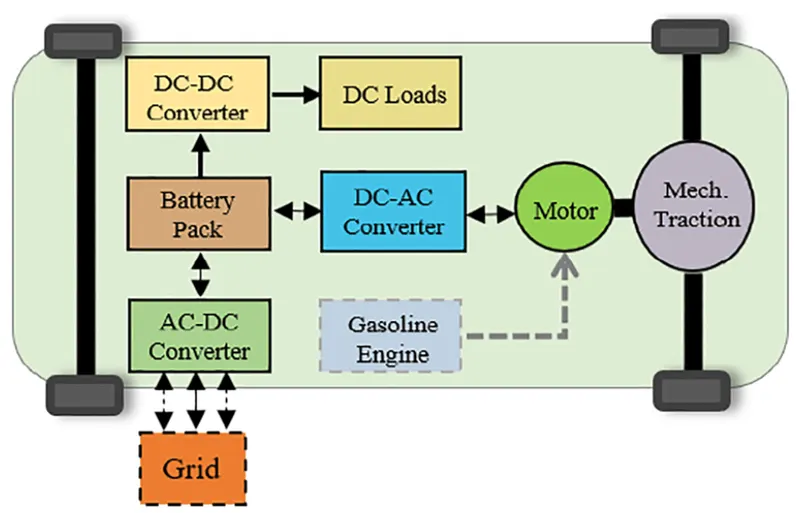
- For an transmitted of power from an battery to the dc motor an chopper is used. Which is change the fixed DC input voltage level to variable DC output voltage level.
- For an transmitted of power from an battery to the ac motor a combination of the Inverter and Regulator is used. Where the inverter convert the battery DC voltage into AC voltage and Regulator convert the fixed AC input voltage to variable AC output voltage.
- During braking, the motor is act as the generator at the time an Chopper is used. Which is change the fixed DC input voltage level to variable DC output voltage level.
- During Charging, the household voltage is AC but an battery consume voltage is DC, so an Rectifier is used to convert the AC voltage source to DC voltage source.
In these places the power converter are used in Electric and Hybrid Electric vehicle
******************************************************************************************
Question 2:
An Electric Vehicle's powertrain with 72V battery pack in shown in the diagram below. The duty ratio for acceleration operation is 'd1' and for the braking operation the duty ratio is 'd2'.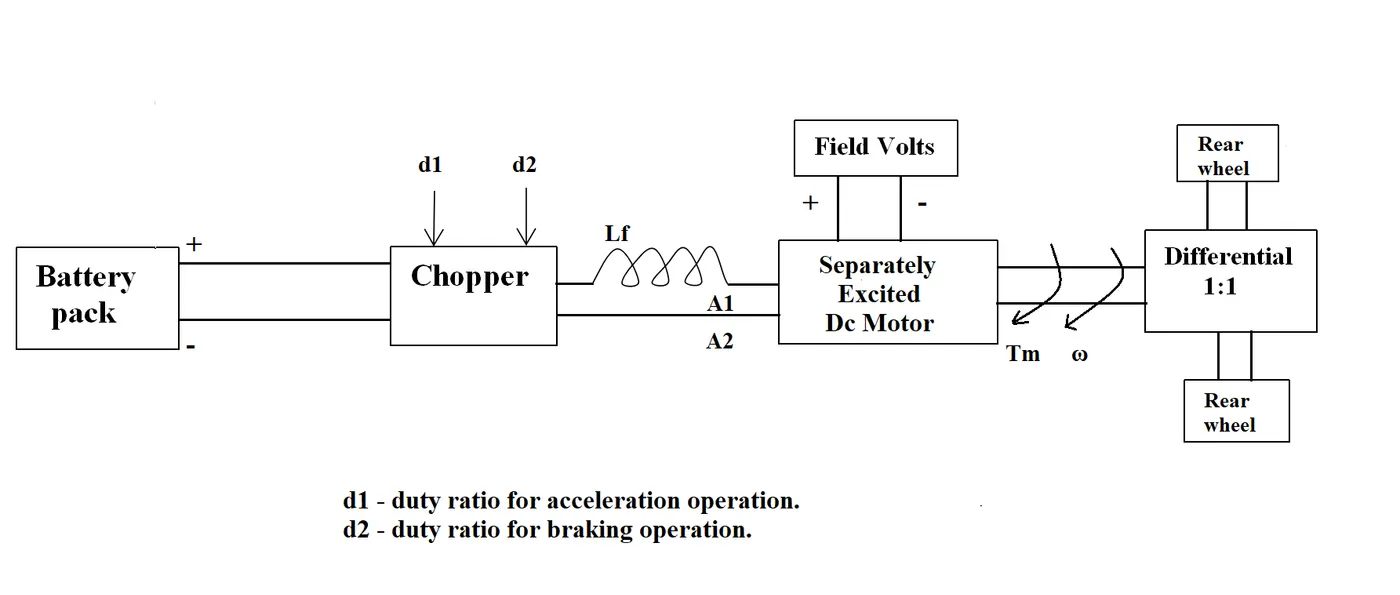
The other parameters of the electric vehicle is given below,
Motor and Controller Parameters:
Rated Armature voltage= 72 V
Rated armature current= 400 A
Ra= 0.5Ω, KΦ= 0.7 Volt second
Chopper Switching frequency= 400 Hz
The vehicle speed-torque characteristics are given by the below equation

What is EV steady state speed if duty cycle is 70%?
Answer:
Given Data:
Battery total voltage (Vin) = 72 V
Armature Current (Ia) = 400 A
Armature Resistance (Ra) =0.5 ohm
Motor Constant (KΦ) = 0.7 Volt Sec
Now Consider that the Ev is run at 70% duty cycle.
So output voltage (Vout) = 72*(70/100) V = 50.4 V
Motor Speed-Torque Equation:
Tm = (Vout*KΦ)/Ra-(ω*(KΦ)^2)/Ra
Tm = ((50.4*0.7)/0.5)-((ω*(0.7)^2)/0.5)
Tm = 70.56-0.98ω.
Vehicle speed-torque Equation:
Tv = 24.7+0.0051ω^2.
To find the steady state speed of the system can be implement by
Tm=Tv
70.56-0.98ω=24.7+0.0051ω^2
70.56-24.7-0.98ω-0.0051ω^2=0
45.86-0.98ω-0.0051ω^2=0
0.0051ω^2+0.98ω-45.86=0
using Quadratic formula:
(ω+231.0718)(ω-38.9150)=0
ω=38.9150,-231.0718.
The Steady state speed of the motor while forward driving is 38.9150 rad/sec.
The Steady state speed of the motor while bracking is 231.0718 rad/sec.
******************************************************************************************
Question 3:
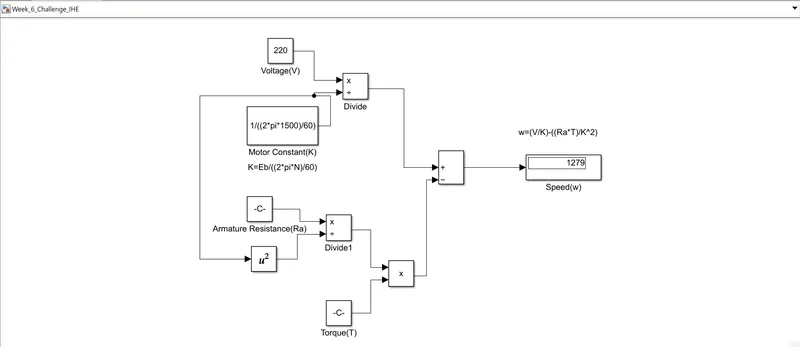
Develop a mathematical model of a DC Motor for the below equation using Simulink.
ω= V/Kϕ -((Ra/Kϕ^2 ).T)
Answer:
'Constant' block is used to take an input of the system like Voltage, Motor Constant, Armature Resistance, Torque.
'Divide' block is used to divide the two value.
'Square' block is used to square the motor contant.
'Product' block is used to multiply of two value.
'display' block is used to show an speed value.
Simulink Model:
******************************************************************************************
Question 4:
Refer to the blog on below topic:
Induction Versus DC brushless motors by Wally Rippel, Tesla
Explain in brief about author’s perspective.
Answer:
According to author's perspective, Induction motor and DC Brushless motor are live and work side by side during the coming golden era for Pure Electrical and hybrid vehicle.
Reason:
Consider that the Induction motor the field current and frequency are controllable so it is easy to controlled the induction motor at the same time the control law are more complex and difficult to understand.
Now consider that the DC brushless motor the rotor heat is very less compare to induction motor and it can be easily cool by the help of cooler and peak point efficiency is higher for the DC brushless motor compare to any other motor at the same time the price of the permanent magnet is high and it definently need an inverter circuit.
While compare to the other motor these two motor are have an special feature to adopted with an vehicle design like Pure Electric and Hybrid Electric vehicle.
And Author concluded that the DC brushless motor is more effictive to Hybrid Electric model and Induction motor is more effictive for an Pure Electric vehicle.
******************************************************************************************