Week-6 Challenge: EV Drivetrain
Q: Which types of power converter circuits are employed in electric and hybrid electric vehicle?
- AC to DC converter (controlled rectifier): An AC to DC converter circuit can convert AC voltage into a DC voltage. The DC output voltage can be controlled by varying the firing angle of the thyristors. The AC input voltage could be a single phase or three phase.
- AC to AC Converters (AC voltage regulator): This converters can convert from a fixed ac input voltage into variable AC output voltage. The output voltage is controlled by varying firing angle of TRIAC. These type converters are known as AC voltage regulator.
- DC to DC Converter (DC Chopper): These converters can converter a fixed DC input voltage into variable DC voltage or vice versa. The DC output voltage is controlled by varying of duty cycle.
- DC to AC Converter (Inverter): this type of converter takes DC supply and converts into AC supply. It is widely used in homes and in EV or HEV.
Q: An Electric Vehicle's powertrain with 72V battery pack in shown in the diagram below. The duty ratio for acceleration operation is 'd1' and for the braking operation the duty ratio is 'd2'.
The given speed torque characteristics is T=V*k/r-(k^2)*w/R
where T is armature torque, V is armature voltage, R is armature resistance, w is speed in rad/sec.
T=V*k/r-(k^2)*w/R
24.7+(0.0051)w^2=V*k/R-(k^2)*w/R
V=70% of 72 = 0.7*72
0.0051w^2+0.98w-8992.15=0
w^2+192.15w-8992.15=0
solving using quadratic equation we get w1= 38.91rad/sec and w2= -231.07rad/sec
Therefore the steady state speed of EV with duty cycle 70% is 38.91rad/sec.
Q: Develop a mathematical model of a DC Motor for the below equation using Simulink.
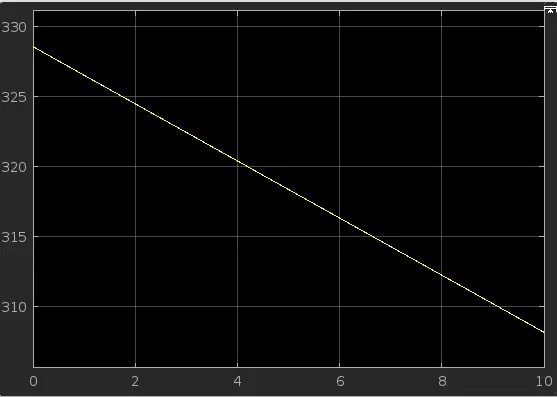
Using the above equation we have obtained the model in simulink using 4 constant block, 3 product block, 1 ramp block, 1 adder block and scope.
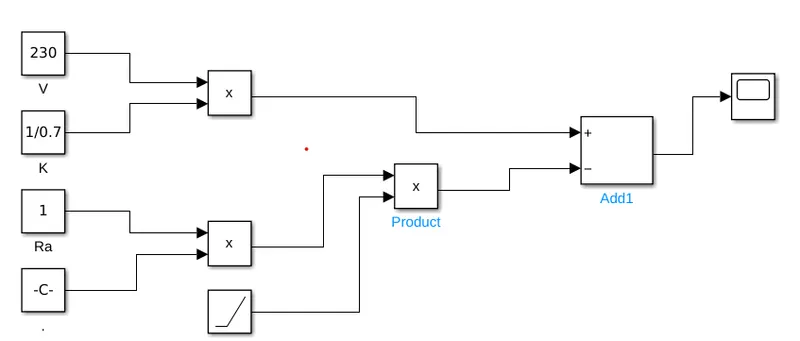
We have obatined torque vs speed graph
Q: Refer to the blog on below topic: Induction Versus DC brushless motors by Wally Rippel, Tesla
Explain in brief about author’s perspective
The author writes about the difference between the dc brushless motor drive and induction motor drive. The author writes in detail about the construction, wroking and cost.
For DC brushless drives, the construction implements 2 or more permanent magnet at the rotor to generate a DC magnetic field. It also consists of a stator core. It requires an inverter for the current control since it cannot run on a DC supply as the current direction needs to be changes repeatedly in order to maintain constant torque. For induction drives, rotor has no magnets but instead stacked steel laminations with buried peripheral conductors. The current in the stator winding generates a rotating magnetic field that interacts with rotor. Induction motor does not require inverter and can be used directly from the supply to start the drive and generate starting torque, wheras DC brushless cannot do the same. They cannot generate starting torque when connected to power supply. Induction motor is connected to a 3 phase mains supply, the rotor rotates at a constant speed and also have limited starting torque. In order to rectify this an inverter is used to operate induction drives from DC supply or battery. DC brushless use permanent magnets and cannot change the strength of magnetic fields. On the other hand induction drives do not have permanent magnets and they can vary magnetic field strength.
Conclusion: The author mentions that DC brushless drives will likely continue to dominate in the hybrid and coming plug-in hybrid markets, and that induction drives will likely maintain dominance for the high-performance pure electrics. Both drives induction and DC brushless live and work side by side during the coming golden era of hybrid and electric vehicles.