Week-6 Challenge: EV Drivetrain
1. Power Converter circuits employed in Electric and Hybrid Electric Vehicles
Main Power Converters used in EVs and HEVs are AC-DC Converter, DC-DC Coverter and DC-AC Converter.
- AC-DC Converter: Converts AC power to DC power
- Single phase
- Three phase
- DC-DC Converts: Converts DC to DC Power. Steady DC to Regulated DC and also with varying voltages and current.
- Buck Converter: Converts DC to DC. Output voltage will be less than or equal to input voltage.
- Boost Converter: Converts DC to DC. Output voltage will be greater than or equal to or equal to or greater than input voltage.
- Buck-Boost Converter: Converts DC to DC. Output voltage will be less than input voltage.
- DC-AC Converter: Converts DC power to AC power
- Single Phase
- Three phase
As per the article "Induction Versus DC Brushless motors" by Wally Rippel- Tesla, HEVs mostly use DC Brushless motors and the there won't be charging of batteries from external supply. Hence, there will be only DC-DC converters used in HEVs. In EVs AC-DC, DC-DC, DC-AC converters will be used. Majority of the EVs use Induction Motors. Hence, AC-DC converter used for charging battery using AC power from external supply and from regenerative power by Induction Motor. DC to DC converter used in charge controllers for regulating DC power. DC-AC converter used for powering Induction Motor from battery.
2. EV Steady State Speed
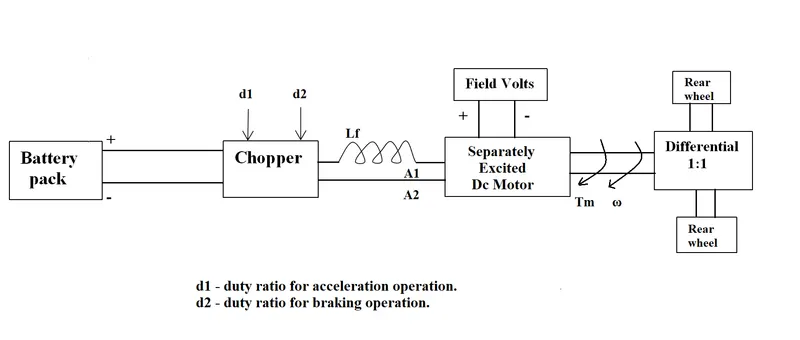
Given Details
- Rated Armature voltage= 72 V
- Rated armature current= 400 A
- Ra= 0.5Ω, KΦ= 0.7 Volt second
- Chopper Switching frequency= 400 Hz
- Vehicle speed-torque characteristics are given as

In the figure, chopper is there in between battery and motor. So, the chopper is a boost converter (considering acceleration).
`V_m= V_(bat) / (1-D)`
`V_(bat)`: battery voltage
`V_m`: Motor input voltage
`D`: Duty ratio
`V_m = 72/(1-0.7) = 72/0.3 = 240V`
Motor Torque equation,
`T_m =[V*(K ϕ)- ω*(K ϕ)^2 ]/R_a`
Here the gear ratio is same. Hence assuming torque on vehicle speed is equivalent to motor torque
Therefore, `[V*(K ϕ)- ω*(K ϕ)^2 ]/R_a = 24.7 + (0.0051)ω^2`
`[240*0.7-ω*0.7^2]/0.5=24.7+0.0051ω^2`
`336-0.98ω=24.7+0.0051ω^2`
`0.0051ω^2+0.98ω-311.3=0`
using the quadratic formula:
`x=[−b±sqrt(b^2−4ac)]/(2a)`
Entering all the values into the formula:
`omega=[−0.98+sqrt(0.98^2−4*0.0051*(-311.3))]/(2*0.0051)`, `omega=[−0.98-sqrt(0.98^2−4*0.0051*(-311.3))]/(2*0.0051)`
`omega=[−0.98+2.703]/0.0102 , omega=[−0.98-2.703]/0.0102`
`omega = 168.92 (rad)/sec, omega = -363(rad)/sec`
Considering acceleration, angular speed can't be negative. Hence, `omega = 168.92 (rad)/sec`
3. Mathematical model of a DC Motor using Simulink
Simulink Model
Constant, Add, Product, Square, Gain and Display blocks used to create the model of the mathematic equation of DC Motor, `ω = V/(Kϕ) -R_a/(Kϕ)^2 .T`.
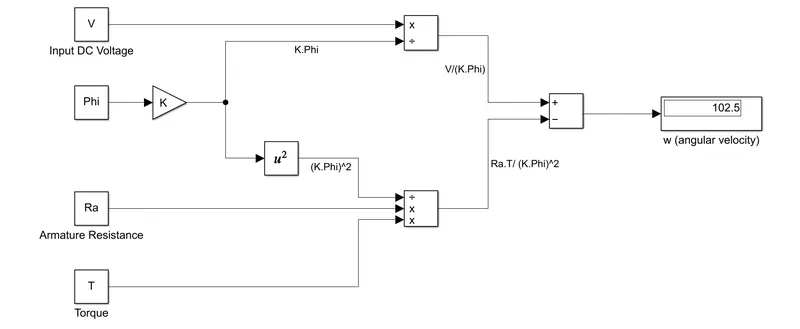
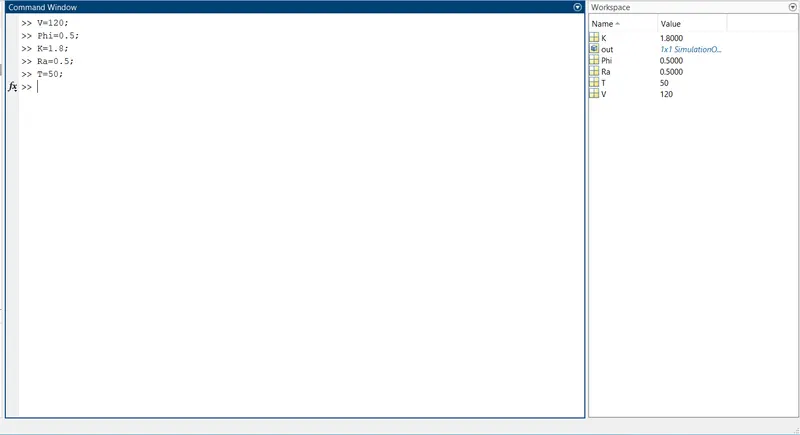
Voltage, Torque, Torque constant, flux, and armature resistance given as variables and the values of variables given in the command window as shown below.
4. Induction Motor Vs DC Brushless Motors
Wally Rippel has long been an advocate for electric vehicles. He starts his comparison between Induction Motor and DC Brushless motor by saying "one size doesn't fit all". In case of IC engines, different types of them were evolved. Among them there is an optimum and efficient one. Even then, the types of them used varied according to Size, Cost, Power etc. Similar to these there are good and bad for Induction Motor as well as DC Brushless Motors. But, their usage varies according to the application needed. Author says that in olden days Lead acid batteries and DC brush motors were there. Now they have been replaced with Li-ion batttery and DC brushless and Induction Motors. In future, these also can be replaced or not.
Windings of DC Brushless motor (DCBM) and Induction motors (IM) are almost similar having three sets of distributed windings. In DCBM, rotor is a permanent magnet and in IM there are stacked steel laminations formed like a short circuit. Speed of the IM will be according to the frequency of the supply provided. Hence the speed will be constant normally. For the speed below rated speed can be varied by varying voltage and speed aboce rated speed can be varied by varying frequency. The primary factor influencing the success of induction motors is that they are readily compatible with conventional utility power. When directly connected to utility electricity with a set frequency, a brushless DC motor doesn't generate any initial torque. They truly require the assistance of an inverter whose "phase" is kept in step with the rotor's angular position.
When directly connected to utility electricity with a set frequency, a brushless DC motor doesn't generate any initial torque. They truly require the assistance of an inverter whose "phase" is kept in step with the rotor's angular position. By using an inverter, IMs can be operated in DC and by varying frequency speed can be varied but still the torque performance is less compared to DCBM.
Both motors are driven by 3-phase modulating inverters. The inverter controls and the rotors are the only modifications. The only control variations with digital controllers are in the control code.
The DC brushless drive generates significantly less rotor heat and has a higher peak point efficiency. It can also operate at unity power factor, whereas the induction drive's best power factor is around 85%. This means that a DC brushless drive's peak point energy efficiency will typically be a few percentage points higher than an induction drive's.
As the size increases the magnetic field loss increases for DCBM as well as the cost of the motor is also higher for DCBM compared to IM. Overall comparison author says that we can't judge the better one. Both have good performance in their said application. The application will be like HEVs will be mostly with DCBMs and Pure EVs will be go with IMs.