Project
Simulation study of BAJA All-Terrain Vehicle (ATV)
Aim
- To carry out a system level simulation study on MATLAB model of BAJA ATV.
- To study about the building blocks of ATV vehicle.
- To study about the parameters used in each blocks.
- To analyse the performance of vehicle varying different parameters.
Description
The figure below shows the schematic diagram of a BAJA All Terrain Vehicle.
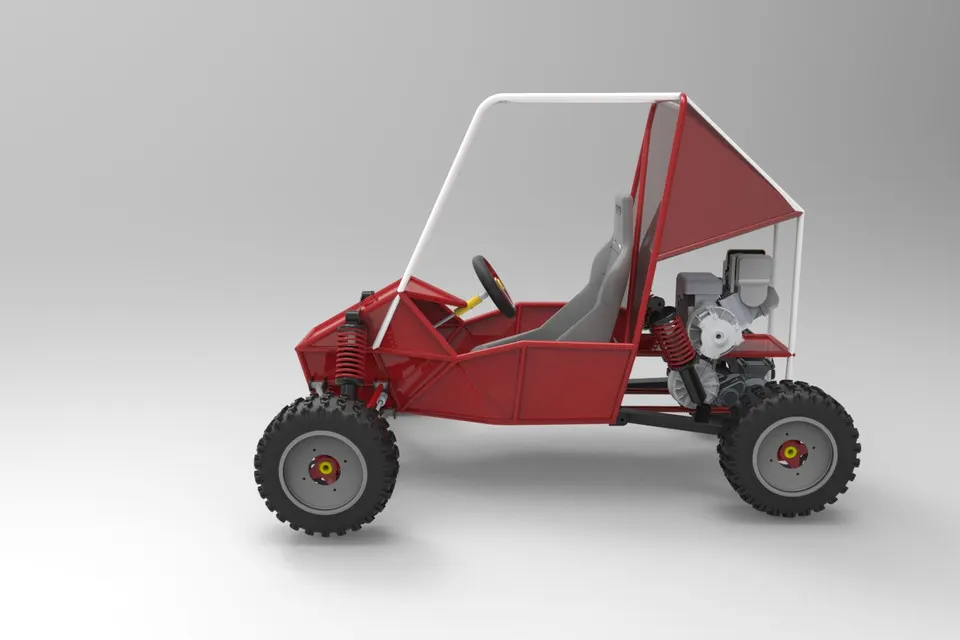
The main components of a BAJA ATV are:
- Vehicle Body
- Suspension
- Tire
- Engine
- Continuously Variable Transmission (CVT)
A generic engine represents both gasoline and diesel engine characteristics with basic parameters. A throttle input provides the torque output. Generic engine block in MATLAB is shown below.
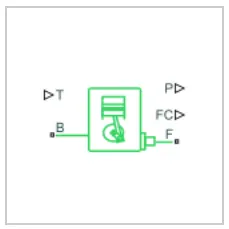
- For the torque ouput of the generic engine, the main parameters specified in the block are speed vector and torque vector.
- As well as torque output, engine power and fuel consumption can be simulated.
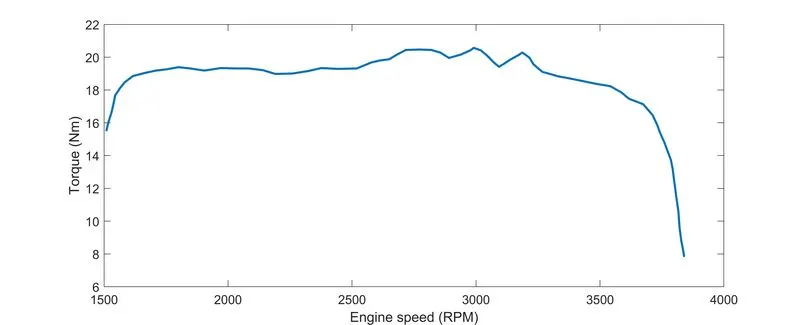
Image below shows the Speed vs Torque characteristics of engine. From this image, the data points ie., the values of speed and torque are interpolated. The extraction of data from image can be done using File Exchange-in GRABIT.
The below image shows a CVT. It contains:
- Primary Pulley with Variator
- Secondary Pulley with Variator
- Belt
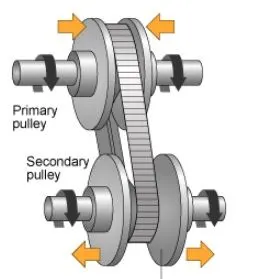
- Primary pulley is connected to engine and Secondary pulley is connected to wheels.
- If the speed of Primary Pulley (Rp) is less than speed of Secondary Pulley (Rs) then the state is Speed Reduction (Rp<Rs).
- If the speed of Primary Pulley (Rp) is greater than speed of Secondary Pulley (Rs) then the state is Over Drive (Rp>Rs).
Simulation Model
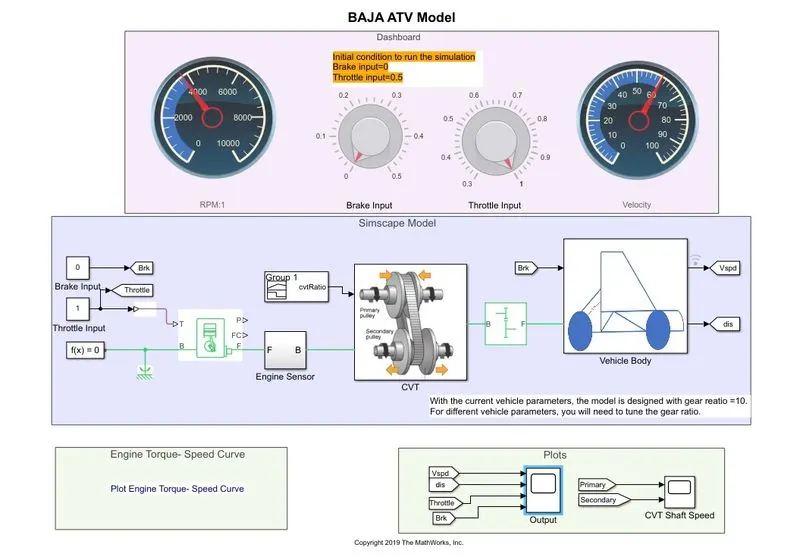
Image shows the Simscape model of CVT Vehicle.
- There is a generic engine to which throttle as well as brake input is given
- Output of engine is torque which is measured using an engine sensor and given to CVT system.
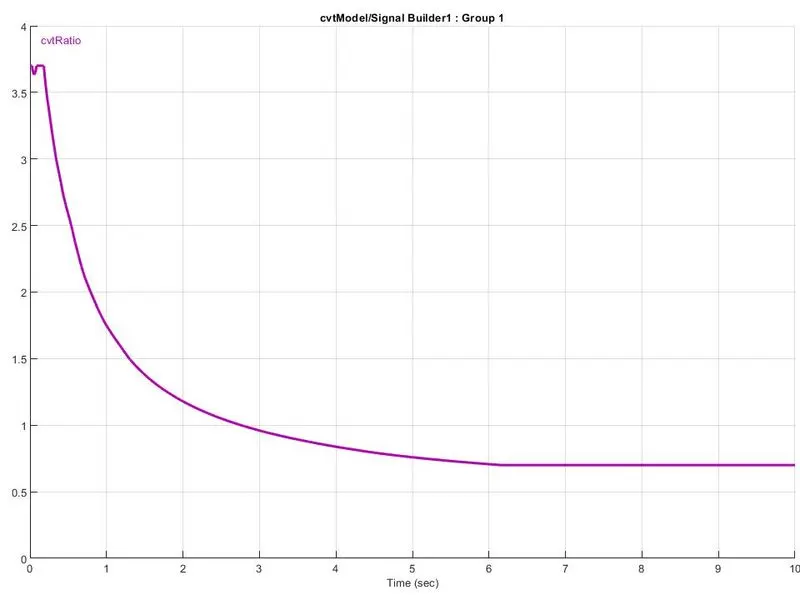
- CVT system contains two inputs- engine torque and CVT ratio.
- CVT ratio input to CVT model is as shown below
Primary and Secondary rpm ie., speed of engine and gear is simulated as shown below
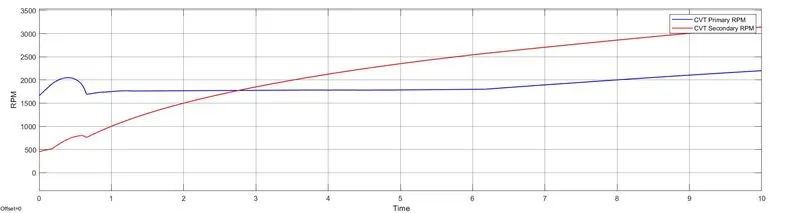
From the CVT ratio input as well as the speed characteristics of CVT shafts, the following points can be observed.
- As the ratio (Rp/Rs) decreases, speed of gear output is increasing
- CVT ratio=1 means that the speed of engine and gear output is same. Which can be observed at 3second.
- Engine speed is almost same since it is the power source and providing constant throttle input. But the speed of gear output varies as CVT ratio changes.
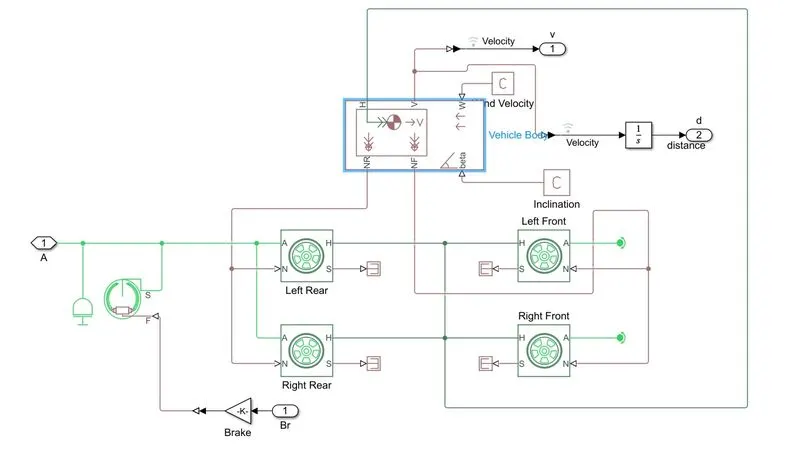
- Torque output from CVT and then through a simple gear is given to wheels.
- Brake block as well as vehicle body is connected to wheels
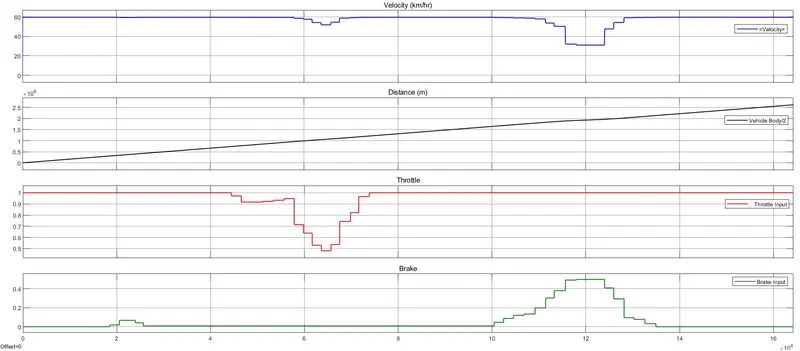
Simulated result by varying throttle and applying brake is shown above.
Throttle is reduced from 4.5 sec to 7 sec.
- It can be observed that the velocity is reduced.
- Due to the inertia of vehicle, there is only slight reduction in distance covered.
Brake applied at 10 sec to 13 sec
- It can seen that a great reduction in velocity
- small reduction in distance covered also can be observed
Conclusion
An idea about BAJA ATV is understood through the simulated model study. From this simulation, various blocks or components of vehicle have studied. Learned about parameter used in blocks. CVT block and its output on varying CVT ratio is analyzed. Velocity, distance covered and rpm of engine and wheels by varying throttle, applying brake and varying CVT ratios are simulated and observed.