Week-6 Challenge: EV Drivetrain
1.Types of power converter in EV & HEV vehicles :
Ther are 3 types of converters
- AC - DC Converter
- DC - AC Converter
- DC - AC Converte
Application of AC - DC Converter (On board charge):
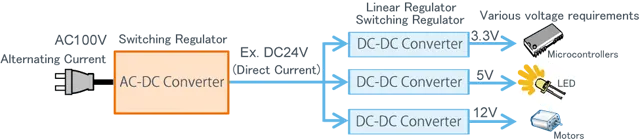
- An AC-DC Converter is a device that converts an AC voltage to DC voltage.
- Electricity supplied to homes is typically 100V or 200V AC.
- On the other hand, most electronic devices operate at 3.3V or 5V DC.
- It is necessary to convert from AC to DC voltage.
- Some motors and lamps can be driven even with AC voltage.
- But for motors that include control circuitry and lamps that have switched to energy-saving LEDs, AC-DC conversion is required.
Application of DC - DC Converter (Chopper):
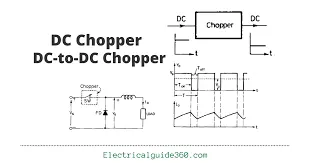
- Practical electronic converters use switching techniques.
- Switched-mode DC-to-DC converters convert one DC voltage level to another, which may be higher or lower, by storing the input energy temporarily and then releasing that energy to the output at a different voltage.
- The storage may be in either magnetic field storage components (inductors, transformers) or electric field storage components (capacitors).
- This conversion method can increase or decrease voltage.
- Switching conversion is often more power-efficient (typical efficiency is 75% to 98%) than linear voltage regulation, which dissipates unwanted power as heat.
- Fast semiconductor device rise and fall times are required for efficiency.
- These fast transitions combine with layout parasitic effects to make circuit design.
- Low-power DC-to-DC synchronous converters consisted of an electro-mechanical vibrator followed by a voltage step-up transformer feeding a vacuum tube or semiconductor rectifier, or synchronous rectifier contacts on the vibrator.
Application of DC - AC Converter (Inverter):
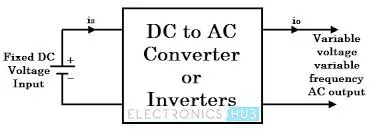
- DC to AC converters is mainly designed for changing a DC power supply to an AC power supply.
- DC power supply is comparatively stable as well as positive voltage source whereas AC oscillates approximately a 0V base stage, typically in a sinusoidal or square or mode.
- The common inverter technology used in electronics is to convert a voltage source from a battery into an AC signal.
- Generally, they operate with 12 volts and commonly used in applications like automotive, lead-acid technology, photovoltaic cell etc.
- A transformer coil system & a switch is the simple circuit used for an inverter.
- A typical transformer can be connected toward the DC signal’s input through a switch to oscillate back quickly.
- Due to the current flow in bi-directional in the primary coil of the transformer, an alternating current signal is an output throughout the secondary coils.
2.Electirc vehicle powertrain:
Motor and Controller Parameters:
- Rated Armature voltage= 72 V
- Rated armature current= 400 A
- Ra= 0.5Ω
- KΦ= 0.7 Volt second
- Chopper Switching frequency= 400 Hz
- Staedy state speed in duty cycle is 70%
vehicle speed-torque characteristics equation (Tv)
- Tv = 24.7 + (0.0051)W^2
Formula used for motor speed-torque characteristics equation (Tm)
- W = V/K_phi - Ra/(K_phi)^2 × T
PROBLEM :
Multiplying Battery voltage and duty cycle :
Va * Duty cycle
72 * 70/100
V = 50.4 v
After simplifying the motor speed-torque characteristics equation (Tm)
Become as;
Tm = (V*K_phi/Ra) - ((K_Phi^2*Wm)/Ra)
Tm = (50.4 * 0.7/0.5) - (((0.7^2)*Wm)/Ra)
Tm = 70.56 - 0.98 * Wm
By equating the motor speed-torque characteristics equation (Tm) and vehicle speed-torque characteristics equation (Tv)
Tm = Tv,
70.56 - 0.98 * Wm = 24.7 + 0.0051 * Wm^2
0.0051 * Wm^2 + 0.98 * Wm - 70.56 + 24.7 = 0
0.0051 * Wm^2 + 0.98 * Wm - 45.89 = 0
By using quadratic equation;
Wm = 38.85 rad/s and Wm = -230.95 rad/s
we can take positive value;
Steady state speed of the vehicle = 38.85 rad/s
3.Mathematical model of DC motor
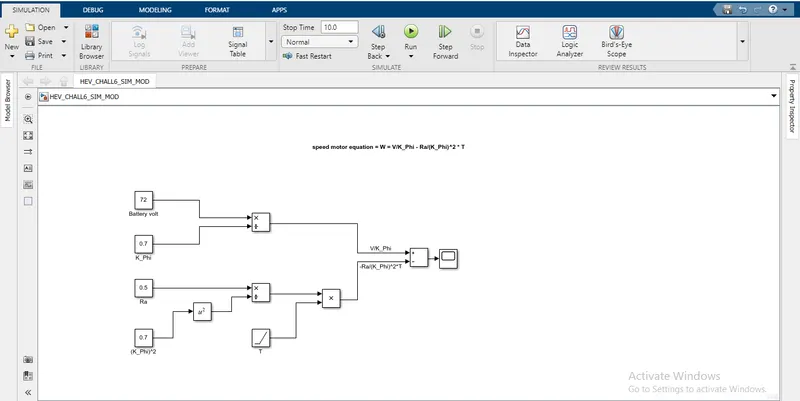
Speed formula is W = V/K_phi - Ra/(K_phi)^2 × T
Graph:
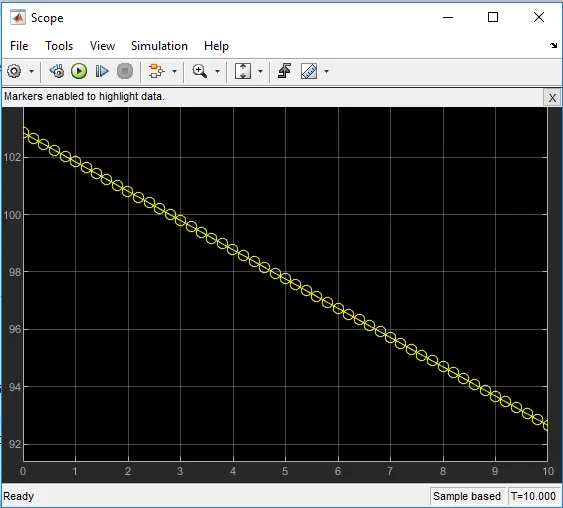
Max speed by vehicle is around 103 kmph
4.Induction versus DC brushless motor
Wally rippel explains about his experions and his future prediction of EV in Automation field.He spoke about there were lead acid batteries, DC brush motors, and contactor controllers in the past generation.But now at present there are non of these.It has been changed by lithim-ion batteries, DC brushless motors or induction & controllers have been replaced by inverters.
- He explains about the working of Brushless DC motor and inverter produces the electric current to the motor.
- Then he talks about the difference between the 3-phase induction motor and Brushless DC motor and thgis both are identical.
- Rippel explains about 3-phase induction motor in detail which has no magnetic poles.Magnetic frequency is generated when the electrical frequency and rotating frequency is differentiated.Currents are produced within the rotor conductors that are approximately proportionate to the voltage.
- He tells that DC brushless play a main role in hybrid electric vehicles and Induction motor plays a main role in pure ev electric vehicles.
- He speaks about the advantage and disadvantage of induction and DC brushless motor.
- Rippel tells that one of the main differences is that much less rotor heat is generated with the DC brushless drive. Rotor cooling is easier and peak point efficiency is generally higher for this drive. The DC brushless drive can also operate at unity power factor.
- whereas the best power factor for the induction drive is about 85 percent. This means that the peak point energy efficiency for a DC brushless drive will typically be a few percentage points higher than for an induction drive.
Conclsion :
Finally the author tells that, DC brushless play a main role in hybrid electric vehicles (HEV) and Induction motor plays a main role in pure (ev) electric vehicles.