Week-6 Challenge: EV Drivetrain
TASK I
A power converter is a type of electrical circuit that transforms electric energy from one form into another that is more suitable for a given load. An output from a converter that performs one or more functions could be different from the input.
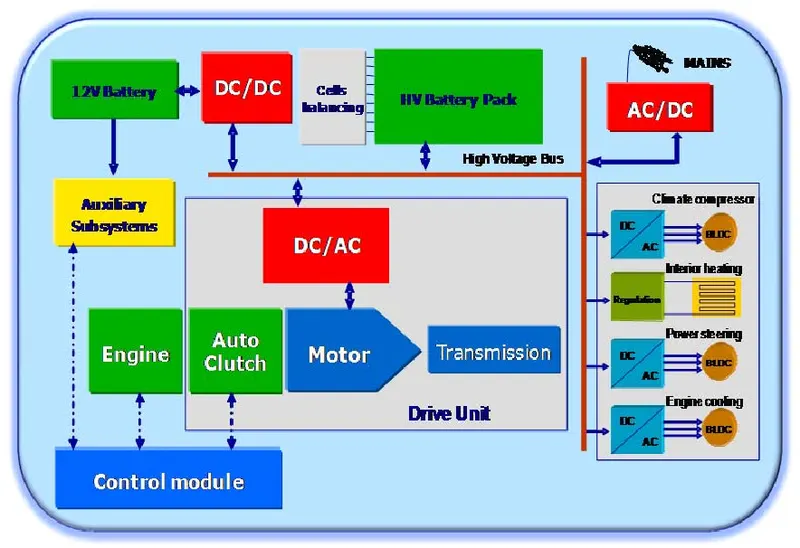
Bipolar junction transistors (BJT), metal oxide semiconductor field effect transistors (MOSFET), insulated gate bipolar transistors (IGBT), silicon controlled rectifiers (SCR), gate turn off SCRs (GTO), and MOS controlled thyristors are examples of high power and fast acting semi conductor devices used in power converters . With the help of these solid state devices set up in a specific circuit layout, the fixed supply voltage can be changed into a variable voltage and variable frequency supply by acting as an electronic on-off switch. Each of these devices has a control input gate or base that the controller uses to send commands to turn the devices on and off.
Power electronic converters are divided into the following categories based on the functions they carry out.
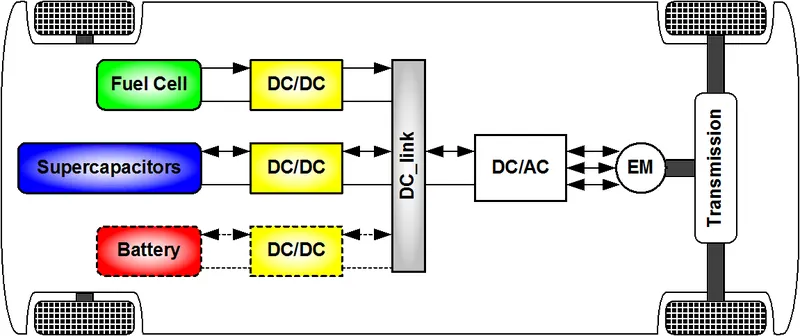
- AC to DC- They are also known as rectifiers and are frequently utilised in electric vehicle charging applications. Similar to an inverter, a rectifier converts AC electricity into DC power.
- DC to AC- It is commonly referred to as inverters. They are utilised in the electric car motor drive. This electrical device changes Direct Current (DC) electricity into Alternating Current (AC), the kind of electricity that can be utilised to power a machine or appliance. In a solar power system, for instance, the inverter converts the electricity held in batteries that have been charged by solar panels into regular AC power, which powers plug-in outlets and other standard 120 volt equipment.
In a hybrid or electrical vehicle (EV), an inverter performs the same role, and its theory of operation is quite simple. For example, the primary winding of a transformer inside the inverter housing receives DC power from a hybrid battery. The direction of current flow is continually and routinely switched through an electronic switch (often a group of semiconductor transistors) (the electrical charge travels into the primary winding, then abruptly reverses and flows back out). The secondary winding circuit of the transformer generates AC current from the flow of electricity both in and out. The power for an AC load is ultimately provided by this induced alternating current electricity. For instance, the electric traction motor of an EV. Three phase bridge inverter topology is the most used in EVs.
- DC to DC- The name of this converter is "chopper." Depending on the circumstance, it modifies the DC current's voltage level. A voltage converter is the more appropriate term. The converter comes in two different varieties. The first is a step up converter, which raises the voltage, and the second is a step down converter, which does the exact opposite. A converter's most typical usage is to take a source of relatively low voltage and step it up to high voltage for heavy duty work under a high power load, but they can also be used in reverse to lower voltage for a source of light load.
For some particular appliances, DC-to-DC converters are utilised to convert high voltage DC input to low voltage DC output. In order to prevent any form of harm, they are also employed to separate some extremely delicate circuit components from other circuit components.
- AC to AC- Fan regulators frequently use it. Electric vehicles cannot use this converter. It is identical to a voltage converter. The main distinction is that this uses an AC power supply.
TASK II
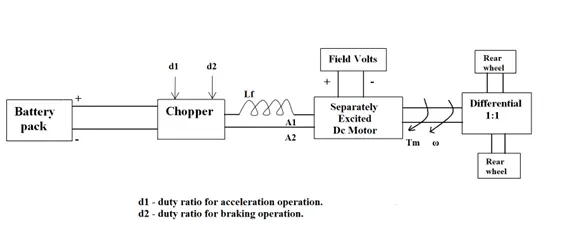
The figure below shows the powertrain of an electric vehicle with a 72V battery pack. The duty ratio for an accelerating action is "d1," while the duty ratio for a breaking operation is "d2."
Given datas;
Battery pack voltage(V)= 72 V
Rated Armature current= 400A
Armature Resistance= 0.5 ohm
Motor constant (kØ)= 0.7
Chopper switchin frequency =400 Hz
Duty cycle= 70%
Solution
Find out the steady state speed
Vehicle output voltage = Battery voltage * Duty cycle
= 72*0.7
= 50.4 V
Vehicle torque equation is
Tʋ=`V.(Kphi)/(Ra)-(Kphi)^2/(Ra).omega`..................(1)
Tʋ= Vehicle torque(N-m)
V= Vehicle voltage(Volts)
`omega`= Steady state speed of vehicle
Substituting all the values in eqn(1)
Tʋ=`(50.4xx0.7)/0.5-(0.7)^2/0.5xxomega`
= 70.56-0.98`omega`.............(2)
The Vehicle speed torque characteristics is given as
Tʋ=24.7+0.0051`omega^2`.............(3)
Now, we have two torque expressions, both of which are expressed in terms of angular speed. The vehicle's torque & motor's torque.
Eq(2)=Eq(3)
70.56-0.98`omega`= 24.7+0.0051`omega^2`........(4)
Rearranging the eqn(4), we get
`0.0051omega^2+0.98omega-45.89=0`............(5)
for solving eqn(5), we have to apply the quadratic equation formula
`x=-b+-sqrt(b^2-4ac)/(2a)`
`x=-0.98+-sqrt(0.98^2-4(0.0051)(-45.89))/(2xx(0.0051)`
`x=-(0.98+-1.377)/0.0102`
x is angular speed(`omega`)
here we get two values ,
`omega=38.92` rad/s or `omega=-231.08`rad/s
The car is travelling forward steadily at a steady speed.So we can choose the positive value 38.92rad/s
The steady state speed of the vehicle is 38.92 rad/s
TASK III
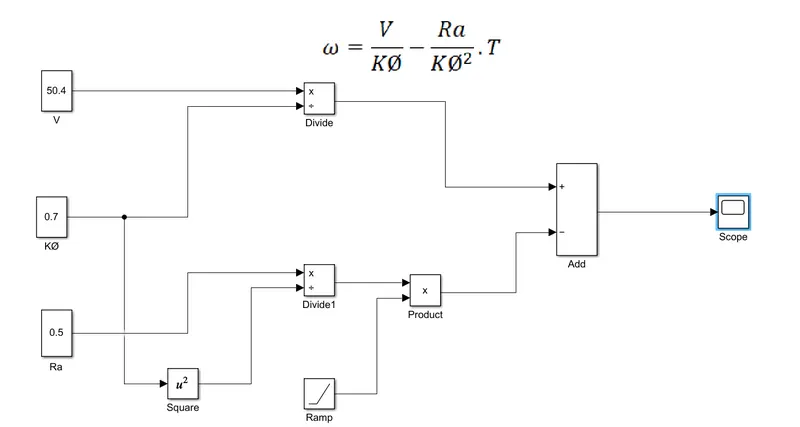
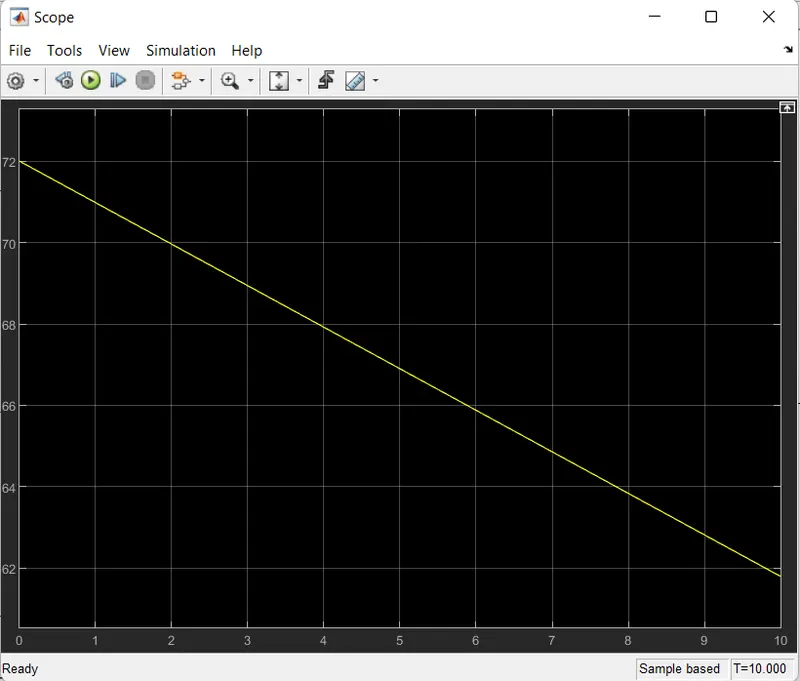
Develop a mathematical model of a DC Motor for the below equation using Simulink.
ω = `V/(Kphi)-(Ra)/(Kphi^2).T`
The values are took from above question
V=50.4 v
K phi=0.7
Ra=0.5
Result
TASK IV
To explain Tesla’s blog on the topic induction versus DC brushless motors
In the above mentioned topic, the author Walley Rippel initially discussed how the replacement of DC brushless motor and induction motor in the future can also be possible as evolution is taking place since from his prior experience, nothing had remained permanent. He keeping in view such as switching from lead to lithium-ion batteries and from a DC motor to an induction or DC brushless motor.In this planet, there are numerous types of engines. Driver preferences will influence how the performance is delivered. The similar situation occurs with electric vehicles. The led acid batteries, DC brush motors, and contactor controllers all become outdated with the passage of time and technological advancements. Lithium has taken the place of lead, and DC is now either induction or DC brushless. In the meanwhile, modulating inverters have replaced contactors. Additionally, this will become antiquated and make way for new technologies. Induction and brushless machines will be in bitter rivalry with one another for this.
The difference between the two motor drives most frequently utilised in the automotive industry: the induction motor drive and the DC brushless motor drive. Rippel goes into great detail about how the two drive types differ from one another in terms of design, labour requirements, and price. He hasn't concluded that one sort is superior than the other, though, based on what he's written. There is no one best engine type, according to Rippel, who concludes the first paragraph by stating that picking an engine is entirely a question of personal opinion. In the same vein, he claims at the blog's conclusion that choosing a motor drive still has "no winner" in it.Despite their similarities, both types of motor drives have advantages and disadvantages.
DC brushless motors- One or more permanent magnets are located in the rotor construction of a DC brushless machine. These magnets produce a DC magnetic field, which is connected to the current-carrying windings in the stator body. The size and polarity of the stator current are continuously changed to ensure that the output torque is constant. Constant torque demands the use of a DC brushless motor, and this control is made possible with the use of an inverter.In DC brushless machines, less heat is produced, the rotor cools more quickly, and the peak point efficiency is higher.
Induction motors-The rotor of this motor is constructed differently from a DC brushless motor since it lacks permanent magnets and instead uses stacked steel laminations with a shorted construction. Despite having the same three sets of distributed windings, the stator. In this motor, the stator, which generates a spinning magnetic field and is connected to the rotor to produce torque, has received an AC supply. Induced voltage that is proportional to the speed difference between the rotor and electrical frequency is present across the shorted structure. Induction machines don't need inverters.Induction machines have two drawbacks: they have constant speed characteristics and can be powered by a DC source or a battery, but their torque performance is still poor. Despite these, they can still be used in electric vehicle applications.The power factor of an induction machine is 85%; unlike DC machines, it cannot be 100%. In comparison to induction machines, this indicates that peak point efficiency is higher in DC brushless machines.
Today, DC brushless drives power every hybrid vehicle. The fact that each has a unique control code distinguishes inverters from DC. In DC, rotor heat generation is reduced. It can also run at unity power factor, whereas the induction drive performs best at roughly 85% power factor. Less expensive but more challenging to control are induction machines. Induction is more effective when used with a smart inverter, and magnetic flux in brushless machines is controlled.
As a conclusion, Rippel has outlined the several factors that may be used to compare the induction and DC brushless motor drives, as well as the benefits and drawbacks of each. As previously said, it ultimately depends on the user's preferences. The induction drive would be better suited for those needs if a user is looking for excellent performance at relatively lower costs. But if a user wants high peak point efficiency, high power factor, and simpler control, the DC brushless drive would be a better option. In the vehicle business, both types have a role and will continue to be relevant in their respective uses.In order to have the best of both drives, Rippel thinks that due to improving vehicle performance, both may be employed side by side under the hood of a car in the future. This would lead to a brand-new type of hybrid that blends the traits of a sports car with those of a regular vehicle
Induction drives will probably continue to rule the high performance pure electric market, while DC brushless motors will probably maintain their superiority in hybrid markets. During the upcoming golden age of electric vehicles, induction and DC brushless should coexist together.
Refferences
- https://electronics.stackexchange.com/questions/58236/why-does-a-tesla-car-use-an-ac-motor-instead-of-a-dc-one
- ELECTRIC and HYBRID VEHICLES Design Fundamentals, Iqbal Husain, 2003, CRC Press LLC