Week-6 Challenge: EV Drivetrain
EV LIVE BATCH 21
- Which types of power converter circuits are employed in electric and hybrid electric vehicle?
In EVs and HEVs, different components has different power requirements as per the function at various stages. To achieve this power converter circuits are employed as required.
A generalised power distribution for EVs, HEVs, PHEVs can be shown as
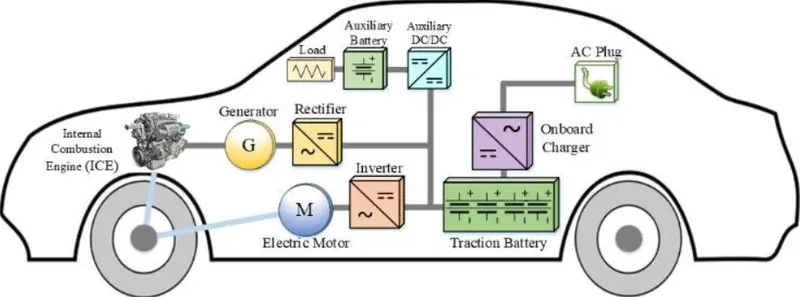
So, the power converters used are,
a) AC - DC converter : Here AC voltage is converted to required DC voltage. These are used in EVs and PHEVs to charge the battery storage used for traction. AC power fed from external grid or charging stations is fed to battery via AC - DC converter. Also used for HEVs where generator is incorporated with the engine producing AC power which is used to charge the battery. And for EVs, when there is regenerative braking, in that case also AC - DC converter comes into picture.
b) DC - AC converter : Here DC supply is converted to required AC supply. This is used to provide AC supply to traction motor from the batteries.
c) DC -DC converters : Here higher value DC voltage is converted to required lower value DC voltages. This happens by means of a converter called Buck converter. Also lower value DC voltages are converted to required higher value DC voltage by means of a converter called Boost Converter. These converters are used to supply voltage from Main Battery to all types of ancillary loads such as Head lights, Tail lights, Cabin lights, wipers, music system, infotaiment system, mirror controls etc. In HEVs auxiliary battery is also used as a extra back-up source, which is charged by both main battery and regenerative braking via DC -DC converters. It supplies power to horn, power steering and controls etc.
2. Refer to the blog on below topic:
Induction Versus DC brushless motors by Wally Rippel, Tesla
Explain in brief about author’s perspective.
In this blog, author Walley Ripple has explained the advancements in the filed of vehicle design. Previously various types of engines were used depending upon the shapes, sizes, prices as per the required performance. Similarly for Electric vehicle drives, there were lead acid batteries, DC brush motors, and contactor controllers. And now, with recent advancements, Lead has been replaced by lithium and brushed DC motor by either BLDC or induction motor and contactor controller are replaced by modulating inverters. Both the motor drives has advantages and disadvantages over one another. Also both have both the motor have construction vise similarity as, the stators are virtually identical. Both have three sets of distributed windings that are inserted within the stator core. The essential difference between the two machines is with the rotor. BLDC has permanent magnet rotor while IM has short circuited steel conductor bars designed to form a rotor.
Considering construction and working principle explained,
Induction motors have some advantages like, no permanent magnets are used hence B fields are adjustable so magnetic losses are reduced and efficiency is maximized. Motor has the ability to start under load. No inverter is needed. Motors are directly compatible with conventional utility power. Induction motor drives require only a speed sensor. As machine size grows, losses do not necessarily grow. Thus, induction drives may be the favored approach where high-performance is desired, also average efficiency may actually be better. Induction motors have great utility, they also have some severe limitations like, they cannot operate on DC source, AC is a must. Shaft speed is proportionate to line frequency. Hence, when used with utility power, they are constant speed machines, also they have limited starting torque and somewhat limited running peak torque capabilities. The best power factor for the induction drive is only about 85 percent. This means that the peak point energy efficiency is comparitively less. Very limited applications.
For BLDC motor, it has got advantages like, much less rotor heat is generated with the DC brushless drive. Rotor cooling is easier and peak point efficiency is generally higher as it can operate at unity power factor. This means that the peak point energy efficiency will typically be comparatively higher. all of the electric vehicles except one were powered by DC brushless drives. Today, all the hybrids are powered by DC brushless drives, with no exceptions. but has some limitations such as, Permanent magnets are expensive also rotors are difficult to handle due to very large forces that come into play when a ferromagnetic material gets close to them. Again it produces no starting torque when directly connected to fixed frequency utility power. So inverter is a must whose “phase” is maintained in step with the angular position of the rotor by means of a rotor position sensor. Also, as machine size grows, the magnetic losses increase proportionately and part load efficiency drops.
Overall, DC brushless drives will likely continue to dominate in the HEVs and PHEVs, and Induction motor drives will likely to maintain dominance for the high-performance pure EVs.