Week-11 Challenge: Braking
EV LIVE BATCH 21
- For a defined driving cycle, calculate the energy required for braking.
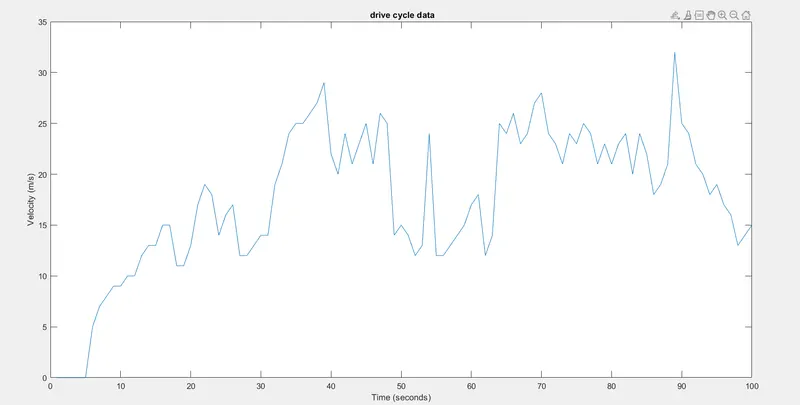
A driving cycle is a set of values, i. e. velocity vs time, which represents how a vehicle travels through a path. In simple words, it is a velocity vs time graph of a vehicle.
Braking is the process of controlling the velocity of an object by inhibiting its motion. An object in motion possesses kinetic energy and to bring the object to a stop this kinetic energy must be removed. Removing the kinetic energy can be accomplished by dissipating the energy through friction.
The kinetic energy of the vehicle is given as,
E = (1/2)*m* (V)^2, where m - mass of the vehicle
V - velocity of the vehicle
now, if velocity of the vehicle is changed due to brakes applied from V1-intial velocity to V2-final velocity,
braking energy required will be, E(b) = (1/2)*m* [(V1)^2 - (V2)^2]
Here, assuming m = 2000 kg and for the value of velocity, taken as m/sec, exel sheet is prepared as driving cycle.
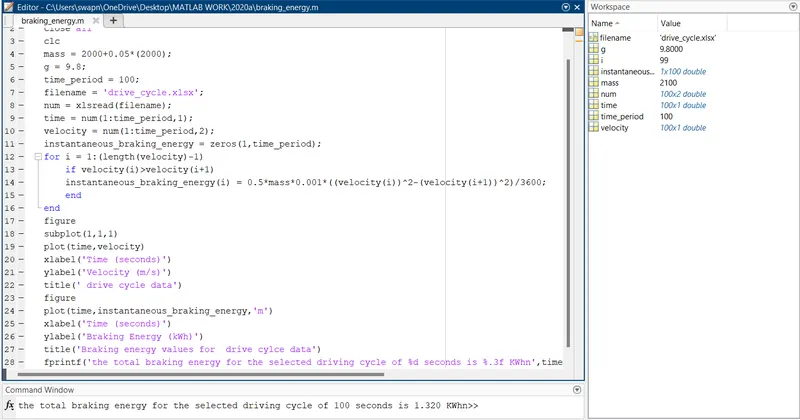
clear all
close all
clc
mass = 2000+0.05*(2000);
g = 9.8;
time_period = 100;
filename = 'drive_cycle.xlsx';
num = xlsread(filename);
time = num(1:time_period,1);
velocity = num(1:time_period,2);
instantaneous_braking_energy = zeros(1,time_period);
for i = 1:(length(velocity)-1)
if velocity(i)>velocity(i+1)
instantaneous_braking_energy(i) = 0.5*mass*0.001*((velocity(i))^2-(velocity(i+1))^2)/3600;
end
end
figure
subplot(1,1,1)
plot(time,velocity)
xlabel('Time (seconds)')
ylabel('Velocity (m/s)')
title(' drive cycle data')
figure
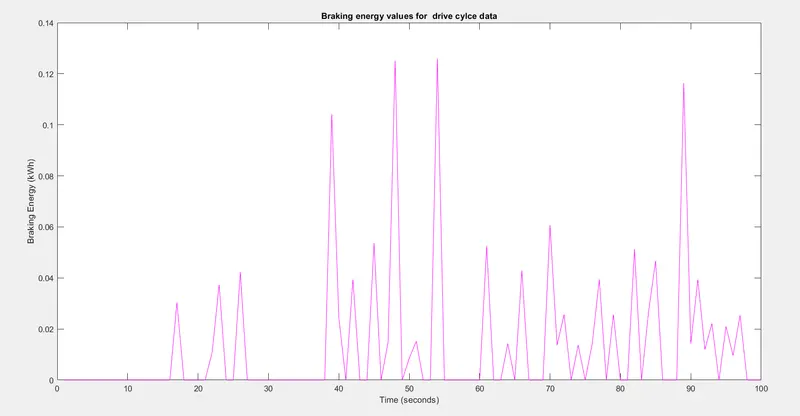
plot(time,instantaneous_braking_energy,'m')
xlabel('Time (seconds)')
ylabel('Braking Energy (kWh)')
title('Braking energy values for drive cylce data') fprintf('the total braking energy for the selected driving cycle of %d seconds is %.3f KWhn',time_period, sum(instantaneous_braking_energy))
2. Why electric motor can’t develop braking torque at high speed similar to starting? How electric and mechanical brakes are coordinated?
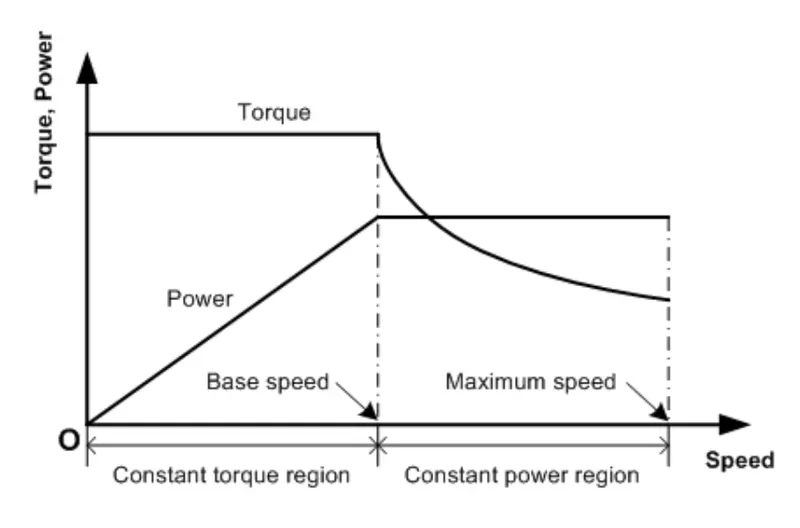
At the time of starting, speed is less or zero, so torque produced by the rotor has high constant value. It will remain so until the speed reaches to the rated or critical speed. This region is constant torque region where motor operates at low speed and high torque delivering increasing power. As speed increases further, torque will reduce gradually. This region is constant Power region, where motor speed is high and torque is low delivering high constant power.
now, in EVs and HVEs, there is a motor-generator, and a battery pack to supply power. As the electric current travels through the motor within a magnetic field, it generates a force. The more current applied, the more the motor will spin.
A generator does something similar, but the direction of the electric flow is reversed, rather than taking in current to spin the armature, the armature is spun through the field by the deceleration of the vehicle i.e. when brakes are applied. This produces electricity, which is used to recharge the battery, and the motor can switch between powering the car and regenerating electricity as fast as the driver can accelerate and lift off.
But at zero RPM, i.e. at the time of starting, all of the electricity the motor creates from the time electric power is applied becomes instant torque—without any back EMF to reduce its output. The higher the revs, the more back EMF, meaning that instantaneous torque effect diminishes.
Hence, at higher speed, electric motor can’t develop braking torque at high speed similar to starting.
- Coordination of Electric and Mechanical brakes :
In Electric Vehicle, Braking system comprises the combination of both electric braking i.e. regenerative breaking and convensional mechanical braking i.e. friction brakes. The coordination of these brakes has to be in such a way that it should meet the required braking force.
There are mainly 2 combinations :
- Series : Here electric braking i.e. regenerative breaking and convensional mechanical braking are applied one after another. Only one system will be operating at a time. If braking force required is sufficient enough to be provided by means of regenerative breaking, then only it will be used preferably otherwise mechanical brakes will be applied. Further more it can be catagorised as, whether sudden requirement is there or not i.e. driver's comfort otherwise energy efficient way can be used
-Parallel : In this case, both regenerative breaking and convensional mechanical braking are applied at the same time.
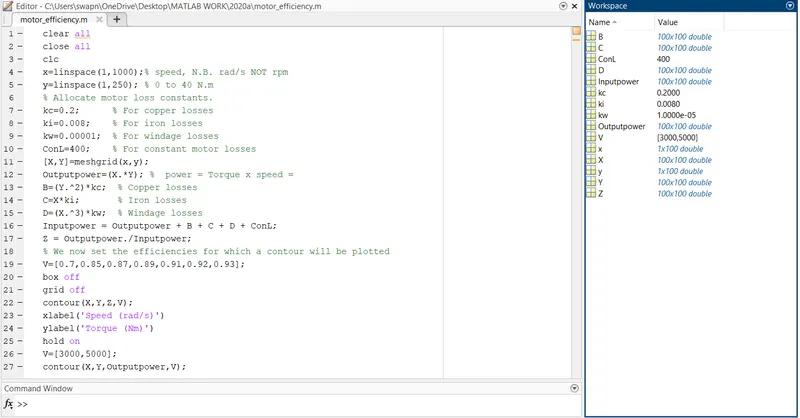
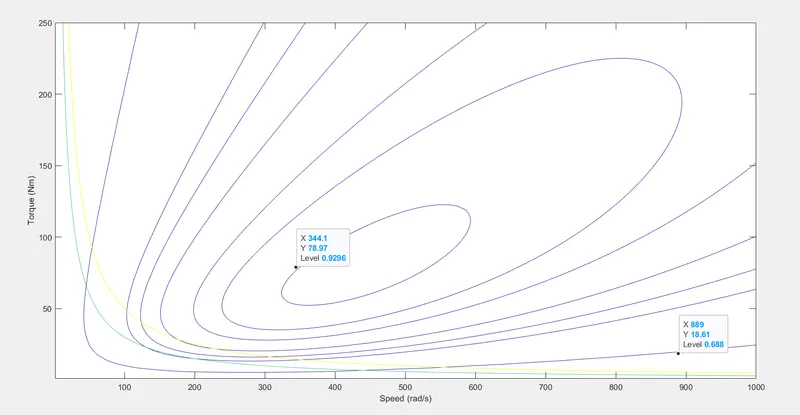
3.Make a MATLAB program which plots contour of given motor speed, torque and efficiency values. Attach the code as a .m file attach a screenshot of all the plots.