Week-6 Challenge: EV Drivetrain
Q1:
There are three types of Power Electronic Converters that are used in Electric and Hybrid Electric Vehicles, namely:
- AC-DC Converter(Rectifiers)
- DC-AC Converter(Inverters)
- DC-DC Converters(Choppers)
We will now look at the use of these converter types in different parts or components of a vehicle.
- Use of AC-DC Converters in EVs- In On-Board Charging of EVs, rectification is an essential and important step. The AC voltage input is of alternating nature however, the battery needs to be supplied with a controlled direct current in order for charging. For this purpose, we require an AC-DC converter power electronic circuitry.
- Inverter Circuitry in EVs: In a motor drive, the DC power output from the battery pack needs to be converted to AC in order to run the motor driving the vehicle. Hence an inverter circuit is used to convert the DC to AC current which is a power converter application.
- DC- DC Converter- There are several systems in a vehicle that require a DC current supply for instance, the lights and the Air Conditioning system which require a lower voltage level as compared to the one available from the high voltage battery. Example. 450 V DC to 12 V DC. Such switching of DC Levels is done by a DC-DC Converter or chopper which is a step-down or buck converter.
Q2:
Duty Ratio d1- acceleration operation and d2- braking operation, new duty ratio-70% or 0.7.
Given,
Motor and Controller Parameters:
Rated Armature voltage= 72 V
Rated armature current= 400 A
Ra= 0.5Ω, KΦ= 0.7 Volt second
Chopper Switching frequency= 400 Hz
Vehicle Voltage= Duty cycle* Voltage of Battery.
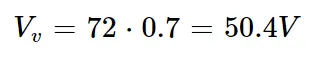
We will calculate speed for the duty-0.7
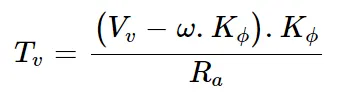
Torque of Vehicle=((Velocity-Steady state speed*motor constant)*motor constant)/Armature resistance.
In equation form: `T_v=((V_v-omega.K_phi).K_phi)/R_a`
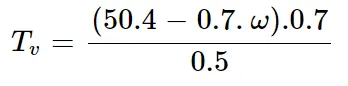
`T_v=((50.4-0.7.omega).0.7)/0.5`
On substitution, we get the equation:
 ......Equation 1
 ......Equation 2
Combining the two equations, we can get a quadratic equation and find two solutions.

w=36.85 rad/s or w= -230.95 rad/s are the two solutions.
We take the 36.85 rad/s speed which is the steady state speed of the vehicle.
Q3:
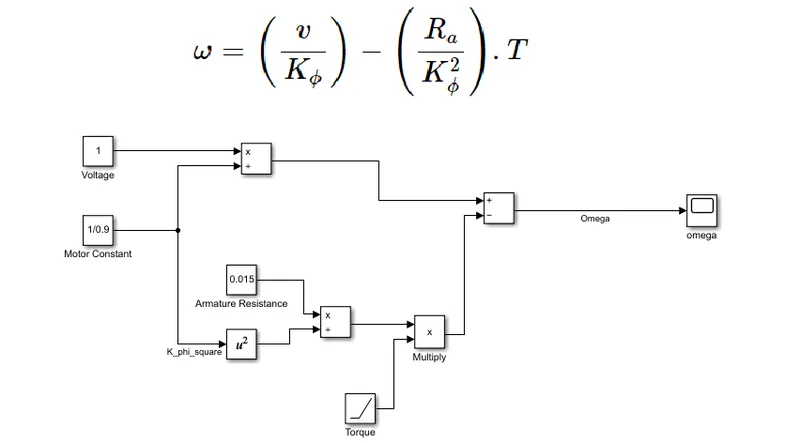
We have to model the following equation using SIMULINK.
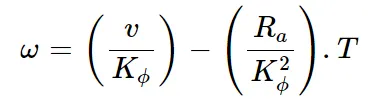
The model was designed as shown below.
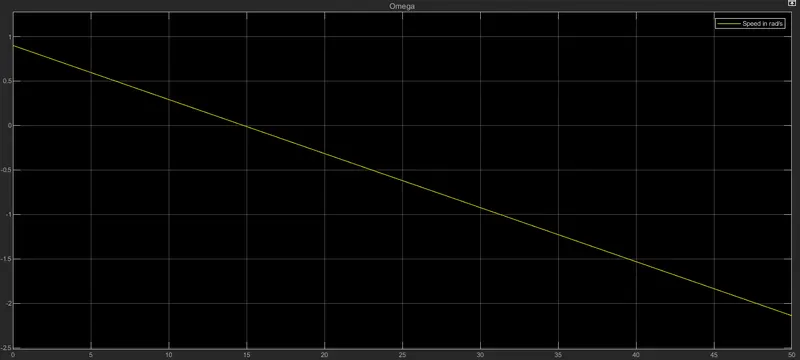
The output of the value of omega is shown in the graph below. This is a graph of speed in rad/s vs time of the simulation. The slope of this curve was about 60.5/kilo-second.
Q4:
In this article, the very experienced industry expert talks about the differences between Brushless DC Motors and Induction Motors and how they are being used in Electric Vehicles for the past so many years.
He starts by saying that one size does not fit all and the usefulness of both Induction as well as Brushless DC Motor will not over power the other and would be used in the industry for different applications as both of these have unique properties and use cases.
He then goes on to compare the two motors. Summarized in the table below are the differences and similarities he has discussed.
| Brushless DC Motor | Induction Motor |
| Use of Permanant magnets causes the motor to become more expensive but easier to control. | No magnets but adjustable magnetic fields which are controlled by making voltage/freq. ratio same. |
| Current control using inverter and position sensor is mandatory for operation. Cannot start under load as there is no starting torque produced. | No position sensor is needed and no inverter. The motor can start under loaded condition also. |
| Operating point is at unity power factor. Less rotor heat is generated and easily cooled. High peak point efficiency. | Power Factor is about 0.85. Peak point efficiency is not as high. |
| Overall Efficiency is lower than induction motor. | High overall efficiency. |
| Control Strategies are effective and easy. | Control of induction motor is complex and difficult to implement. |
He finally states that no matter which motor you choose, there is no clear winner. Even though Brushless DC Motors have been used in 95% of the HEV and plug-in hybrid vehicles made till date and probably would be continued further but Induction motor could also be used in applications where high performance pure electric vehicles need to be designed.