Week-6 Challenge: EV Drivetrain
1. Which types of power converter circuits are employed in electric and hybrid electric vehicle?
ANS-
Power Converters-
A converter is an electrical circuit which accepts a DC/AC input and generates a DC/AC output of a different voltage, usually achieved by high frequency switching action employing inductive and capacitive filter elements.The DC to DC converters are used in a wide range of applications including computer power supplies, board level power conversion and regulation, dc motor control circuits and much more.
Following power converter circuit used in electric vehicle.
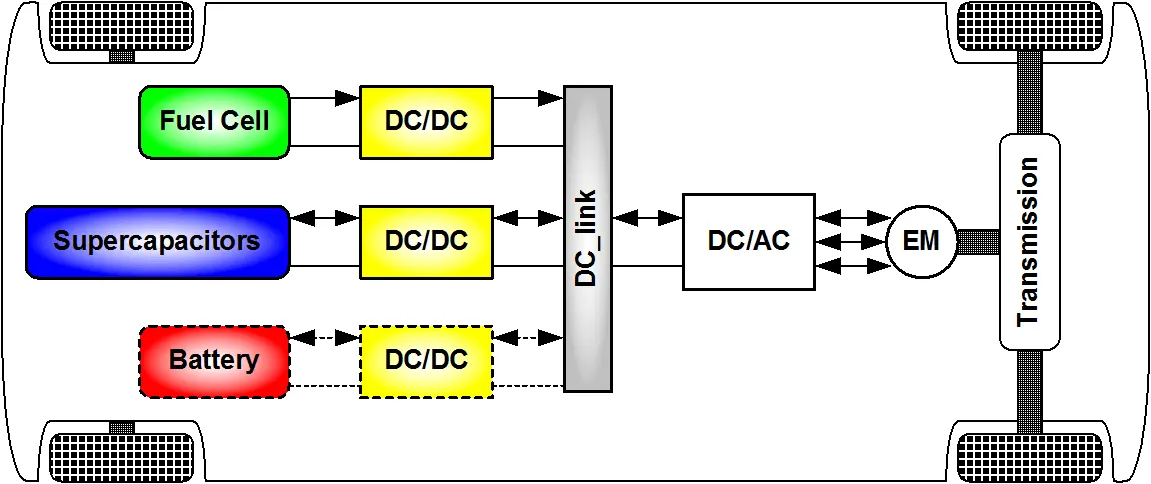
An elctric vehicle is vehicle that uses different typrs of energy sources ,fuel cell,battery supercapacitiors etc in a fuel cell battery configuration the fuel cell must provide almost the same power all the time due to the fixed voltage of the battery, and in a battery/supercapacitor configuration only a fraction of the energy exchange capability of the supercapacitor can be used.Here the concept of DC to DC converters are introduce.
DC to DC converters-
Their are main two types of converters
1.Non-isolated Converters
2.Isolated converters
1.Non- Isolated Converters-
The non-isolated converters type is generally used where the voltage needs to be stepped up or down by a relatively small ratio such as less tham 4:1.
Following type of converters comes under the non-isolated converters
buck, boost, buck-boost, Cuk and charge-pump converters
a.Buck COnverter-
A buck converter (step-down converter) is a DC to DC power converter which steps down voltage from its input (supply) to its output (load). It is a class of switched mode power supply (SMPS) typically containing at least two semiconductors a diode and a transistor, although modern buck converters frequently replace the diode with a second transistor used for synchronous rectification and at least one energy storage element, a capacitor,inductor, or the two in combination. To reduce voltage ripple, filters made of capacitors (sometimes in combination with inductors) are normally added to such a converter's output and input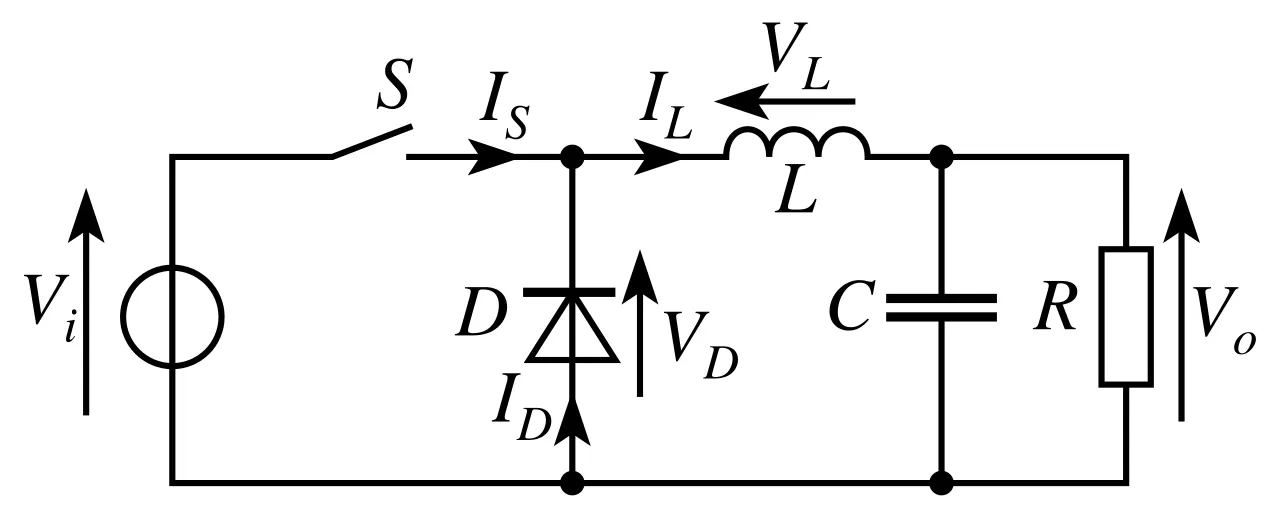
b.Boost Converter-
A boost converter is step up converter which step up the DC to DC the voltage .It is a class of switch mode power supply (SMPS) containing at least two semiconductors and at least one energy storage element: a capacitor inductor.

c.Buck Boost Converter-
A Buck-Boost Converter is a DC to DC converter that has output voltage magnitude that is either greater than or less than the input voltage magnitude.It is equivalent to flyback converter using signal inductor instead of transformer.
2.Isolated Converters-
Usually in this types of converters high frequency transformer is used in the applications where the output need to be completely isolated from the input. isolated convertes are of following type
Half-Bridge, Full-Bridge, Fly-back, Forward and Push-Pull DC/DC converters
a) Half-bridge Converter-
Half Bridge converter is a type of DC to DC Converter that like flyback and forward converter can supply output voltage either higher or lower than the input voltage and provide electric isolation via transformer
b)Full Bridge Converter
A full bridge converter is on of the common used converter that provide isolation in addition to stepping up and stepping down the input voltage. Other functions may include reversing the polarity and providing multiple output voltages simultaneously. Bridge converter has three main stages: The Square wave generator, energy transfer network,rectifier network.
2. An Electric Vehicle's powertrain with 72V battery pack in shown in the diagram below. The duty ratio for acceleration operation is 'd1' and for the braking operation the duty ratio is 'd2'.
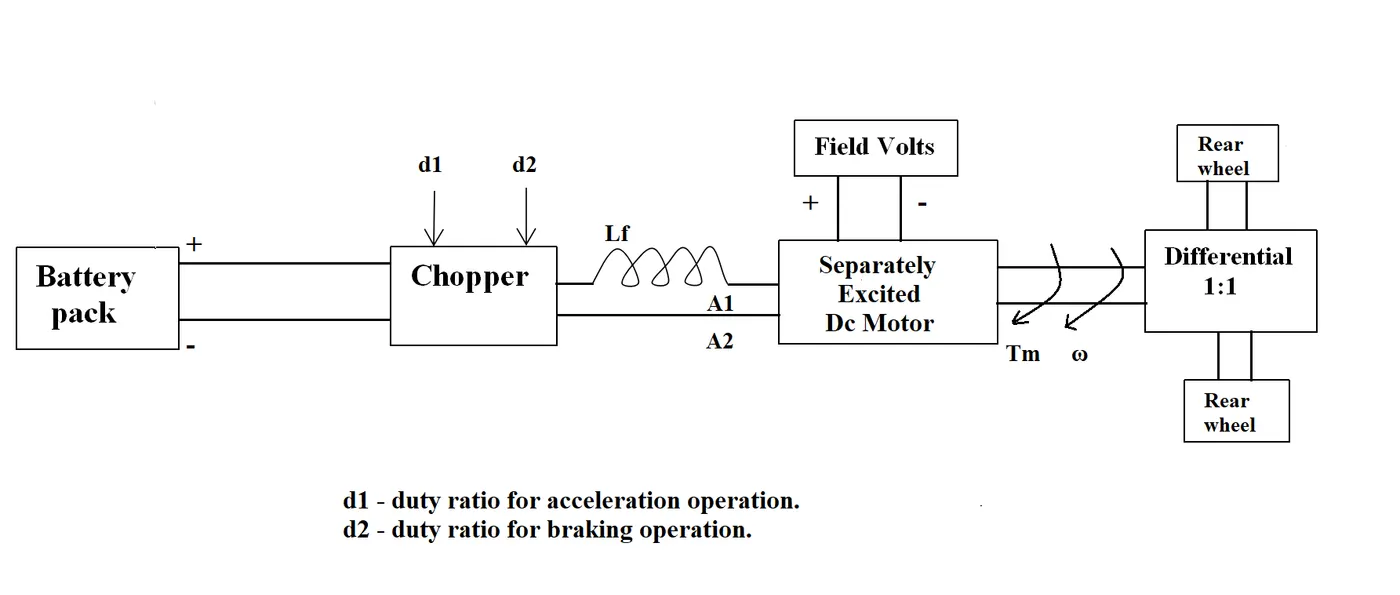
The other parameters of the electric vehicle is given below,
Motor and Controller Parameters:
Rated Armature voltage= 72 V
Rated armature current= 400 A
Ra= 0.5Ω, KΦ= 0.7 Volt second
Chopper Switching frequency= 400 Hz
The vehicle speed-torque characteristics are given by the below equation

What is EV steady state speed if duty cycle is 70%?
Ans-
As we have given the equation T=24.7+(0.0051)ω2......................equation No 1
we have given the duty cycle is 70%
means actual armature voltage will be 0.7*72=50.4V
We have know the motor torque equation
T=Vk(ϕ)/Ra-(k(ϕ)2/Ra)ω
T=50.4*0.7/0.5-(0.7)*(0.7)/0.5*ω
T=70.56-0.98ω...........................equation No 2
Comparing both the equation
24.7+(0.0051)ω2=70.56-0.98ω
0.0051ω2+0.98ω-45.86=0
by solving the above quadratic equation we get two roots
ω=38.915 rad/sec and ω=-231.07
So Steady state speed is 38.915 rad/sec or 371 RPM
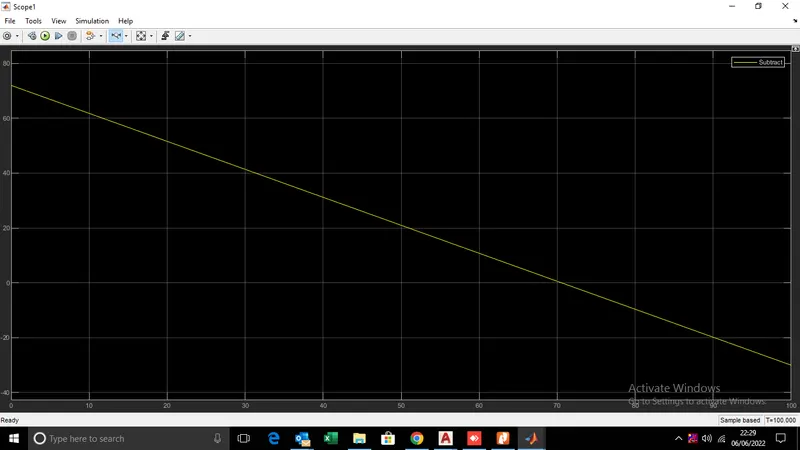
3. Develop a mathematical model of a DC Motor for the below equation using Simulink.
ω">ω= V/Kϕ">ϕ -Ra/Kϕ">ϕ^2 .T
Ans- By using above data we can module the above equation as follow
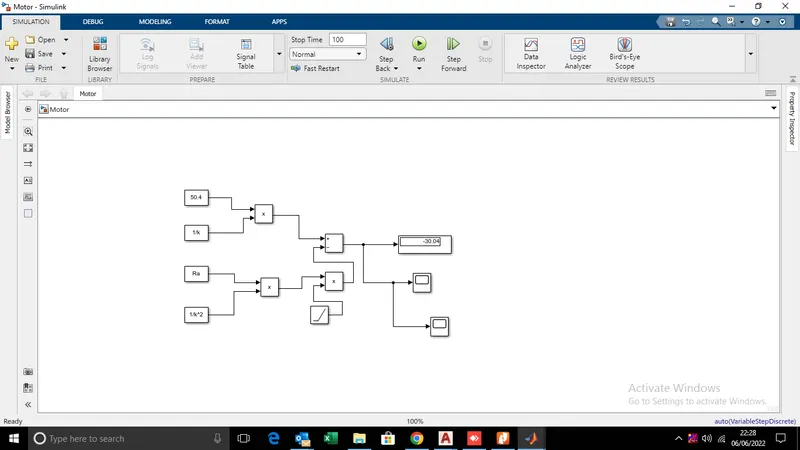
We Get the output as below as per speed torque characteristics.
4. Refer to the blog on below topic:
Induction Versus DC brushless motors by Wally Rippel, Tesla
Explain in brief about author’s perspective
Ans-
This blog is writen by Walley Rippel who is a long time proponent of electric vehicle he was an engineer at AeroVironment where he helped to develope the EV1 for General Motors .Walley has also worked for Jet propulsion laboratory on electric battery research.
In first he said one size is not fitted for all In that odious world of gas powered vehicles, engines are not all alike. There are flat-heads, Hemis, straight, opposed, and V configurations. And on and on. One would have thought that, years ago, someone would have figured out which was best. That would have ended all the choices and thereafter only the one best engine type would be in production. Not so. There is no one best engine type, rather there are different types of engines to suit personal requirements, such as price and performance. This is also true for electric vehicle drives.He sai earliar lead acid battery were used but now lead replaced by the lithium for DC motor and controllers operation.
After that he comes to the closure look in this he exlain what are the tehnologies? How do they work ? What differentiate them?
In that he brief up the working pronciple and differentiate he said With brushless machines, the rotor includes two or more permanent magnets that generate a DC magnetic field . In turn, this magnetic field enters the stator core and interacts with currents flowing within the windings to produce a torque interaction between the rotor and stator.
And in induction Motor the induction rotor has no magnets – just stacked steel laminations with buried peripheral conductors that form a “shorted structure.” Currents flowing in the stator windings produce a rotating magnetic field that enters the rotor.
Latter that he told about the similarities and disimilarities both DC brushless and induction drives use motors having similar stators. Both drives use 3-phase modulating inverters. The only differences are the rotors and the inverter controls. And with digital controllers, the only control differences are with control code.DC brushless drives require an absolute position sensor, while induction drives require only a speed sensor.One of the main differences is that much less rotor heat is generated with the DC brushless drive. Rotor cooling is easier and peak point efficiency is generally higher for this drive. The DC brushless drive can also operate at unity power factor, whereas the best power factor for the induction drive is about 85 percent. This means that the peak point energy efficiency for a DC brushless drive will typically be a few percentage points higher than for an induction drive.
He also said the induction motor has not require an invertor and it has ability to start under the load condition.
And in case DC motor it required the invertor to start
He also said that back in the 1990s all of the electric vehicles except one were powered by DC brushless drives. Today, all the hybrids are powered by DC brushless drives, with no exceptions. The only notable uses of induction drives have been the General Motors EV-1the AC propulsion vehicles, including the tzero and the Tesla Roadster.
and he conclude the blog with still no winner in that topic he said DC brushless drives will likely continue to dominate in the hybrid and coming plug-in hybrid markets, and that induction drives will likely maintain dominance for the high-performance pure electric vehicle.So we can say no one is better neithe DC brushless drives nor 3Phase Induction Motor.Eac of has its own disadvantages.