Week-6 Challenge: EV Drivetrain
EV 17TH LIVE BATCH
1.Que:
The task of a power converter is to process and control the flow of electric energy by supplying voltage and current in a form that is optimally suited for user loads. The large number of automobiles in use around the world has caused and continues to cause serious problems of environment and human life. Air pollution, global warming, and the rapid depletion of the earth's petrolem resources are now serious problems. Electric vehicles, hybrid electric vehicles and fuel cell electric vehicle have been typically proposed to replace conventional vehicle in the near future.
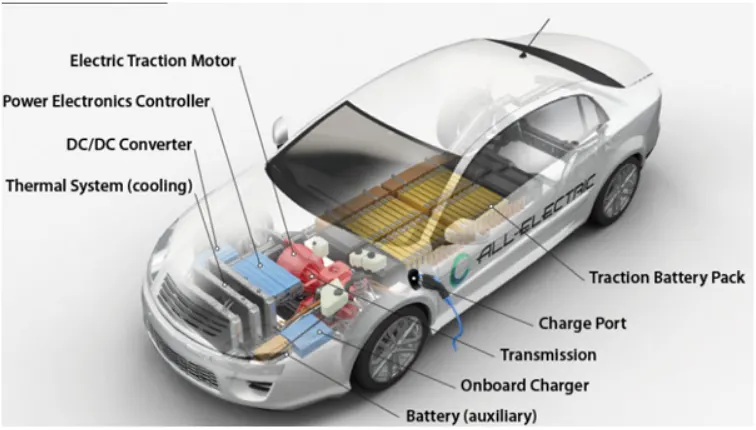
An ev is a vehicle that uses a combination of different energy sources, fuel cell, batteries and super capacitors to power an electric drive system. In ev,one or more energy storage device assist the main energy source. Thereby system cost, mass, and volume can be decreased, and a significant better performance can be obtained. Two often used energy storage devices are batteries and super capacitors.
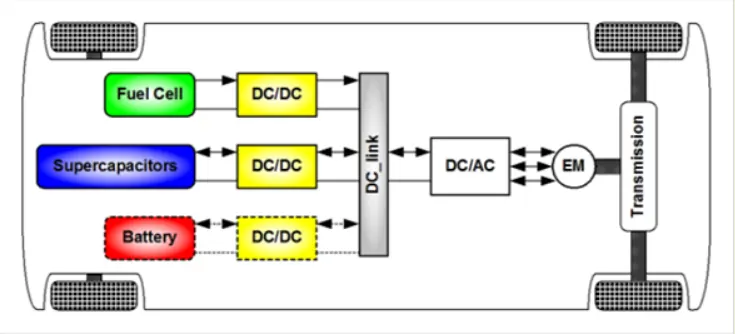
The main component of an electric vehicle are
DC-AC Inverter
DC-DC Converter
Battery
Motor
Electric vehicle comprises of 2 main power converter components they are
DC-DC Converter
DC-AC Inverter
2.Que:
Given
Duty cycle = 70% = 0.7
Voltage = Rated armature voltage* Duty cycle = 72*0.7 = 50.4 volts
T-motor Torque
V-Voltage
Ra-armature resistance
`Kphi`-motor constant
w- angular speed of motor
Torque-speed characteristic of DC motor:
Tm = (V K`phi`/Ra)-(((K`phi`)^2/Ra)*w
Tm = ((50.4)*0.7)/0.5-((0.7)^2/(0.5))*w
Tm = 70.56-0.98w...........................EQ(1)
Tv = 24.7 + (0.0051)w^2...................EQ(2)
equating the above equation(1) & (2)
24.7 +(0.0051)w^2 = 70.56-0.98
so we get quadratic equation
0.0051w^2 + 0.98w - 45.86 =0
In order to find roots to solve the above equation which is in the form of quadratic equatrion
ax^2 + bx + c = 0 by using these formulae:
`x = (-bpm root2b^2-4ac)/2a`
substituting the equations value in above formula
w = 0.98 `pm`((`root`(0.98)^2-4*0.0051*45.8)/2*0.0051
here we get w = 38.92 rad/sec or 231.02 rad/sec
steady state of the angular speed is 38.92 rad/sec
3.Que:
4.Que:
Induction versus DC brushless motors
His prospective about electric vehicle future technology cannot be predicted easily. The gas powered vehicles engines are not all same and there is no best engine type people choose according to their requirement such as price and performance these also comes under electric vehicles but in nearby future ev drives may get stability.
The author said that both induction motor and DC brushless motor have advantages as well as disadvantages and he explained about basic construction of both the motors. Induction motor does not have permanent magnets and it is connected to 3-phase utility power, torque is produced at the outset the motor has ability to start under load so the inverter is not needed so it has ability to compatible with the conventional vehicles. if induction motor size increases the losses will not increases. with the help of induction motor drive we can achieve required high performance.
Limitations of induction motor is it require source power as AC it will not operate in DC. This motor has limited starting torque and limited running peak torque capabilities as shaft spped is proportionate to line frequency so in order to overcome such draw back it requires an inverter and feedback signal and speed variation depends upon the frequency input. it is hard to control. in DC brushless motors the strength of magnetic field is adjusted when maximum torque is required, especially at low speed, the magnetic field strength should be maximum-so that inverter and motor currents are maintained ai their lowest possible values. This minimizes the i^2R losses where DC brushless machine require permanent magnet which is cost efficient. construction of DC brushless motor is costly compared to induction motor because of magnets. He finally said that dc brushless motors will dominance in HEV and PHEV and induction motor is highly preferred in pure ev.