Week-6 Challenge: EV Drivetrain
Aim:-
- To identify the types of power converter circuits employed in electric vehicle.
- To calculate steady state speed of an EV with given inputs if duty cycle is 70%.
- Refer to the blog and explain in brief about author's perspective.
Question 1:
Which types of power converter circuits are employed in electric and hybrid electric vehicle?
Power Eletronic Converters:-
- In Electric and hybrid Electric Vehicles(EV/HEV), The power electronic converters are onsidered as the key elements that interface their power sources to the drivetrain of the EV's. In order to design highly efficient converters for the EV's power system, advanced DC/DC and DC/AC converters are required o adapt the output voltage and current levels with high power quality.
The 3 types of converters which are widely used in an Electric vehicle are:
AC to DC conveter(On Board Charger):-
- AC to DC conveters are most commonly used in Plug-in Hybrid Electric Vehicle (PHEV) & Plug-in Vehicles (PEV).
- These vehicles get their propulsion power from an external electricity source (charging stations) which is alternating current.
- The battery needs to be charged using a direct current source. For this purpose, AC to DC converter is employed in a PHEV & PEV.
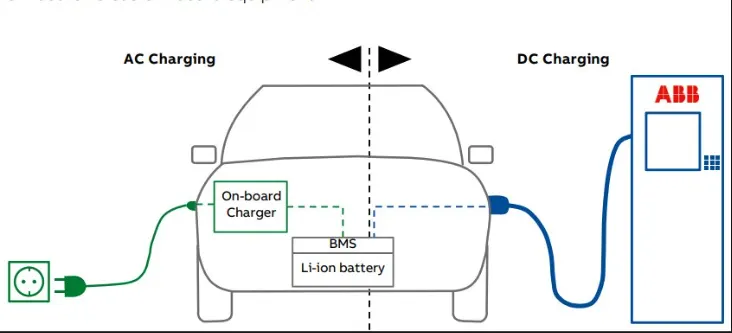
Fig 1.
DC to DC converter(Chopper):-
- DC to DC converters can be used to interfeace the elements in the electric power train by boosting or chopping the voltage levels.
- By introducing DC to DC converter which can choose the voltage variation of the devices and the power of each device can be controlled.
- The power of the DC to DC converter depends on the characteristics of the vehicle such as top speed, acceleration time from 0-100 Km/h, weight, maximum torque and power profile( peak power, continuous power).
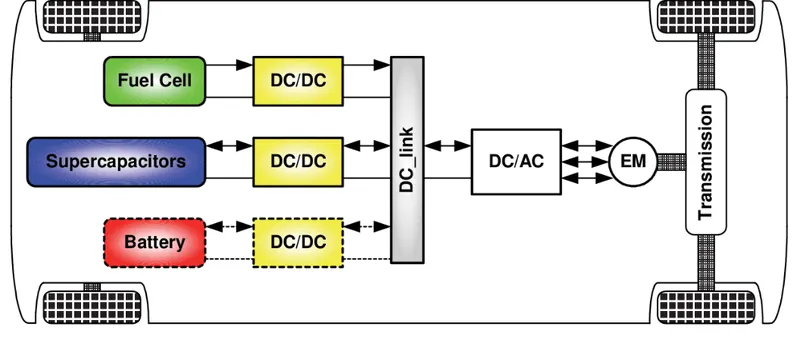
Fig 2.
DC to AC converter(Inverter):-
- The DC to AC converter is required to convert the dc power to a suitable ac power for the electrical machine.
- The power output from battery pack (DC current) is converted using inverter to be used in electric motor (AC Current).
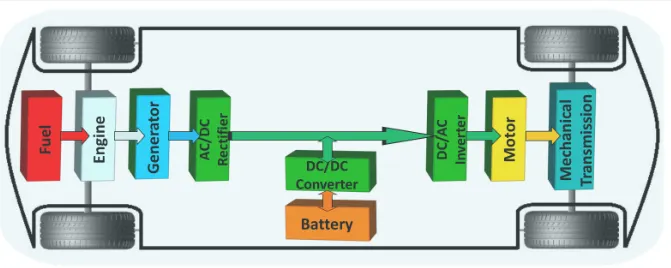
Fig 3.
Question 2:
An Electric Vehicle's powertrain with 72V battery pack in shown in the diagram below. The duty ratio for acceleration operation is 'd1' and for the braking operation the duty ratio is 'd2'.
The other parameters of the electric vehicle is given below,
Motor and Controller Parameters:
Rated Armature voltage= 72
Rated armature current= 400 A
Ra= 0.5Ω, KΦ= 0.7 Volt second
Chopper Switching frequency= 400 Hz
The vehicle speed-torque characteristics are given by the below equation

What is EV steady state speed if duty cycle is 70%?
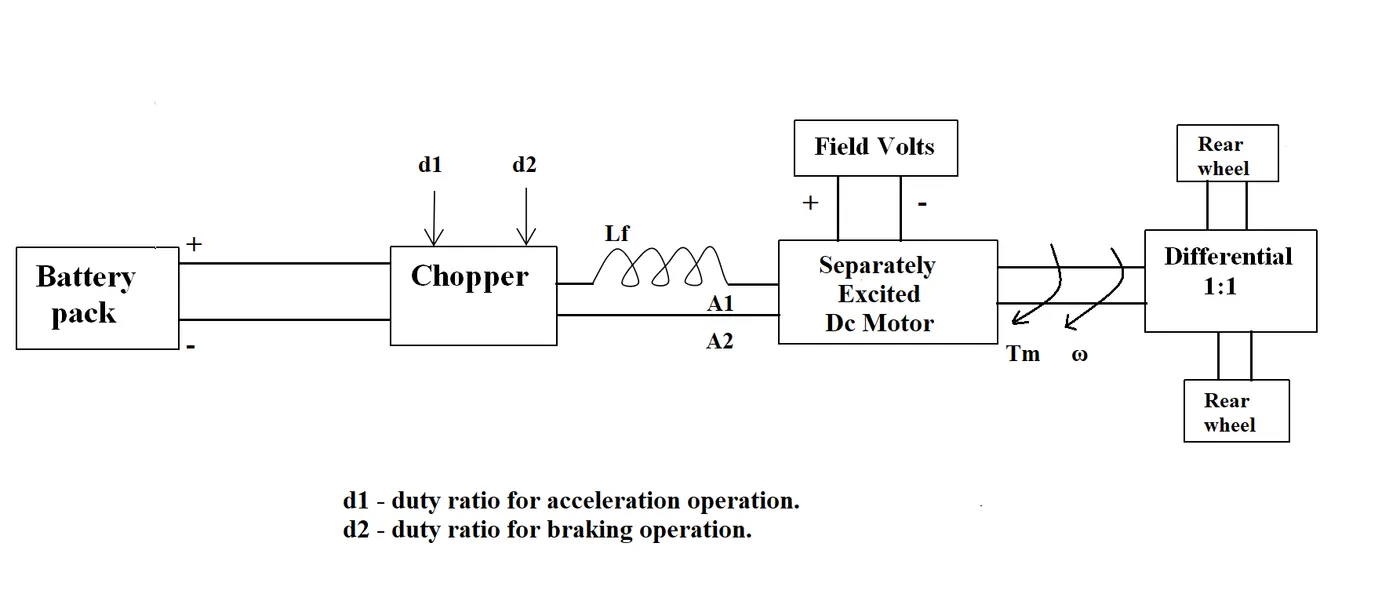
Given:-
The following input parameters are given:
Battery pack voltage (V) = 72V
Rated armature current = 400A
Armature Resistance (Ra) = 0.5 ohm
Motor constant (KΦ) = 0.7 Volt second
Chopper Switching frequency= 400 Hz
Duty Cycle = 70%
Solution:-
Vehicle otput voltage (Vv) is given by:-
Vv = Battery voltage (V) * Duty Cycle
Vv = 72 * 0.70
Thus vehicle Voltage (Vv)= 50.4V
Now equation for vehicle torque is given by
T = [Vv*KΦ / Ra] - [ω*(KΦ) ^2/Ra]
T = [50.4*0.7/0.5] - [ω*(0.7)^2/0.5]
= 70.56 - 0.98 ω
Equating given and calculate equation for torque - speed we get,
24.77+ 0.0051 ω^2 = 70.56 - 0.98 ω
0.0051 ω^2 + 0.98 ω - 45.86 = 0
solving the quadratic equation,
ω = 38.914 rad/sec ω = -230.95rad/sec
we take the positive value 371.601 RPM
Thus steady- state vehicle speed with 0.7 duty cycle is, 371.6 RPM
Question 3:
Refer to the blog on below topic:
Induction Versus DC brushless motors by Wally Rippel, Tesla Explain in brief about author’s perspective.
In this blog, the authore ompares the features of the induction motors and Brushless DC Motors and after detailed discssion, concludes around the point that DC brushless drives will dominate in the hybrid and coming plug- in hybrid markets and that induction dives will be used in high performance pure electric vehicles and the possibility of induction and DC brushless motors bothworking together in a single vehicle.
The constructional difference between the two motors is between their rotors, the stators having almost similar construction. The rotor of the brushless DC motor has permanent magnets and the interaction between the stator magnetic field and the rotor magnetic fields produce the required torque. The author focuses on the point that, to produce the variable stator magnetic field the current control required is provided by the inverter. Thus the brushless DC motors could be useless if it wasn't for the developments in the power electronics. The rotor of the induction motor has a squirrel cage type of construction and is self-starting. Thus the induction motor requires less ancillary equipment and can directly be connected to the utilitysupply.
The heat generated in the rotor is less, power factor (higher peak operating point), efficiency is better in BLDCs. On the other hand, since these motors have permanent maget rotors, the magnetic field strength is constant and there is no scope for minimization of lossese. These issues can be very effectively addressed in the induction motor drives, where the magnetic field is proportional to V/f. Thus, optimum efficiency can be maintained minimizing the losses. with an increasing rating, these factor proves advantagous for the average efficiency of the IM because BLDC drives cannot really control the amount of power lost.
Spinning induction machines produce little or no voltage when de-excited thus they are easier to protect where as Permanent magnet (PM) rotors are also difficult to handle due to very lare fores that come into play anything ferromagnetic gets close to them thus requires high amount of protection. IM's retains cost advantages over BLDC drives.
These comparisons make BLDC drives suitable for commercial vehicles like HEVs and PEVs and 3 phase IM drives will dominate high performance pure electric vehicls.
CONCLUSION:
*The power eletronic component play a very important role in the vehicle control and operation of the vehicle.
*BLDC and Induction motor drivs will prevail in the EV market in the years to come.