Week-6 Challenge: EV Drivetrain
1. Which power converter circuits are employed in electric and hybrid electric vehicles?
2. An Electric Vehicle with a 72V battery pack is shown in the diagram below. The duty ratio for acceleration operation is 'd1', and the 'duty ratio is 'd2' for the braking operation.
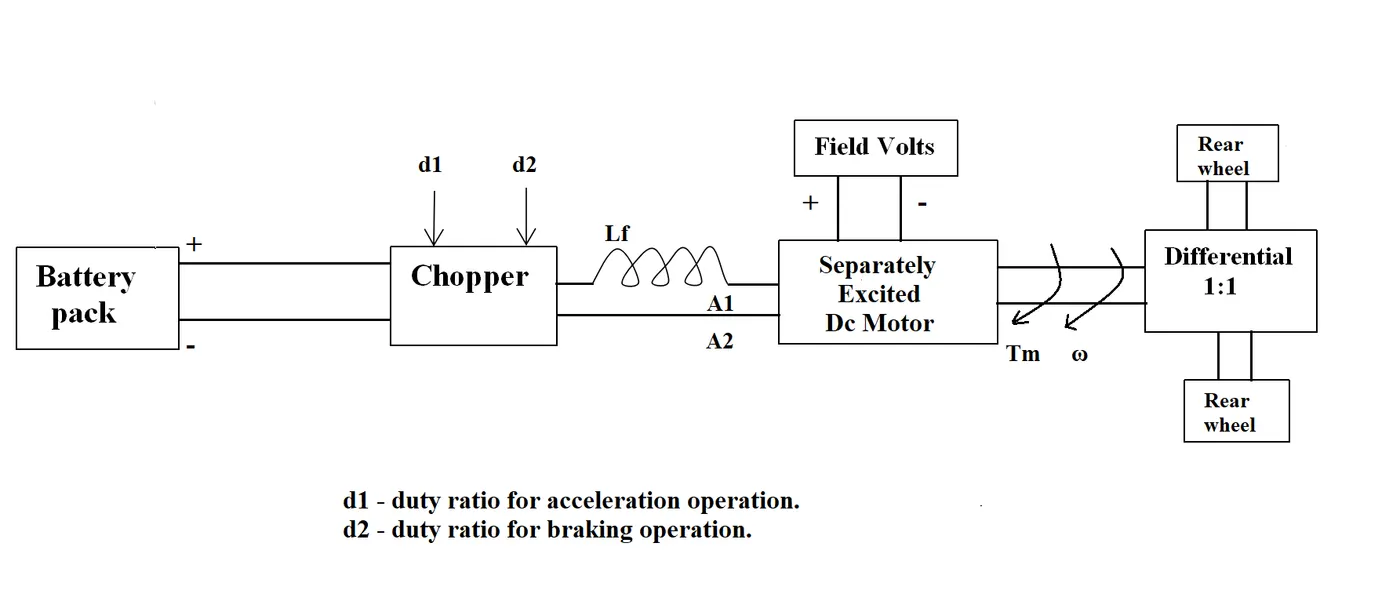
Th' o'her parameters of the electric vehicle are given below,
Motor and Controller Parameters:
Rated Armature voltage= 72 V
Rated armature current= 400 A
Ra= 0.5Ω, KΦ= 0.7 Volt second
Chopper Switching frequency= 400 Hz
The below equation gives the vehicle speed-torque characteristics

What is EV steady-state speed if the duty cycle is 70%?
3. Develop a mathematical model of a DC Motor for the below equation using Simulink.
ω">ωω= V/Kϕ">ϕϕ -Ra/Kϕ">ϕϕ^2 .T
4. Refer to the blog on the below topic:
Induction Versus DC brushless motors by Wally Rippel, Tesla
Explain in brief the author's perspective
************************************************************************************************************************************************************************************
Q) Which power converter circuits are employed in electric and hybrid electric vehicles?
A)
The types of power converter circuits which are employed in electric and hybrid electric vehicles are:
- AC to DC Converter
- DC to AC Converter
- AC to AC Converter
- DC to DC Converter
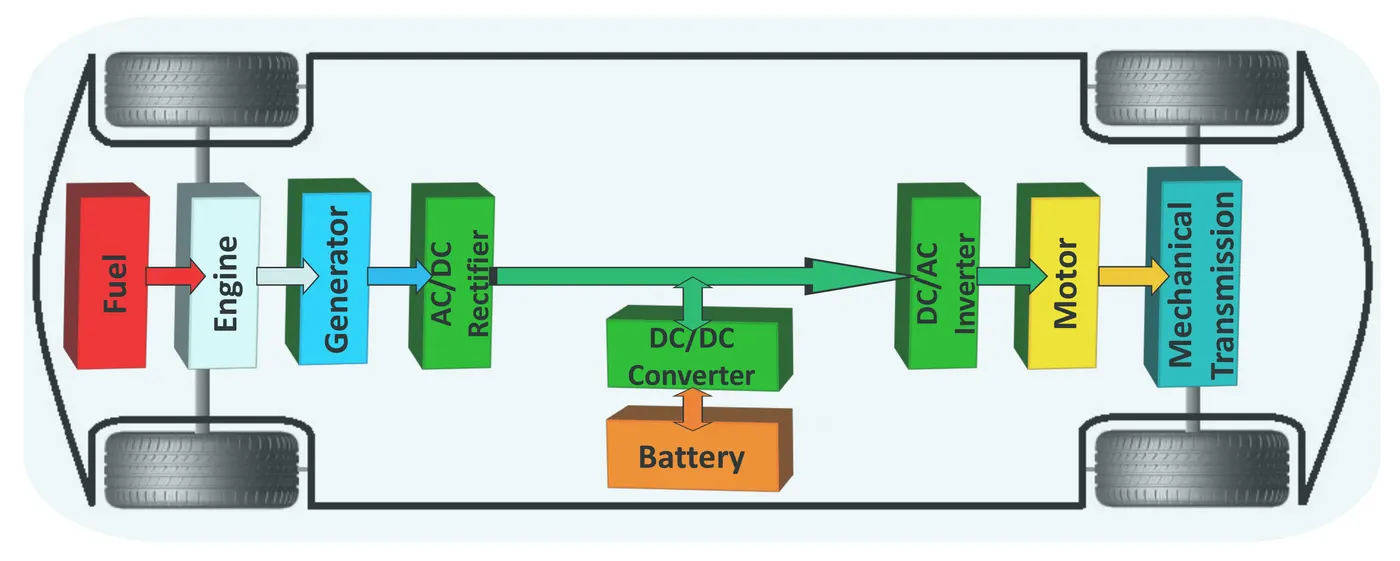
AC to DC Converter: This sort of converter takes an AC power supply and converts it to a DC one. The power produced from a power plant is communicated to our homes at a voltage of 230V at a recurrence of 50Hz, which we can use to power our electrical apparatuses. Yet, our applianced work on a DC supply, not an AC one; thus, we want a converter for this application. Ac to DC converters are telephone chargers, PC chargers and so on. An AC power supply has a substituting waveform that over and over inverts bearing. An AC to DC converter will forestall the current evolving course, so it just streams unidirectionally. In the AC to DC converter circuit, there is a stage down transformer, a diode, a capacitor, and a low dropout voltage (LDO) controller.
The progression down transformer takes the significant level 230V from the mains supply and steps it down to a lower level, for example, 12 or 13V for our utilization. However, it is still in the AC structure. Then, at that point, a diode or gathering of diodes is executed to confine the current to stream in only one heading. There will be positive and negative tops at each half cycle like a sine wave in an AC wave. The diode(s) will eliminate the negative pieces of the waveform, so there are positive pinnacles, as it were. This is called amending, and this piece of the circuit is alluded to as a 'rectifier. This can be a half-wave, full-wave or scaffold rectifier. Then, at that point, the corrected result voltage waveform is smoothened by a channel capacitor. At long last, the LDO controller will control the result for our utilization. On account of EVs or HEVs, the battery pack which works with a DC power supply is charged at home or at a charging station, the two of which are provided power in AC structure from the electric network. Thus, the chargers for these vehicles illustrate the AC to DC power converter.
DC to AC Converter: This sort of converter takes a DC supply and converts it to an AC one. The power provided from a battery or capacitor can have its structure changed to the AC type for use in homes or frameworks with an AC load. On occasion, the power created by sunlight based chargers are put away in batteries in the DC structure, and this can power a house which utilizes an AC power supply so we can use this power from the mains. This converter is alluded to as an inverter broadly used in homes and EV/HEVs. The DC supply is changed to an AC waveform utilizing an electronic switch, which is fundamentally a bunch of semiconductor semiconductors, such as IGBTs and MOSFETs. These switches are constrained by a regulator to one or the other be in an open or shut position to coordinate current progression in a circuit. The regulator conveys messages to the changes to advise it to open/close and even chooses the frequency for the equivalent. By doing this activity, the DC mirrors an AC and can be taken care of to the heap required. On account of EVs and HEVs, the battery pack will supply its power to the inverter. The inverter contains a transformer which comprises an essential and auxiliary winding. The current from the battery is first provided to the crucial winding, where the electronic switches will more than once invert the current bearing to make an AC waveform. This ongoing will return where it came from. The AC in the essential winding will actuate an AC in the optional winding, which then, at that point, supplies this current to an AC load, for example, the AC traction engine.
AC to AC Converter:
This converter takes an info AC waveform with a specific voltage and recurrence and results in an alternate AC waveform with another voltage and reproduction. The resulting voltage or frequency can be changed or kept up by relying upon the application. This converter has numerous applications in our routine, for example, light diminishing and engine speed control. There are four primary sorts of AC to AC converters:
- Cycloconverters: This type is otherwise called a recurrence transformer. It will change the recurrence of an information AC waveform and result in an AC waveform with another repeat, yet it can likewise change the greatness of the power. This kind of converter has no DC linkages and dodges any change between AC and DC to forestall misfortunes and save costs. The input wave's recurrence is changed by changing the terminating point applied to a thyristor. We can get a resulting wave for the wave's moved forward/down recurrence contrasted with the input by exchanging the positive and negative appendage thyristors.
- AC to AC convert with DC Link: As the name proposes, this type incorporates a DC link alongside a rectifier and an inverter. The rectifier first amends the info AC waveform to eliminate the negative parts of the AC wave and result in just the positive segments. This makes a DC waveform that is then put away in the DC link and converted back to an AC waveform utilizing the inverter.
- Matrix Converter: This type converts from one AC to another straightforwardly without utilizing a DC linkage to lessen expenses and misfortunes that would somehow be caused by a DC link capacity component. It is used basically to expand the dependability and proficiency of a framework. Matrix converters utilize bidirectional switches (IGBTs) to direct the current and square voltages of the two polarities.
- Hybrid Matrix Converter: This type is the same as the matrix converter in that they consolidate the AC//DC/AC plan with the matrix plan. It utilizes unidirectional switches and two converter stages without the DC link to diminish the size and weight of the converter.
DC to DC Converter: This sort of converter is like a transformer in that it can change the voltage from its ongoing level to another level. It can take an information supply of voltage and increment it or do the exact inverse and decline it like a stage up or venture down transformer. This sort of converter is known as a chopper. The motivation behind utilizing this sort of converter is to give a vital degree of power to a specific part and the well-being of the apparatus and the client. If a claim is supplied with close to nothing or a lot of voltage, it will not work because of lack of power, or it will be harmed, so everything relies upon the heap prerequisite. It works by taking the DC supply and going it through an exchanging component that converts the waveform to a square wave that is AC. Then, at that point, this AC is gone through a channel which will turn it back into a DC supply for use in a heap. In EVs, HEVs and customary vehicles, this converter is utilized for different purposes. For example, On account of venturing down the voltage, the vehicle radio might require a ventured down voltage of 12V to work and wouldn't need the total voltage of the vehicle battery. On account of moving forward the voltage, the vehicle's engine may require 500V to work. However, the car might require more voltage than the battery pack. There are two fundamental sorts of DC to DC wouldn't disengaged and non-segregated types.
The non-confined type can be partitioned into five sorts:
- Buck: to venture down the voltage Support - to move forward the voltage.
- Buck/Boost: this can make both moves ahead and venture down tasks however is primarily used to switch extremities.
- Cuk: like the Buck/Boost type.
- Charge Pump: move forward/venture down the voltage for low power sources.
The disengaged type can be partitioned into two kinds:
- Flyback converter: like the Buck-Boost converter, with the exception that it utilizes a transformer rather than an inductor to store energy.
- Forward converter: this type will utilize a transformer to send energy between the info and result in a solitary step.
--------------------------------------------------------------------------------------------------------------------------------------------------------------------------------------------------------------------------------------------------------------------------
Q) An Electric Vehicle's powertrain with a 72V battery pack is shown in the diagram below. The duty ratio for acceleration operation is 'd1', and the duty ratio is 'd2' for the braking process.
The other parameters of the electric vehicle are given below,
Motor and Controller Parameters:
Rated Armature voltage= 72 V
Rated armature current= 400 A
Ra= 0.5Ω, KΦ= 0.7 Volt second
Chopper Switching frequency= 400 Hz
The below equation gives the vehicle speed-torque characteristics
What is EV steady-state speed if the duty cycle is 70%?
A)
Given Information:
Rated Armature voltage= 72 V
Rated armature current= 400 A
Ra= 0.5Ω
KΦ= 0.7 Volt second
Chopper Switching frequency= 400 Hz
since, duty cycle is 70%; Vo = 70% x 72 = 50.4 V
we know the equation gives the torque-speed relation:
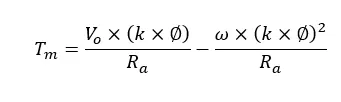
Now substitute the shared values into the above equation, and we get:
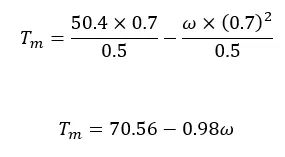
In the steady-state condition 
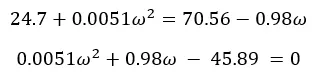
On solving the above quadric equation, we will have two values for the angular speed, assuming the forward direction to be positive, and we will be considering the positive values of the angular velocity.
`omega` = 38.92 (or) -231.09 rad/sec
--------------------------------------------------------------------------------------------------------------------------------------------------------------------------------------------------------------------------------------------------------------------------
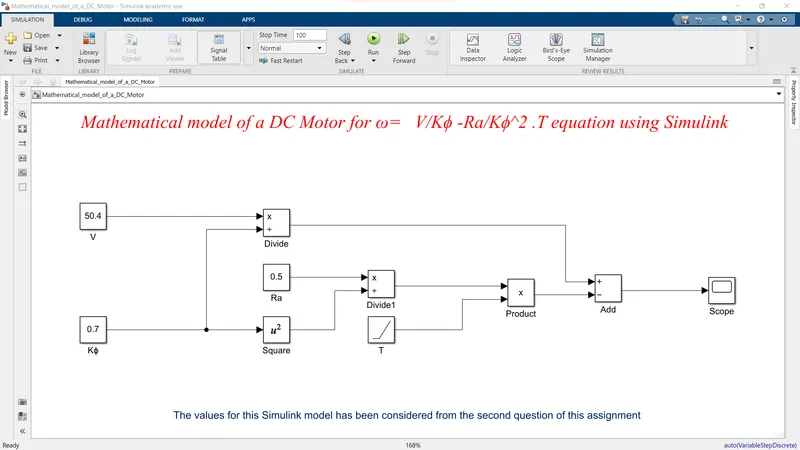
Q) Develop a mathematical model of a DC Motor for the below equation using Simulink.
ω">ωω= V/Kϕ">ϕϕ -Ra/Kϕ">ϕϕ^2 .T
A)
Simulink Model for the equations is:
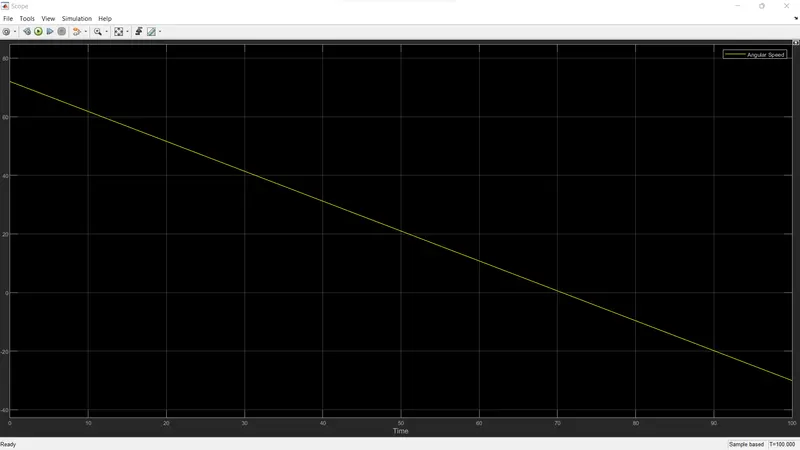
Simulation results/Graphs:
--------------------------------------------------------------------------------------------------------------------------------------------------------------------------------------------------------------------------------------------------------------------------
Q) Refer to the blog on the below topic:
Induction Versus DC brushless motors by Wally Rippel, Tesla
Explain in brief the author's perspective.
A) The writer composes this blog to distinguish between the two most regularly involved motor drives in the vehicle industry: the DC brushless motor drive and the acceptance motor drive. Rippel explains the contrasts in development, working, and cost between the two drive types. Be that as it may, with what he has composed, he has not concluded that one sort is better compared to the next. In the last lines of the initial section, Rippel composes that there is nobody's best engine type and that it is each an issue of individual inclination regarding picking an engine. In this equal respect, he closes the blog expressing that there is still no victor' in motor drive choice. Disregarding both motor drive types having similitudes, they likewise have advantages and drawbacks. For DC Brushless drives, we are informed that their development executes at most minuscule two extremely durable magnets at the rotor to produce a DC attractive field. It also comprises a stator centre (thin, stacked overlays). It likewise utilizes an inverter for the ongoing control, implying that it can't run on a DC power supply as the ongoing course must be changed more than once to keep a steady force. For acceptance drives, their rotor has no magnets. However, rather stacked steel covers with covered fringe guides structure a shorted structure'. The ongoing stator windings create an attractive pivoting field that interacts with the rotor. Acceptance motors can be utilized straightforwardly with power from the mains and don't need an inverter to begin the drive; furthermore, they create the beginning force. It can start under the mains load applied. Be that as it may, DC brushless drives can't do likewise. They can't produce a beginning force when associated with a mains power supply. They require an inverter to do this. Enlistment motor drives can't run on a DC power supply and are exclusively subject to an AC power supply. Moreover, whenever they are associated with a 3 stage mains supply, the rotor pivots at a consistent speed, and they have a restricted beginning force and pinnacle force. An inverter can be utilized to work the enlistment drive from a DC power supply or a battery to redress this. Likewise, if the inverter recurrence has fluctuated, the consistent speed is no longer an issue - it tends to fluctuate. DC Brushless drives utilize long-lasting magnets and can't change the strength of their attractive fields. It would be attractive on the off chance that they would be able because when the rotor requires the most extreme force, the attractive field strength ought to likewise be at a most powerful level. This considers the inverter and motor flows to be, consequently, lessening the power misfortune by heat scattering. Likewise, when the force required is least, the attractive field strength should again be least to decrease hysteresis and vortex current misfortunes. The super durable magnets utilized are likewise very costly, costing $50 per kilogram, and their attractive fields are hard to control if ferromagnetic material draws near enough to the area. Then again, acceptance drives don't have long-lasting magnets. Thus, they can shift their attractive field strength. Whenever utilized with a smart inverter, they can be worked with least hysteresis, whirlpool current misfortunes and most incredible productivity as the attractive field strength can be changed according to the prerequisite by the rotor. These misfortunes don't increment, assuming the size of the acceptance drive additionally increments; however, as a DC brushless drive gets greater, its misfortunes increment and their effectiveness diminished. So acceptance drives enjoy a money-saving advantage contrasted with DC brushless drives, despite DC Brushless drives producing less intensity at the rotors. So rotors effectively and have a higher pinnacle point productivity than acceptance drives. FOR EXAMPLE, the DC brushless motor can work at a solidarity power factor of 1, while enlistment drives can work up to a power factor of roughly 85%. Taking everything into account, Rippel has explained the various perspectives about the acceptance and DC brushless motor drives. Furthermore, enjoys point by point the benefits and impediments of the two kinds. As referenced before, toward the day's end, it relies upon the client's inclination. If a client is looking for a special exhibition with similarly lesser expenses, the enlistment drive would be more qualified for those necessities. Notwithstanding, if it is high pinnacle point proficiency, high power factor and more straightforward control that a client looks for, then, at that point, the DC brushless drive would be the more brilliant decision. Both types have their place in the vehicle business and will hold their significance in their applications. Rippel trusts that because of the rising exhibition of vehicles, one day, both might be utilized next to each other under the hood of a car to deceive the two drives. This would bring about another mixture that joins the characteristics of a standard vehicle, for example, a car, with that of a game car.
************************************************************************************************************************************************************************************