Week-6 Challenge: EV Drivetrain
converters-
A device which converts one waveform to another waveform is called a converter.
Example
1 AC to DC converter - Rectifier
2 DC to AC Converter - Inverter
3 DC to DC converter - Chopper
4 AC to AC converter - Cyclo converter
Electrical vehicle-
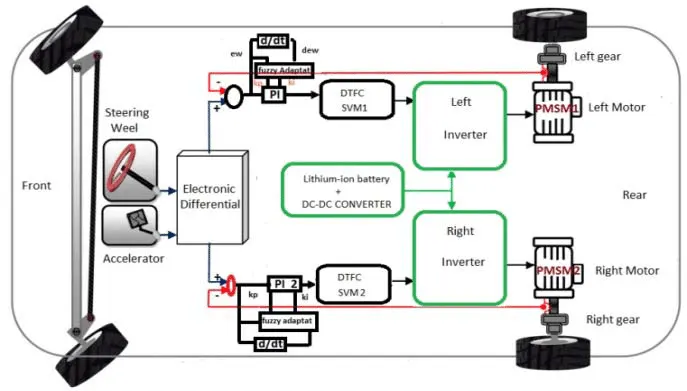
Rectifier
But in electrical vehicles, we will use Ac to dc converter to charge the battery from an external AC supply.
Chopper-
To control the speed we will use a dc to dc converter and also get control of the power input if we are using DC motor
then directly we can feed the motor
Inverter-
When Induction motors are present then we need to convert it from dc to AC and feed it to the induction motor.
But mainly we need control on both voltage as well as frequency so we need both inverter and chopper
Hybrid electrical vehicle-
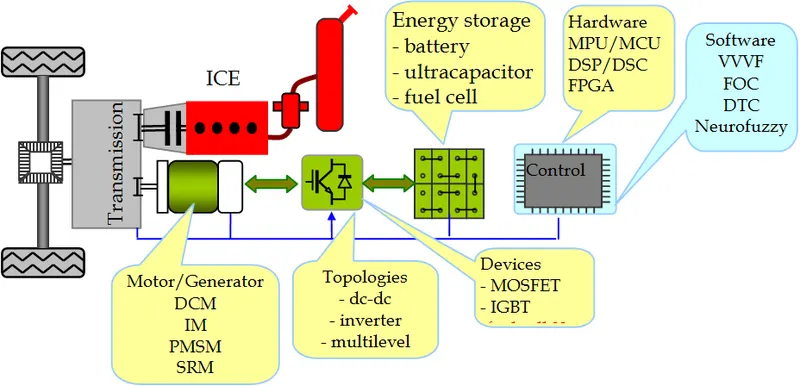
Rectifier-
To charge the battery here also we need AC to DC converter.
Inverter-
If we are using an induction motor then we need to use DC to AC supply to run the induction motor
CHopper
Choppers also are used to control the voltage and frequency in the DC motor to control
Mainly all type of converter is used in both the vehicle base on the requirement except
AC to AC converters are less used in electrical vehicle
Ans 2-
Given data
Rated Armature voltage= 72 V
Rated armature current= 400 A
Ra= 0.5Ω, KΦ= 0.7 Volt second
Chopper Switching frequency= 400 Hz
The vehicle speed-torque characteristics are given by the below equation

What is EV steady-state speed if the duty cycle is 70%?
We know that
T=KΦV/Ra-W(kΦ)^2/Ra
Vavg=Vt*duty cycle
V= Vavg=72*0.7
V=50.4Volt
T=0.7*50.4/0.5-0.7^2*W/0.5
T=70.56 -0.98 W equation-1
. equation-2
The study states
Braking Torque= Accelerating torque
24.7+(0.051)W^2=70.56 -0.98 W
`nbsp; 0.0051W^2+0.98W-45.86=`
We can use the quadratic formula to solve this
`nbsp; W1, W2=(-b+-root2( b^2-4ac))/(2a)`
`nbsp; `W1, W2=(-0.98+-root2 (-0.98^2-4*0.0051*45.86))/2*0.0051`
By solving this equation we have got the W1 value as
W1=-231.07184542581 W2=38.91498268071
Angular velocity cannot be negative so the actual speed = 38.91red/sec
W=38.91 rad/sec
Ans3-
A mathematical model of a DC Motor for the below equation using Simulink is given below
ω= V/Kϕ -Ra/Kϕ^2.T
procedure to make this model-
1 I have taken 4 constant block and, gain block , divide block , product block and display
2 I have arrenged them as we are seeing in below figure
3 I have defined all constant and gain block value in simulink model workspace as shown below
V=24 volt
T= 3 N-m
Ra=1 ohm
Kphi=0.5 volt-sec
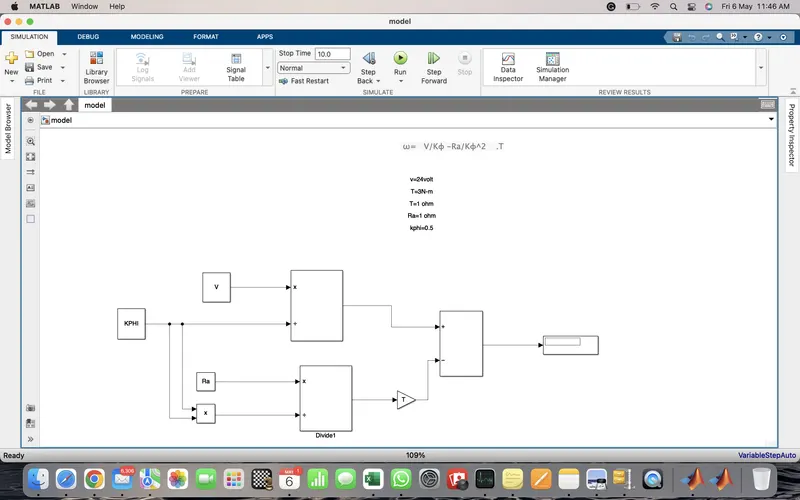
4 Now I have run the program by giving run timeas 10 sec.
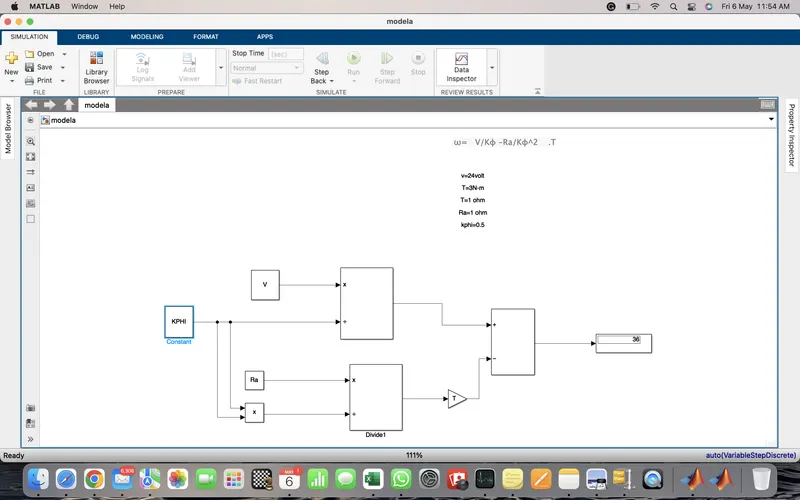
Output-
36 is the angular speed we have got after runnining the simulation
Ans 4-
Induction Versus DC brushless motors by Wally Rippel, Tesla
Author prospective-
In this article author is compairing dc brushless motor with induction motor.As now DC brushless motor are used in hybrid electrical vehicle only as hybrid electrical vehicle are depending more on electrical power less on fuel we will see here also compition between DC brushless and induction motor, In induction motor eddy current and hysterisis loss are additional compare to DC brushless motor becouse of efficiency people are more prefering to DC brushless motor. DC brushless motor is having permanent magnet which very much costly and also it will get effected if any ferromagnetic matreal are their near to it so induction motor are more preferable. Author is stating that in coming years induction motor in dc motor have tough fight between them. Induction motor and DC motor are having same stator connection but different rotor structur in induction motor only steel rods are used. When inverter are intraduce then V/f method came which makes induction motor very much important than induction motor.