Week-6 Challenge: EV Drivetrain
Q.1.
- A converter is an electrical circuit that accepts a DC input and generates a DC output of a different voltage, usually achieved by high frequency switching action employing inductive and capacitive filter elements.
- A power converter is an electrical circuit that changes the electric energy from one form into the desired form optimized for the specific load. A converter may do one or more functions and give an output that differs from the input.
- It is used to increase or decrease the magnitude of the input voltage, invert polarity, or produce several output voltages of either the same polarity with the input, different polarity, or mixed polarities such as in the computer power supply unit.
- The DC to DC converter is used in a wide range of applications including computer power supplies, board-level power conversion and regulation, dc motor control circuits, and much more.
- The converter acts as the link or the transforming stage between the power source and the power supply output.
- There are several kinds of converters based on the source input voltage and the output voltage and these fall into four categories namely the AC to DC converter known as the rectifier, the AC to AC cyclo converter or frequency changer, the DC to DC voltage or current converter, and the DC to AC inverter.
Converters used in HEV
AC-DC converter:
- The AC to DC converter is generally used in plug-in hybrid electric vehicles and plug-in electric vehicles.
- the AC to DC converter is also known as a rectifier. This process of conversion from AC to DC is called rectification and it straightens the direction of the current and does not let it get reversed.
- Rectifiers are of various forms such as Vaccum tube diodes, wet chemical cells, mercury-arc valves, stacks of copper and selenium oxide plates, silicon controlled rectifiers, semiconductor diodes, and other silicon-based semiconductor switches.
- They are often found serving as components of dc power supplies and high voltage dc transmission systems. The radio signal detectors also serve as rectifiers. Also in gas heating systems, flame rectification is used to detect the flame presence.
DC-DC converter:
- DC to DC converter is very much needed nowadays as many industrial applications are dependent upon DC voltage sources. The performance of these applications will be improved if we use a variable DC supply.
- It will help to improve the controllability of the equipment also. Examples of such applications are subway cars, trolleybuses, battery-operated vehicles, etc. We can control and vary a constant DC voltage with the help of a chopper.
- A chopper is a basically static power electronics device that converts fixed DC voltage/power to variable DC voltage or power. It is nothing but a high-speed switch that connects and disconnects the load from the source at a high rate to get variable or chopped voltage at the output.
Converters used in EV
- AC-DC converter
- DC-DC converter
- Bidirectional converter: It allows the power to flow in both directions. It contains AC-DC, DC-DC, and DC-AC converters in a single unit. It is used for the regeneration process.
DC-AC converter :
-
A power inverter, inverter, or inverter is a power electronic device or circuitry that changes direct current (DC) to alternating current (AC). The resulting AC frequency obtained depends on the particular device employed.
-
Inverters do the opposite of "converters" which were originally large electromechanical devices converting AC to DC.
-
The input voltage, output voltage and frequency, and overall power handling depend on the design of the specific device or circuitry. The inverter does not produce any power; the power is provided by the DC source.
-
A power inverter can be entirely electronic or maybe a combination of mechanical effects (such as a rotary apparatus) and electronic circuitry. Static inverters do not use moving parts in the conversion process.
-
Power inverters are primarily used in electrical power applications where high currents and voltages are present; circuits that perform the same function for electronic signals, which usually have very low currents and voltages, are called oscillators.
Q.2.
given
Va = 72 V
Ia = 400A
Ra = 0.5 ohm
KΦ= 0.7 Volt second
chopper switching frequency = 400 Hz
SOLUTION
supply voltage at 70% duty cycle, = 0.7*72 = 50.4 V
Torque speed equation of dc motor=( V.kΦ/Ra - (KΦ)2/Ra . w )
inserting values, we get,
T = 70.56 + 0.98w
now, comparing speed torque characteristics to that of the motor,
70.56 + 0.98w = 24.7 + 0.0051.w2
`implies` 0.0051w2 + 0.98w - 45.86 = 0
now, as the above equation represents the quadratic form of equations, solving the equation from the below given formula,
w = -b +_ √b2 - 4.a.c/2.a
we get,
w = 38.9 rad/sec.
Q.3.
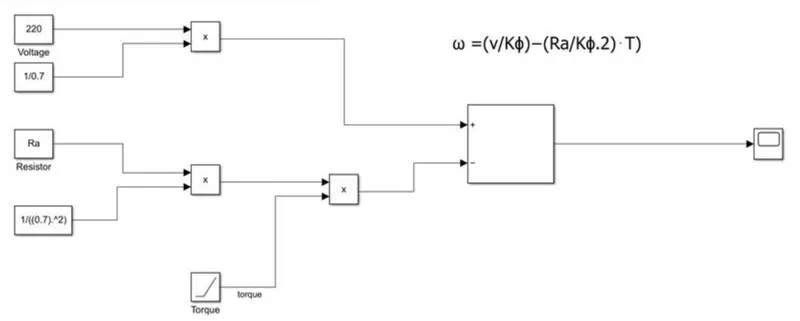
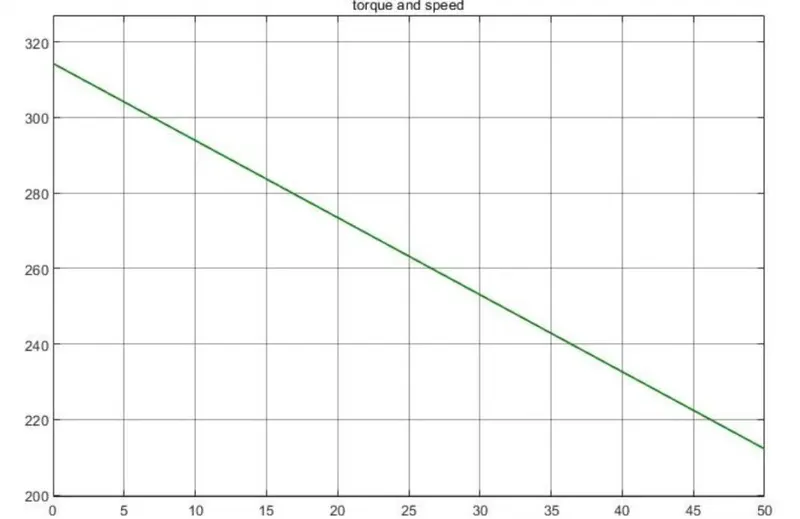
the model for the dc motor is as below:
Q.4.
The Author, Wally Repel has expressed his experience of the changing of machine mechanics and some thought about future.
He started with the types of engines that were there when he was young and that there is no perfect/ ideal engine for all vehicles. The type of engine that a car need deend on the performance and use of the vehicle and also on the budget of the user, which also applies for the electric vehicles.
He has mentioned the components that replaced the components in his time. He stated about the lead batteries that are replaced by the lithium batteries, and DC brush motors by DC brushless or induction motors, and the contactors modulating the inverters. He express his thought if there will be any stability in the near future in the components or will they also be replace by another advanced ones, and the life of brushless and induction machines for years.
Next he compares between the brushless and the induction motors and explains its construction and working. He mentions that both IM AND BLDC have the same stator functioning and that they differ in construction of the rotor. the difference he mentions is that the IM has no magnets in the rotor unlike the brushless DC rotor.
he also mentions that no inverter is needed to start the IM when it is connected to the 3-phase supply, and that Tesla's invention would have been useless if the inverter was needed to start it, whereas the BLDC importantly needs an inverter to start as it produces no starting torque.
He then states about the limitations of the IMs.he says that for the 3 phase IM AC is a must and with them being a constant speed machine when applied with utility power, they still have a limited torque performance as compared to the dc machines.
Later he starts discussing if brushless is ideal or the induction.
He mentions some minor differences in the two that, apart from the similarities there have with the same stators and same 3 phase modulating inverters, they differ only in the rotor and the inverter controls, that the BLDCs require an absolute position sensor, while induction drives require only a speed sensor, also the main difference, the peak point energy efficiency for a DC brushless drive will typically be a few percentage points higher than for an induction drive.
He then explains how an ideal BLDC has adjustable permanent magnet that is able to reduce the losses, but practically there is no easy way to adjusting them. Whereas in IM there are no magnetws and the B field is adjustable which maximises the efficiency and reduces the losses. this optimisable efficiency of IM increases its performance. Hence in this case he favours the INDUCTION MOTORS over BLDCs as he states that "induction drives may be the favored approach where high-performance is desired; peak efficiency will be a little less than with DC brushless, but average efficiency may actually be better."
Next he mentions that although IM are cost effective over PM machines and hence make devices at low cost, they have difficult control laws, i.e., they are difficult to control, they are complex and really difficult to understand. This makes it difficult to achieve stability in IMs over BLDCs."This means added development costs, but likely little or no recurring costs."
CONCLUSION
He concludes that both BLDC and IMs will continue to dominate their own markets, i.e hybrid and plug in hybrid markets for BLDCs and IMs will maintain their dominance for the high-performance pure electrics. He also states that as the performance levels increase and become advanced, he concludes that the BLDCs and the IMs will work side by side in the future hybrid and electrical era.