EV DRIVETRAIN
OBJECTIVE-1`to`Which types of power converter circuits are employed in electric and hybrid electric vehicle?
In EVs, the Fuel Cell (FC) stack, battery bank, and Supercapacitors (SCs) bank are usually used as clean energy sources. Combining such energy sources leads to a FC/SC/battery Hybrid Power System (HPS). In comparison with single-sourced systems, HPS has the potential to provide high quality, more reliable, and efficient power.
In HPSs, the power-electronic converters are considered as the key elements that interface their power sources to the drivetrain of the EVs. In order to design highly efficient converters for the EV’s power system.They are required to adapt the output voltage and current levels with high power quality They are :-
- DC/DC converters
- DC/AC converters
NOTE:-
What is an AC? AC refers to current that changes in magnitude and polarity (orientation) with time. It is often expressed in Hertz (Hz), the SI unit of frequency, which is the number of oscillations per second.
- used to control the unregulated DC input voltage to desired voltage level with improved efficiency (> 90%)
- switching frequency varies from 10 kHz to 1 MHz to reduce the component size.
- DC/DC converters are classified into- Unidirectional and Bidirectional
- Unidirectional converters are used for sensors, safety, utility, entertainment, and control equipments.
- Bidirectional converters play important roles such as, battery charging, regenerative braking and back-up power. We rae more interested in this type of converters
- The converter topologies are classified as: buck, boost, buck-boost converters
- Buck Converter: The buck converter is step down converter and produces a lower average output voltage than the dc input voltage. The figure is as shown below-
- Boost converter: The output voltage is always greater than the input voltage. The figure is as shown below-
- Buck-Boost converter: The output voltage can be either higher or lower than the input voltage. The figure is as shown below-
- The amount of power flow between the input and the output can be controlled by adjusting the duty cycle (ratio of on/off time of the switch ). Usually, this is done to control the output voltage, the input current, the output current, or to maintain a constant power
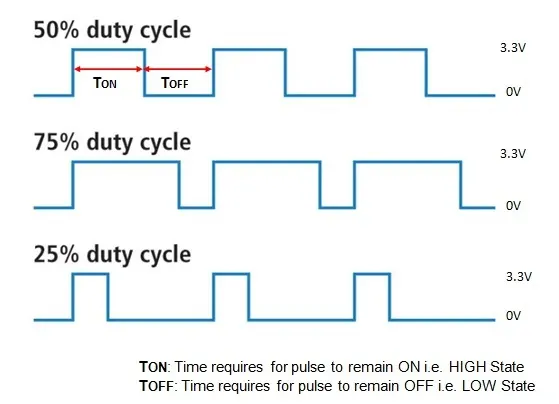
- What is the Function of DC/DC Converter? More properly called a voltage converter, this electrical device actually changes the voltage (either AC or DC) of an electrical power source. There are two types of voltage converters: step up converters (which increases voltage) and step down converters (which decreases voltage). The most common use of a converter is to a take relatively low voltage source and step-it-up to high voltage for heavy-duty work in a high power consumption load, but they can also be used in reverse to reduce voltage for a light load source.
- Why is a DC/DC converter necessary? While DC/DC converters can be based on a number of different designs, the underlying function remains the same. We might be talking about a step-up converter, which turns a low-voltage input into a high-voltage output, or a step-down converter, which does the opposite. The batteries of an electric vehicle typically output several hundred volts of DC. The electric components inside the vehicle, however, vary in their voltage requirements, with most running on a much lower voltage. This includes the radio, dashboard readouts, air conditioning, and in-built computers and displays. In electric vehicles which use a DC motor, actually running the motor can use up to three times the voltage provided by the battery. With the help of the right converter, we can bridge this gap without having to resort to a larger, prohibitively-heavy battery.
DC/AC Converters (Inverter)
What is the function of DC/AC converter? An inverter is an electrical device that converts electricity derived from a DC (Direct Current) source to AC (Alternating Current) of the type that can be used to drive a device or appliance.
DC power from a hybrid battery is fed to the primary winding in a transformer within the inverter housing. Through an electronic switch (generally a set of semiconductor transistors), the direction of the flow of current is continuously and regularly flip-flopped (the electrical charge travels into the primary winding, then abruptly reverses and flows back out). The in/outflow of electricity produces AC current in the transformer's secondary winding circuit. Ultimately, this induced alternating current electricity provides power for an AC load—for example, an electric vehicle's (EV) electric traction motor. A rectifier is a similar device to an inverter except that it does the opposite, converting AC power to DC power.
REFERENCE
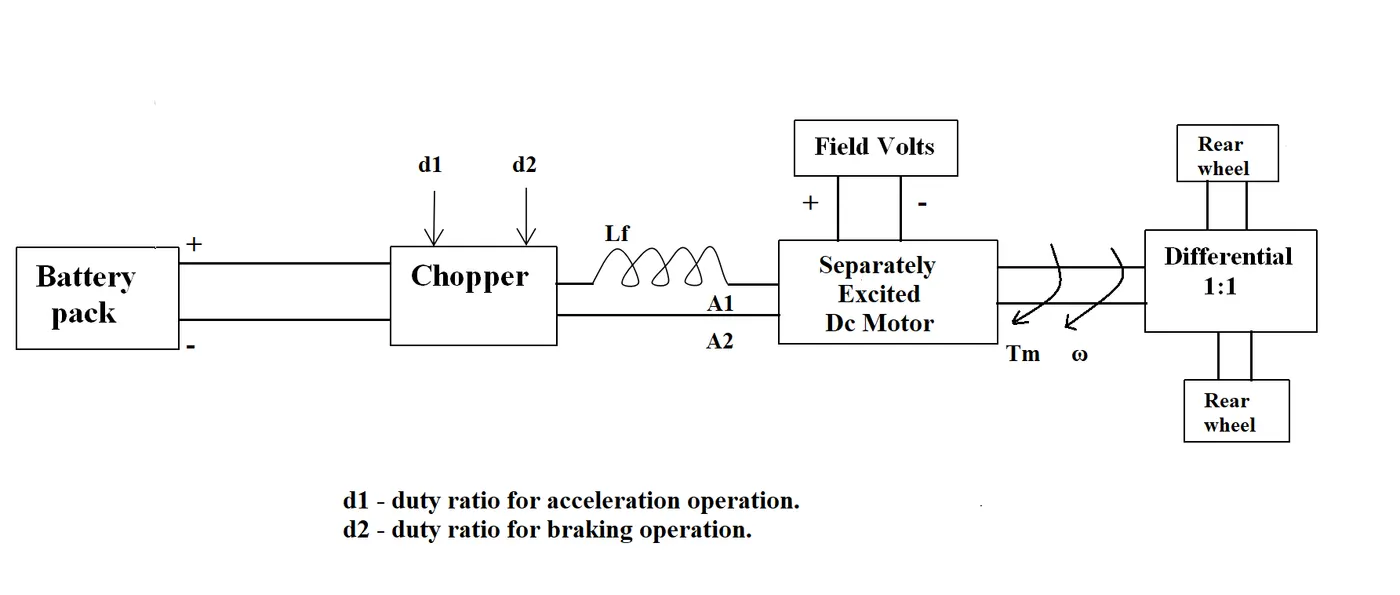
The other parameters of the electric vehicle is given below:-
Rated Armature voltage (V) = 72 V
Rated armature current (Ia) = 400 A
Ra= 0.5Ω, KΦ= 0.7 Volt second
Chopper Switching frequency= 400 Hz
The vehicle speed-torque characteristics are given by the below equation

What is EV steady state speed if duty cycle is 70%?
SOLUTION:-
Given values,
Ia = 400A, Ra = 0.5 `Omega`, K`phi` = 0.7 Volts,
since duty cycle is 70%, Va=70% of 72 V=50.4V
Speed-Torque Characteristics `to` Tv = 24.7 + (0.0051)`omega^2`
Torque equation for DC motor `implies T=(Kphi*V_a)/R_a-((Kphi)^2*omega)/R_a`
`T=(0.7*50.4)/0.5-(0.7^2*omega)/0.5`
`T=70.56-0.98*omega`
Now we can equate the given speed-torque characteristic with the torque equation of the motor under steady state condition,
T=Tv
`70.56-0.98*omega=24.7+0.0051*omega^2`
`omega=38.90 (rad)/sec`
OBJECTIVE-3`to`
Refer to the blog on below topic: Induction Versus DC brushless motors by Wally Rippel, Tesla Explain in brief about author’s perspective.
| DC Motors | Induction motors |
|
|
|
|
|
|
|
|
|
|
|
|