Week-6 Challenge: EV Drivetrain
1) Types of power converters employed in Electric and Hybrid electric vehicle:
a) AC - DC converters or Rectifiers - They are used as chargers for EV batteries. The batteries need DC supply to charge so the conversion of AC to DC is necessary.
b) DC - AC converters or Inverters - in motor drive application
c) DC - DC converters or choppers - to step up or step down the voltage to the required level. The higher voltage of the battery cannot be given directly to auxillary accessories like head lights, rear lights, Sound systems etc. So they have to be stepped down to a lesser value. DC - DC converters are used in such cases.
2)Battery voltage = 72V
Duty cycle = 70%
Actual voltage = 72 * (70/100) = 50.4 V
Ia = 400 A
Ra = 0.5 ohm
`kphi = 0.7`
`Tv = (V*kphi - kphi^2 *w) / R`
= (50.4*0.7 - 0.7^2 * w) / R
= 70.56 - 0.98*w ----(1)
Given Tv = 24.7 +0.0051*w^2 ----------(2)
Equating (1) and (2)
70.56 - 0.98*w = 24.7 +0.0051*w^2
0.0051*w^2 + 0.98*w - 45.86 = 0
w = 38.91, -231.07
Taking positive value, the steady state speed, w = 38.91 rad/s = 371.56 RPM
Torque Tv = 70.56 - 0.98*38.91 = 32.4 Nm
3) Speed equation model in simulink:
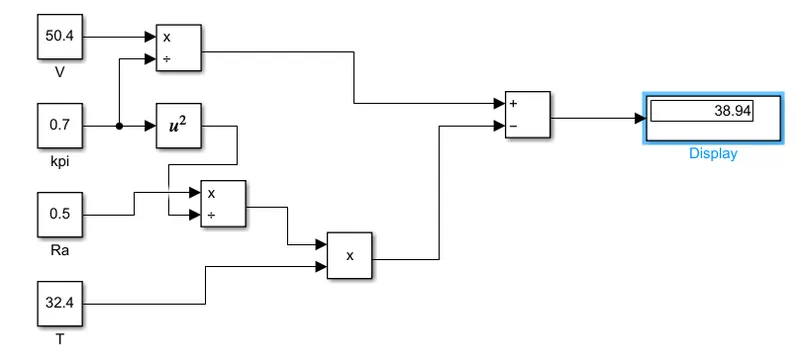
The speed equation has been modelled in simulink and tested for the above example. The output result is same as the solved equation above.
4)Summary:
DC brushless and Induction machines:
With brushless machines, the rotor includes permanent magnets that generate a DC magnetic field. The magnitude and polarity of the stator currents must be continuously varied for the torque to be constant which is provided by an inverter. Both 3-phase induction motor and the DC brushless motor have three sets of distributed windings within the stator core. The essential difference between the two machines is with the rotor. The induction rotor has no magnets. When a 3-phase induction motor has the ability to start under load. No inverter is needed. They are compatible with conventional utility power. In contrast, a brushless DC motor produces no starting torque when directly connected to utility power. They need an inverter.
The 3-phase induction motors can operate only in AC. They are constant speed machines with limited starting torque. The induction machine can be operated with a battery or DC source through an inverter which also provides variable speed by adjusting inverter frequency. The torque performance can be improved with feedback loops to produce the exact frequency required by the motor.
DC brushless drives require an absolute position sensor, while induction drives require only a speed sensor for control.
The peak point energy efficiency for a DC brushless drive will be a few percentage higher than for an induction drive since less rotor heat is generated in DC brushless drive and it can also operate at unity power facter.
In an ideal brushless drive, the strength of the magnetic field produced by the permanent magnets cannot be changed easily. In contrast, induction machines have no magnets and B fields are adjustable. Thus, the induction machine when operated with a smart inverter has an advantage over a DC brushless machine. With DC brushless, as machine size grows, the magnetic losses increase proportionately and part load efficiency drops. With induction, as machine size grows, losses do not necessarily grow. Thus, induction drives are favored when high-performance is desired; peak efficiency will be a little less than with DC brushless, but average efficiency may actually be better.
Permanent magnets are expensive and are also difficult to handle. Induction motors is a cost advantage over PM machines especially for high performance drives. Induction machines are more difficult to control. Achieving stability over the entire torque-speed range and over temperature is more difficult with induction than with DC brushless. This means added development costs, but likely little or no recurring costs.
Conclusion: DC brushless drives will likely continue to dominate in the hybrid and coming plug-in hybrid markets, and that induction drives will likely maintain dominance for the high-performance pure electrics.