Week-6 Challenge: EV Drivetrain
Aim:
To learn about the power converters in the electric and hybrid electric vehicle. To also learn more about the relation between battery and DC motor and to learn further about the types of DC motors in electric and hybrid electric vehicle.
Question 1
An electric vehicle needs rectifier for converting the AC power to DC power for charging the battery.
It also needs an inverter for the battery to power the three phase induction motor. The inverter converts the DC power of the battery to AC voltage and frequency for the three phase induction motor.
If the battery is 100V and the other loads in the car are low voltage (e.g: 12V) loads such as the sound system or the cooling system, a chopper is used for converting the high voltage DC to a lower voltage DC. This is used in th auxiliary of an electric car.
Another type of converter is an AC to AC converter is a fan regulator which is changing AC voltage and frequency at one level to another level of AC voltage and frequency.
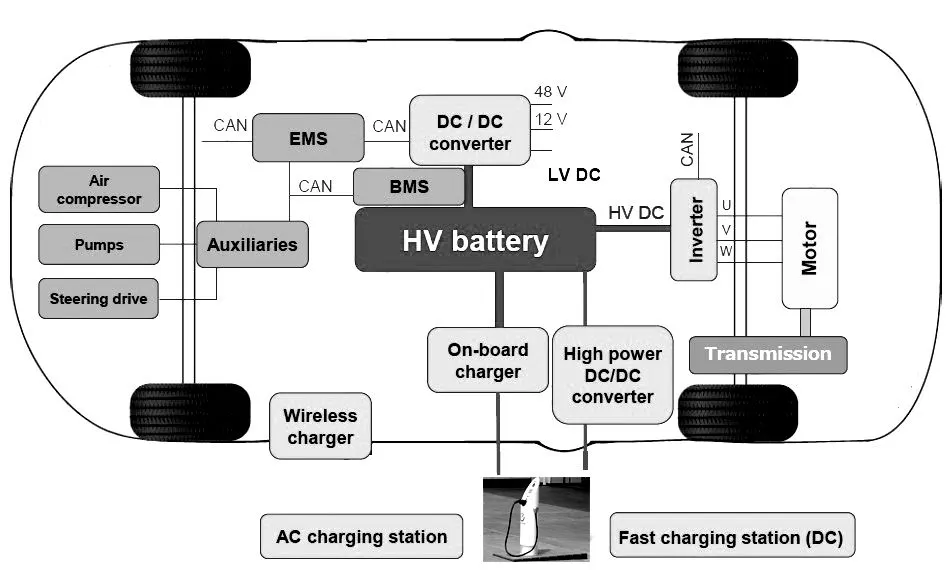
Figure 1: Power converters in electric vehicles
Question 2
The speed of the electric vehicle depends on the speed of the motor. Considering the battery voltage is Vb and the duty cycle is d.The motor voltage Vm is given by Vm=Vb*d
If the duty cycle is 70% then the voltage to the motor is 70%*72V= 50.4V.
The armature resistance Ra is given by Ra=Vm/Ia. Ra = 72V/400A= 0.18`ohm`
The torque-speed relation for a DC machine is: `T=(V*(Kphi))/(Ra) - ((Kphi)^2*w)/(Ra)`
where V is the voltage supply, `Kphi` is the motor constant, Ra is the armature resistance, `omega` is the motor angular speed and T is the motor torque.
Substituting the values in the equation: `T= ((50.4)*0.7)/0.5 - ((0.7)^2*omega)/0.5`=70.56-0.98`omega` ----------(1)
Another torque equation thats provided in the question is: `Tv= 24.7 + 0.0051*(omega)^2` --------(2)
Equating equation (1) and (2) we get: 70.56 -0.98`omega`= 24.7 + 0.0051*`omega^2`
The quadratic equation obtained is : 0.0051`omega^2`+0.98*`omega`-45.86=0
This is an equation of the form `ax^2+bx+c=0` the solution for which is given by:
`omega= (-0.98+- sqrt((0.98)^2-4*(0.0051)*(-45.86)))/(2*0.0051)`
The value for `omega` is given by 38.82 rad/sec and -230.98rad/sec
Hence the value for `omega` is 38.82 rad/sec.
Question 3
The author gives perspective on which motor technologies for electric vehicles are still relevant and what trend we should be observing for the future. The author predicts that both induction motor and DC brushless motor will have a competition in the foreseable future.
The author then goes on to describe the working of each type of motor as follows. The DC brushless motor uses a permanent magnet that generate a DC magnetic field. As the rotor rotates, it is necessary that the magnitude and polarity of the stator currents be continuously varied – and in just the right way - such that the torque remains constant and the conversion of electrical to mechanical energy is optimally efficient. The device that provides this current control is called an inverter.
The essential difference between the DC brushless motor and the 3 phase induction motor is only the rotor.The induction motor on the other he induction rotor has no magnets – just stacked steel laminations with buried peripheral conductors that form a “shorted structure.” Currents flowing in the stator windings produce a rotating magnetic field that enters the rotor. No inverter is also needed for the induction motor.
If an inverter is added to a DC induction motor however, it becomes possible to power an induction machine from a battery or other DC source. variable speed also becomes possible simply by adjusting the inverter frequency using some feedback loops.
Less rotor heat is generated in case of brushless DC motors as compared to in an induction motor. The eddy loss reduction is however also easier in an induction motor as compared to a brushless DC motor. An induction motor with a smart inverter can be advantageous in addition to the fact that an induction motor is cheaper since it does not use permanent magnets. However the control aspects of an induction motor and the stability of the induction motor make it more complex to operate than a brushless DC motor.
The points are summarised as follows.
| DC brushless motor | 3 phase induction motor |
| The rotor includes two or more permanent magnets that generate a DC magnetic field (as seen from the vantage point of the rotor). | The rotor is made up of stacked steel laminations with buried peripheral conductors that form a “shorted structure.” |
| No inverter is needed for interfacing with a battery. | When a 3-phase induction motor is connected to utility type 3-phase power, torque is produced at the outset; the motor has the ability to start under load. No inverter is needed |
| Not as high limited peak running torque capabilities. | When used with utility power, they are constant speed machines. Finally, when operated from utility power, they have limited starting torque and somewhat limited running peak torque capabilities. |
| Not so easy eddy loss reduction due to the permanent magnets. | Easier eddy loss reduction. |
| Permanent magnets are expensive – something like $50 per kilogram. Hence DC motors are very expensive. | This means that induction motors will likely retain a cost advantage over PM machines |
The author then goes on to describe the relevance to the electric vehicle industry as follows. The brushless DC motor is used in hybrid electric vehicles whereas the induction motor is still extensively used in pure electric vehicle. It will be interesting to see the technology trends when hybrids become more electrically intensive.