Project-1: Powertrain for aircraft in runways
Question 1
The various types of aircraft weights are as follows
- Basic Empty Weight (BEW) is the weight of the aircraft "as built" and includes the weight of the structure, power plant, furnishings, installations, systems and other equipment that are considered an integral part of an aircraft before additional operator items are added for operation.
- Dry Operating Wieght (DOW) BEW + Weight of Crew (Pilot + Cabin including their bags) + Pantry
- Operating Weight (OW) DOW + Takeoff fuel (i.e. Ramp Fuel - Taxi fuel)
- Maximum Zero Fuel Weight (MZFW) DOW + Payload (anything put on the aircraft that generates revenue to the company, e.g. passenger, baggage, cargo, mail and fret)
- Maximum Taxi Weight (MTW) MZFW + Ramp fuel
- Maximum Takeoff Weight (MTOW) MZFW + Takeoff fuel, or MTW - Taxi fuel
- Maximum Landing Weight (MLW) MTOW - Trip Fuel
List of airplanes by weight:
| Type | MTOW [kg] | MLW [tons] |
|---|---|---|
| Antonov An-225 | 640,000 | 591.7 |
|
Scaled Composites Model 351 Stratolaunch |
589,670 | |
| Airbus A380-800 | 575,000 | 394 |
| Boeing 747-8F | 447,700 | 346.091 |
| Boeing 747-8 | 443,613 | 306.175 |
| Boeing 747-400ER | 412,770 | 295.742 |
| Antonob An-124-100M | 405,060 | 330 |
| Boeing 747-400 | 396,900 | 295.742 |
| LOckheed C-5 Galaxy | 381,000 | 288.417 |
| Boeing 747-200 | 377,840 | 285.700 |
| Boeing 747-300 | 377,840 | 260.320 |
List of helicopters by weight:
| Type | MTOW [pounds] | MTOW [kg] |
|---|---|---|
| Mil Mi-12 | 231485 | 105000 |
| Mil Mi-26 | 123459 | 56000 |
| Sikorsky CG 35-E | 73500 | 33300 |
|
Boeing CH-47D/F Chinook |
50000 | 22680 |
|
AgustaWestland AW101 |
34,392 | 14600 |
| Sikorsky S-92 | 26500 | 12020 |
|
Eurocopter EC 225 Super Puma |
24692 | 11200 |
|
Boeing Vertol CH-46 Sea Knight |
24300 | 11000 |
| NHIndustries NH90 | 23370 | 10600 |
| Eurocopter AS532 Cougar | 19840 | 9000 |
| Bell 412EP | 11900 | 5397 |
| Europcopter EC145 C-2 | 7903 | 3585 |
Question 2
Ground speed is how fast an airplane is traveling, relative to a fixed point on the ground. Ground speed is how fast an airplane's shadow would move across the land. If there's a strong wind pushing an aircraft, that's reflected in the ground speed.
Airspeed, in contrast, is how fast an airplane is really flying strictly under its own power, which is calculated by subtracting the wind speed from the ground speed.
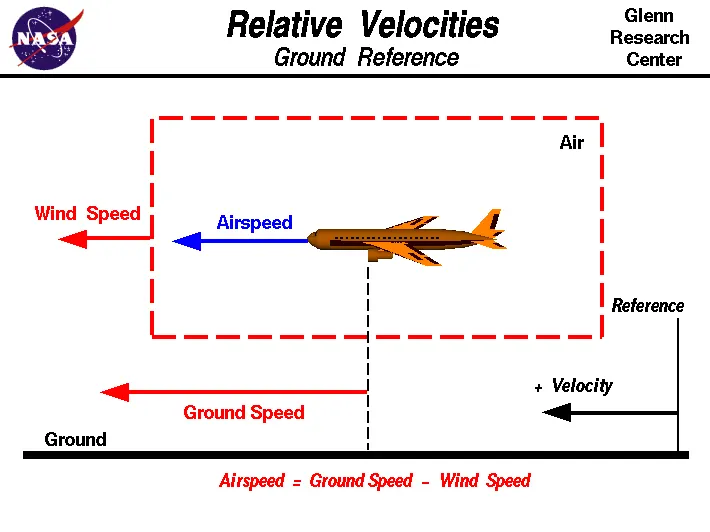
Figure: Aircraft velocities
Back in February 2019, a Virgin Atlantic Boeing 787 jet flying over Pennsylvania in route from Los Angeles to London reached what might seem like an amazing speed of 801 miles per hour (1,289 kilometers per hour), according to CBS News.
But the speed record wasn't because that Virgin Atlantic aircraft itself was exceptionally fast. Like a sprinter running with the wind at his back, the aircraft benefited from an exceptionally fast jet stream, a high-speed wind moving at 231 miles per hour (371.7 kilometers per hour). It was the fastest jet stream in more than 60 years.
As CBS News explained, the result was that the 787 flew considerably faster than the aircraft's typical cruising speed of 561 miles per hour (902.8 kilometers per hour).
Therein lies the difference between airspeed and ground speed.
Question 3
Although airports and traffic controllers strive to keep taxi time and tarmac delays to a minimum, it can often take many minutes of start-and-stop maneuvering before an airplane actually takes off. Typically, the busier the airport, the more time an aircraft spends on the ground – with some busy airports seeing durations as long as 30 minutes between pushback and takeoff.
Taxiing, sometimes called “taxying”, refers to an aircraft’s movement while on the ground, under its own power. This term excludes the accelerating run along a runway before takeoff and the decelerating run immediately upon landing.
By using jet engines as an aircraft’s primary thrust for taxiing, airlines are expending huge amounts of jet fuel while still on the ground, which could be much better used for flying. With the Cost of Fuel being their single biggest expense, many airlines plan to adopt electric taxiing to save fuel and reduce environmental impacts.
Jet blast is the phenomenon of rapid air movement produced by the jet engines of aircraft, particularly on or before takeoff. A large jet-engined aircraft can produce winds of up to 100 knots (190 km/h; 120 mph) as far away as 60 metres (200 ft) behind it at 40% maximum rated power. Jet blast can be a hazard to people or other unsecured objects behind the aircraft, and is capable of flattening buildings and destroying vehicles.

Figure: Effect of jet blast
In aviation, pushback is an airport procedure during which an aircraft is pushed backwards away from an airport gate by external power. Pushbacks are carried out by special, low-profile vehicles called pushbacktractors or tugs.
Although many aircraft are capable of moving themselves backwards on the ground using reverse thrust (a procedure referred to as a powerback), the resulting jet blast or prop wash might cause damage to the terminal building or equipment. Engines close to the ground may also blow sand and debris forward and then suck them into the engine, causing damage to the engine. Therefore aircraft engine power is not used to move it on the ground at the airport.
Electric taxiing systems use electric motors fitted inside the wheels of the aircraft’s landing gear. Electric power is supplied to these motors by an onboard Auxiliary Power Unit (APU). This innovative new approach enables airplanes to move backward and forward solely under electric power. This way, aircrafts can avoid reliance on main engines for traversing the airport taxiways while burning fuel unnecessarily.
Benefits of electric taxiing
Projected savings from the use of electric taxiing systems can be as much as 4% in airlines’ total fuel budget, providing an average annual savings of US$250,000 per aircraft, with some airlines seeing savings of as much as US$500,000 per aircraft along with reduction of their environmental footprint.
In addition, the electric motors’ ability to operate in both reverse and forward modes mean that ground equipment will no longer be needed for pushback or towing operations. This will ease congestion in the gate areas and enable ground staff to shorten aircraft turnaround time. Some other important benefits include:
- Extended lifespan of aircrafts’ main jet engines
- No damage from foreign objects sucked into engines during taxiing
- Improved health and safety of groundcrew
- Decarbonizing of air transport
- Reduction of air pollutants such as carbon monoxide (CO), carbon dioxide (CO2), nitrogen oxides (NOX) and unburned hydrocarbons (UHC)
Question 4
Pushback is an airport procedure that results in an aircraft being pushed backwards away from an airport gate by external power, which is usually provided by pushback tractors or aviation tugs.
Although the majority of aircraft are able to move backwards (known as a powerback) it may lead to avoidable damage being caused, either to the engine, other equipment being used during the procedure, or the terminal building itself. This is why pushback tractors and aircraft tugs are generally preferred to ensure that aircraft is safely moved from the gate.
In regards to tugs, they are hugely capable of moving the majority of aircraft ranging from light, single-engines to business jets, narrow-body airliners and more. Another positive is that aircraft tugs are able to successfully move the majority of aircraft without the need for adapters, although they tend to be required when it comes to moving more unique planes.
Procedure:
Pushbacks at busy aerodomes are usually subject to groudn control clearance to facilitate ground movement on taxiways. Once clearance is obtained, the pilot will communicate with the tractor driver (or a ground handler walking alongside the aircraft in some cases) to start the pushback. To communicate, a headset may be connected near the nose gear.
Since the pilots cannot see what is behind the aircraft, steering is done by the pushback tractor driver and not by the pilots. Depending on the aircraft type and airline procedure, a bypass pin may be temporarily installed into the nose gear to disconnect it from the aircraft's normal steering mechanism.
Once the pushback is completed, the towbar is disconnected, and any bypass pin removed. The ground handler will show the bypass pin to the pilots to make it clear that it has been removed. The pushback is then complete, and the aircraft can taxi forward under its own power.
Question 5
- Take off: It is the phase of flight in which an aircraft vehicle leaves the ground and becomes airborne. For light aircraft, usually full power is used during takeoff. Large transport category(airliner) aircraft may use a reduced power for takeoff, where less than full power is applied in order to prolong engine life, reduce maintenance costs and reduce noise emissions.
Takeoff power is almost never maximum engine power.
- Maximum power affects engine life as it brings significant wear to the engine. IIRC, if max power is used on takeoff, the crew must log an entry in the logbook to notify maintenance.
- Turbo-fans produce a lot of power. If you require max power to takeoff, you better double-check your numbers, or you're operating with a pretty narrow margin.
The reality is the reverse: airlines love to do low power takeoffs, and they avoid a high power takeoff as much as practical. Occasionally, a condition such as high ambient temperature (resulting in high pressure altitude), heavy load, obstacle on departure path may demand a max power takeoff. Possible wind shear may also prompt the crew to select a higher takeoff power.
Figure: Airplane take off
- Tyre design: An aircraft tyre is constructed for the purpose it serves.
- They support the weight of an aircraft while it is on the ground.
- It also provides the necessary traction for braking and stopping of an aeroplane.
- Tyre also helps to absorb the shock of landing and provide cushioning the roughness of takeoff, roll-out, and taxi operations.
Unlike an automobile or truck tyre, it does not have to carry a load for a long period of continuous operation. However, an aircraft tyre absorbs the high impact loads of landing, and also it’s operating at high speeds for a short time when required.
Retreading – Retreading is methods of restoring a worn tyre by renewing the tread area or by renewing the tread area plus one or both sidewalls. Repairs are included in the tyre retreading process.
Load Rating – Load rating is the maximum permissible load at a specified inflation pressure.
Ply Rating – Ply Rating is used to identify the maximum recommended load rating and inflation pressure for a specified tyre. It is an index of tyre strength.
Speed Rating – The speed rating is the maximum takeoff speed to which the tyre has been tested.
Skid Depth – Skid depth is the distance between the tread surface and the deepest groove as measured in the mould.
Aircraft tyres must have an approved speed and load rating and have sufficient clearance when retracted through landing gear to allow for tyre growth. Tyre growth is the increase in the size of the tyre due to centrifugal forces at high speed.
Figure: Tyre design
- Rolling resistance:The friction between aircraft and runway will be proportional to the normal force exerted by the aircraft on the runway.
The normal force will be the difference between Weight of aircraft and Lift, the friction coefficient will be typically of a magnitude of 0.02 for a standard tarmac runway.
The rate of change of velocity can be predicted at any point on the take-off roll by substituting results for T, D and F into the initial equation for dV/dt. The subsequent velocity at any point can be found by integrating this resulting equation and the distance traveled found by then integrating the velocity.
Typically acceleration will be dominated by the drag component as thrust, weight and friction are relatively constant during this period. This leads to the result shown where acceleration is inversely proportional to velocity squared.
- Aircraft tyre pressure:
Aircraft tires generally operate at high pressures, up to 200 psi (14 bar; 1,400 kPa) for airliners, and even higher for business jets. The main landing gear on the Concorde was typically inflated to 232 psi (16.0 bar), whilst its tail bumper gear tires were as high as 294 psi (20.3 bar). The high pressure and weight load on the Concorde tyres were a significant factor in the loss of Air France Flight 4590.
Tests of airliner aircraft tires have shown that they are able to sustain pressures of maximum 800 psi (55 bar; 5,500 kPa) before bursting.During the tests the tires have to be filled with water, to prevent the test room being blown apart by the energy that would be released by a gas when the tire bursts.
Aircraft tires are usually inflated with nitrogen to minimize expansion and contraction from extreme changes in ambient temperature and pressure experienced during flight. Dry nitrogen expands at the same rate as other dry atmospheric gases (normal air is about 80% nitrogen), but common compressed air sources may contain moisture, which increases the expansion rate with temperature.
- Braking forces when landing :The following braking devices are used to decelerate the vehicle until it stops. (i) Ground spoilers (ii) Wheel brakes (iii) Thrust reverser systems
(i) Ground spoilers usually deploy automatically (if armed) upon main-landing gear touchdown or upon activation of thrust reversers. Ground spoilers provide two aerodynamic effects.
- Increased aerodynamic drag which contributes to aircraft deceleration
- Lift dumping, which increases the load on the wheels and thus increases the wheel brake efficienc
(ii) Wheel brakes: The braking action results from the friction force between the tires and the runway surface. The friction force is affected by:
- Aircraft speed
- Wheel speed
- Tire condition and pressure
- Runway condition
- The load applied on the wheel
- The number of operative brakes
The braking force is equal to the load applied on the wheel multiplied by the runway friction coefficient.
(iii) Thurst reversers: They provide a deceleration force that is independent of the runway condition. Thrust-reverser efficiency is higher at higher airspeed therefore thrust reversers must be selected as early as possible after touchdown.
- The resulting total stopping force is the combined result of:
- Aerodynamic drag
- Reverse thrust
- Rolling drag
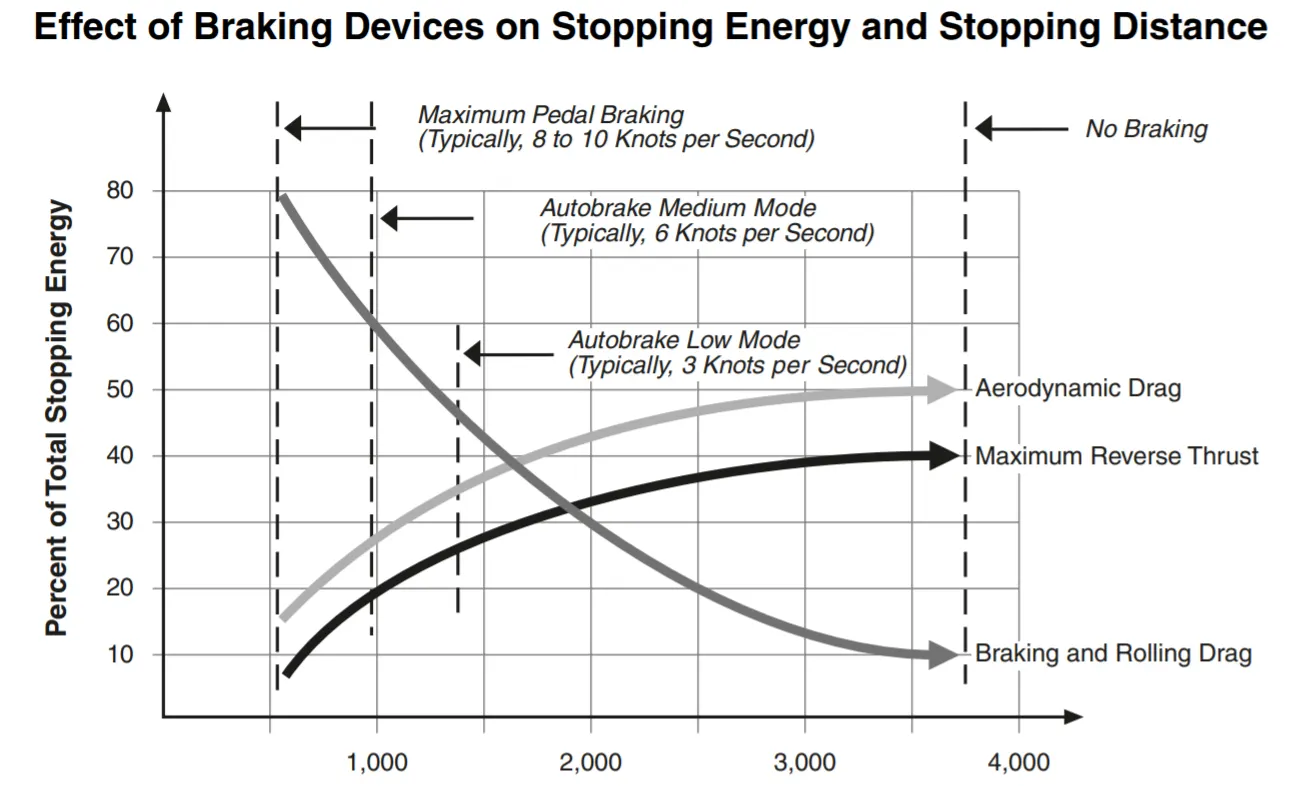
Figure: Aircraft braking
Question 6
To push or pull the aircraft the following three forces will act on the aircraft and the towing vehicle.
- Rolling resistance force: The force that resists the motion of a body rolling on a surface is called the rolling resistance or the rolling friction.
The rolling resistance can be expressed as
Fr = `mu`* W
where
Fr = rolling resistance or rolling friction (N, lbf)
`mu` = rolling resistance coefficient - dimensionless (coefficient of rolling friction - CRF)
W = m ag
= normal force - or weight- of the body (N, lbf)
m = mass of body (kg, lb)
ag = acceleration of gravity(9.81 m/s2, 32.174 ft/s2)
- Aerodynamic drag force: Drag is the aerodynamic force that opposes an aircraft's motion through the air. Drag is generated by every part of the airplane (even the engines).
For drag to be generated, the solid body must be in contact with the fluid. If there is no fluid, there is no drag. Drag is generated by the difference in velocity between the solid object and the fluid. There must be motion between the object and the fluid. If there is no motion, there is no drag. It makes no difference whether the object moves through a static fluid or whether the fluid moves past a static solid object.
Drag is a force and is therefore a vector quantity having both a magnitude and a direction. Drag acts in a direction that is opposite to the motion of the aircraft.


= drag 
= density of fluid 
= speed of the object relative to the fluid 
= drag coefficient 
= cross sectional area
- Hill climbing force: It is the force needed to move the vehicle/aircarft up the gradient.
The hill climbing force is given by Fhc=m*g*sin`psi`
where m= Total mass of the vehicle in kg
g= gravitational constant that is 9.8m/s^2
`psi`= inclination angle in radian
Vehicle and pushback tractor specifications:
Assuming the Boeing 737-500 aircraft for which the mass (m1)= 60000kg. Width (w)= 28.88m, Height (h)=11.13m
Coefficient of rolling resistance `mu`= 0.012
Tractor weight is considered to be (m2) = 12000kg accordin is to IATA Airport Handling Ground Support Equipment Specification AHM 955: “Functional Specification for an Aircraft Tractor.”
Assuming that the towing vehicle is running at a velocity of v=17km/h=4.7m/s
The hill climbing angle `psi`=0 radian since the aircraft is being pulled on the ground by the pushback tractor.
Calculations
- Friction force (Ff)= `mu`*m*g= (0.012)* (m1+m2)*(9.8m/s^2)=(0.012)*(60000+12000)*(9.8m/s^2)= 8475.84N
- Drag force (Fd)= 0.5*`rho`*Cd*A*v^2=0.5*1.225*0.02*(w*h)*v^2=0.5*1.225*0.02*321.43*(4.7)^2= 88.75N
- Hill climbing force= m*g*`psi`=(m1+m2)*(9.8m/s^2)*0=0
Total force (Ftotal)= Ff+Fd= 8475.84 N + 88/75 N= 8564.59 N
Calculation of Torque(T)= Ftotal* r= 8564.59* 0.5175= 4894.66 Nm
Calculation of Power(P)= Ftotal*v= 8564.59* 4.7= 40.253 kW
Therefore, the total power required to tow an aircraft with a tractor vehicle is 40.253kW.
Question 7
Power is the amount of energy transferred per unit time. As calculated in the previous section, the total power required for towing the aircraft= 40.253kW
Amount of energy required for towing the aircraft (E)= P*t. Assuming that the towing time is 5 minutes (300 seconds). The energy required for towing the aircraft = 40.253kW*(300/3600)= 3.354 kWh
A brushless DC motor can be used with voltage 480V and current 110A.
Figure: Brushless DC motor
The duty cycle (D) of can be calculated as follows: P/Pin= 40.253kW/ (480V*110A)=0.7623
The duty cycle range to control the speed from 0 to highest is 0.7623.
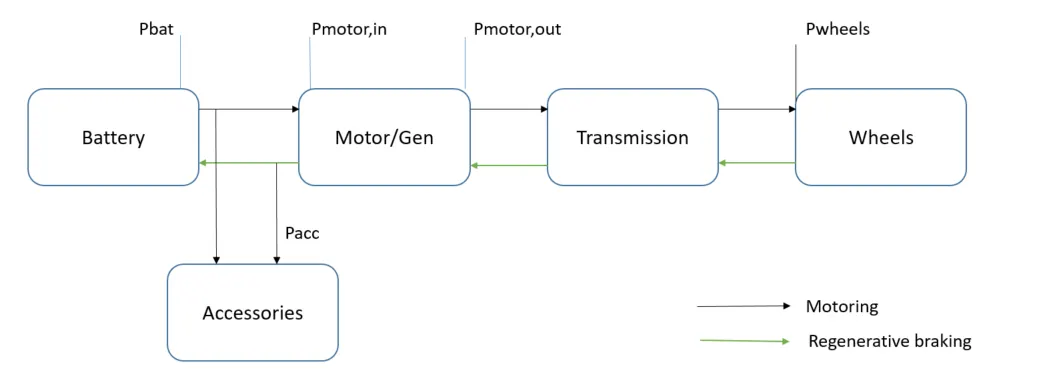
The above image shows the power train for the electric aircraft.