Week-6 Challenge: EV Drivetrain
Study 1:-
Power Converter Circuits in Hybrid Electric Vehicle and Electric Vehicle:-
The power electronic converter controls the flow of power from the source to motor
The power converter drive used in DC Motor is DC Drive and drive used in AC Motor is AC Drive.
Converter used in vehicle are as follows,
DC-DC Converters:-
DC-DC Converters are used in EV and HEV to convert the unregulated DC input to regulated DC output. It is known as DC Chopper.
Non Isolated Converters:-
In this type of converter the input and output side are not isolated i.e, they are physically connected . These type of converters are used in application which requires power less than 100W.
Example:- Buck , Boost and Buck-Boost Converters.
Isolated Converters:-
In this type of converters the input and output sides are isolated.They are used in applications which requires power above 100W. They have high voltage ratio convertion and efficiency.
Example:-Flyback ,Forward ,Half-Bridge and Full-Bridge rectifier.
AC-DC Converter:-
It is used to convert power from AC to DC and then feeds it to the battery , this is also known as onboard charger which is commonly known as rectifier.
DC-AC Converter:-
It converts the DC power from the battery to AC power to supply the motor which is known as inverters . It controls both magnitude and frequency of output AC voltages , as per requirement the DC power is converted into AC which is either Single Phase or three Phase AC Supply.
Study 2:-
Calculate EV Steady State Speed:-
Given Data:-
Motor and Controller Parameters:
Rated Armature voltage= 72 V
Rated armature current= 400 A
Ra= 0.5Ω, KΦ= 0.7 Volt second
Chopper Switching frequency= 400 Hz
The vehicle speed-torque characteristics are given by the below equation
`Tv =24.7 + (0.0051)omega^2` -----> (1)
Duty Cycle = 70% = 0.7
Actual Voltage = 0.7 * 72 = 50.4 V
Torque Speed Characteristics of DC Motor,
`omega = (v/(kphi))-((Ra)/(kphi)^2)T`
`omega = (50.4/0.7)-((T*0.5)/(0.7)^2)`
`omega = 72 - ((0.5T)/0.49)`
`0.49(72-omega)=0.5T`
`35.28 - 0.49 omega = 0.5T`
T=70.56 - 0.98 `omega` -------> (2)
By equating the equation 1 and 2,
24.7 + 0.0051 `omega^2 = 70.56 - 0.98 omega`
`0.0051omega^2+0.98omega-45.86=0`
`omega^2+192.156 omega-8992.156=0`
On solving the above quadratic equation,we get
`omega = 38.915`rad/s or `omega = -231.0718` rad/s
Steady state Speed of EV at duty cycle 70% is 38.915 rad/s
Study 3:-
Mathematical Model of a DC Motor:-
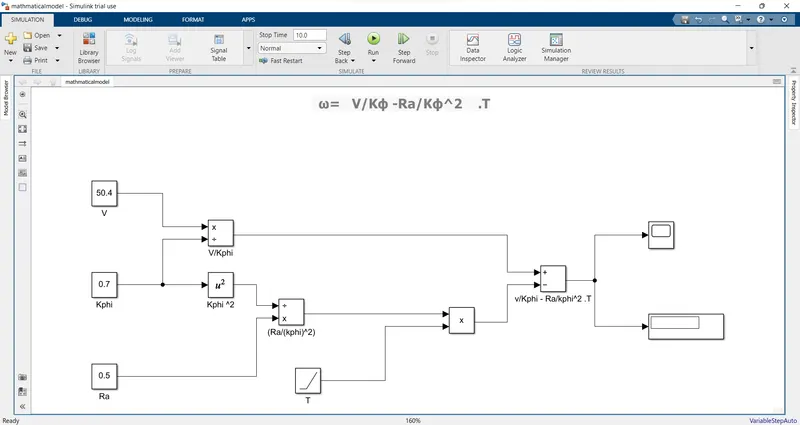
The Given Equation:-
ω= V/Kϕ-Ra/(Kϕ)^2 .T
Model:-
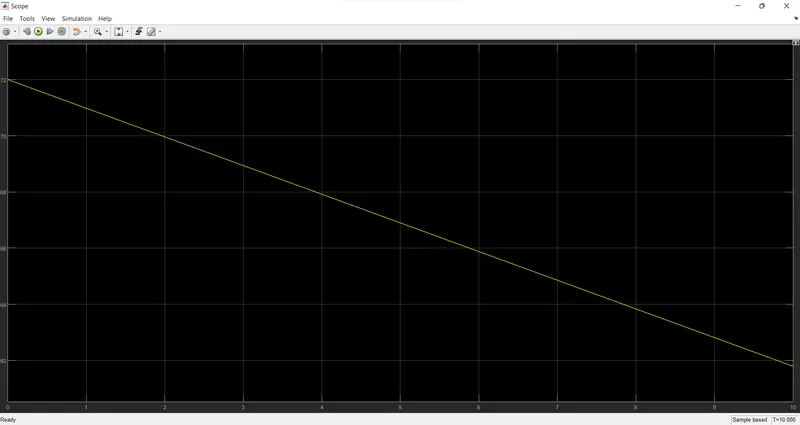
Result (Scope):-
Study 4:-
Induction Vs DC brushless motors by Wally Ripple,Tesla:-
As per the view of the author from tesla,
1.The type of engine has to be taken as per the requirement since there is no perfect machine.
2.In early days the lead acid battery,DC brush motor and Contactor controllers are used which are replaced by Lithium batteries,DC Brushless or induction motor and Modulating Inverters.
3.The two technologies Brushless DC Motor and induction motors are compared.
4.Brushless DC motor requires inverter which provides current control without which it is useless.
5.3 phase Induction Motor was invented by Nikola Tesla.
6.The Stator of 3 phase Induction motor and brushless DC motor are virtually identical as both the motors have three sets of distributed winding.
7.The difference between the two motor is in the rotor , Since induction motor has no magnet in rotor whereas the brushless DC motor has permanent magnets on the rotor.
8.As per the view of Wally ripple there is no winner between Induction and DC Brushless motor since the brushless DC motors will dominate hybrid and plug-in hybrid market whereas the induction motor drives will dominate in high performance pure electric
9.Since there are more common hardwares are seen in both drives it is possible to see induction and brushless works side by side in the comming era of hybrid and electric vehicles.