Week-6 Challenge: EV Drivetrain
1. The types of power converter circuits that are employed in electric and hybrid electric vehicle are :
- DC-DC Converters: Isolated, Non-Isolated, Resonant Converters.
- DC-AC Converters: Inverter
- AC-DC Converters: Rectifier
- AC - AC Converters
2. Electric Motor Power Train
Vo = 70% (Va) = 70%(72) = 50.4 V
Ra = 0.5 ohm
K*phi = 0.7 Vsec
ω= (V/Kϕ -Ra/Kϕ^2 ) .T
= ( 50.4/0.7) - (0.5/0.7^2).T
= 70.979 T
Or
T = 1/70.979 T = 0.01408 T.
In a Dynamic system
Tv = 24.7 + 0.0051 w^2 is equal to T
therefore,
0.0051w^2 - 0.01408 w +24.7 = 0
after solving the quadratic equation
w = 38.94 rad/sec
3. Mathematical model of a DC Motor
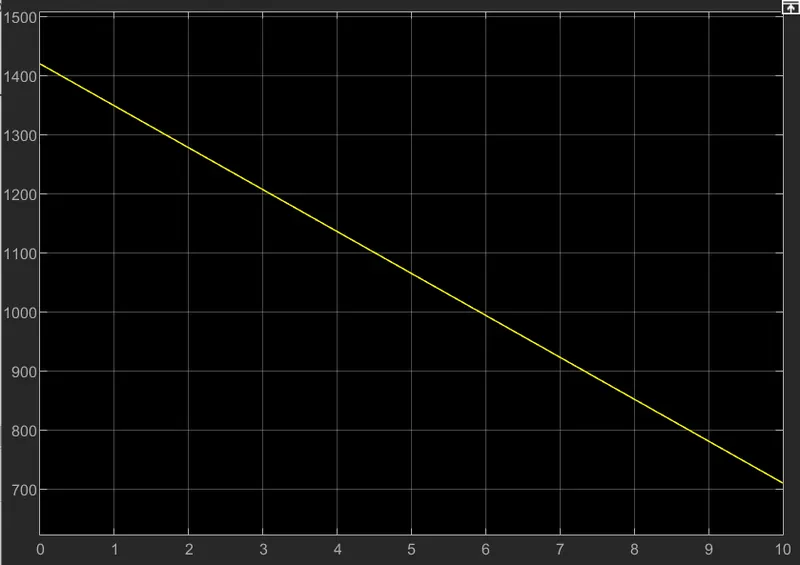
ω= (V/Kϕ -Ra/Kϕ^2 ) .T
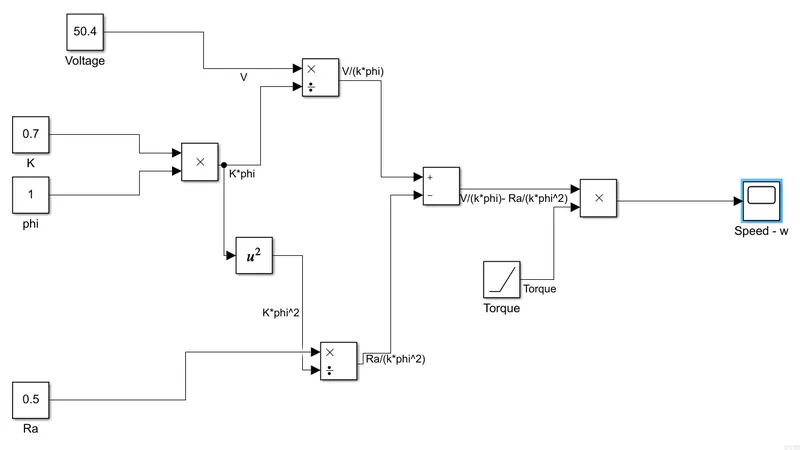
Result:
4. In the blog Induction Motors vs DC Brushless Motors, Walley Ripple has explained the two technologies, how they work, what is the difference between them and the common things between both the motors.
Walley Ripple was an Engineer at AeriVironment where he developed EV1 for General Motors and later joined Tesla. He worked at Propulsion Laborartory on EV batteryReaserch. He won the Great Transcontinental Electric Car Race in the year 1968 against MIT as an undergrad student at Caltech.
He begins by saying "One Size Not Fit All"
He says that there is No best Engine Type, rather there are many different types of engines that suit a personal requirement. This can be a trade-off between price and performance. The same applies to EV as well. there is No One motor that is best, But there are many different motors that can be used based on the application.
At present, Lead-acid batteries are replaced with Lithium-Ion, Dc brush motor is replaced with Dc Brushless or Induction Motor, Contactor Controller is replaced with modulating inverters. He predicts that both induction and the brushless motor will be present for many years ahead.
He gives a "Closer Look" to explain in detail concepts between the two Motors.
| Brushless Dc Motor | Induction Motor |
| 2 or more permanent magnets | No magnets in the rotor |
| DC magnetic field | Rotating magnetic field |
| Stator currents and magnitude is continuously varied. | an induced voltage exists that is proportionate to the speed difference between the rotor and electrical frequency. |
| Conversion from electrical to mechanical is optimally efficient | Directly compatible with conventional power supply |
| Inverter for current control | No Inverter is needed |
There are many other limitations between the two converters
Induction Motor
- Induction Motor is difficult to control
- Achieving stability over the entire torque-speed range and over temperature is more difficult with induction than with DC brushless.
- Development costs of IM is more but are not recuring.
Brushless DC motor
- Permanent Magnets are expensive.
- PM rotors are difficult to handle due to large forces acting on ferromagnets.
- IM is less expensive than BLDC.
- No field weakening is possible to control the speed.
He Concludes by saying " Still No winner"
BLDC drives continue to dominate hybrid and plug-in hybrid markets. IM dominates the high-performance pure electrics.
Both IM and BLDC have hardware in common which shows both have a good future and they work side by side during the transformation from IC engine to EV.