Week-6 Challenge: EV Drivetrain
1). Types of power converters employed in electric and hybrid electric vehicles:
Block diagram of Electric Vehicle:
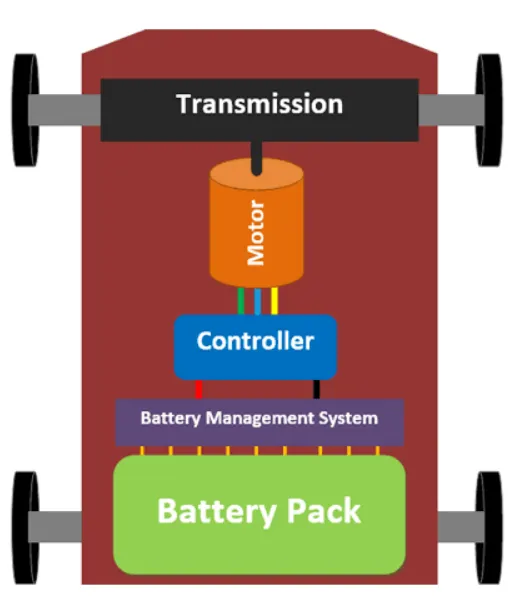
Power converters used in Electric vehicle :
(i) If the motor employed is AC induction motor then 3-`phi` Inverter circuit used between battery and AC motor. The same inverter circuit act as Rectifier circuit during regenerative action to convert regenerated AC power to DC power which is fed to charge the battery. Therefore, semiconductors used in the inverter circuit should be of bidirectional type.
or
If the motor employed is PMDC motor, then Chopper circuit is used between battery and DC motor.
(ii) Onboard charger circuit employs Rectifier to convert the AC supply at customer terminals to DC supply to charge the battery.
(iii)DC -DC converter(usually chopper) is used to power the auxiliaries(like A/C, head lights, interior lights,radio etc) from the battery.
Block diagram of Hybrid(series-paralllel) Electric Vehicle :
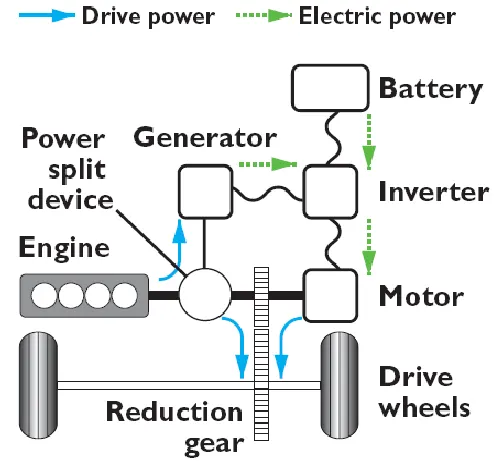
Power converters used in Hybrid (series-parallel) vehicle :
(i) Usually motor and generator used are of same type of AC motors(Permanent Magnet AC Synchronous motors used in Toyota Prius), so 3-`phi` Inverter circuit is employed in between battery and AC motor and generator. The same inverter circuit act as Rectifier circuit during regenerative action to convert regenerated AC power to DC power which is fed to charge the battery.
(ii) If the hybrid is PLUGGED IN model(PHEV), then onboard charger circuit comprises of Rectifier to convert the AC supply at consumer terminals to DC supply.
(iii) DC-DC converter(usually chopper) is used to power the auxiliaries from the battery.
2).Calculation of Steady state speed of vehicle from given torque - speed characteristics of motor and vehicle:
Gven details:
Rated Armature voltage = 72 V
Rated armature current = 400 A
Ra= 0.5Ω, KΦ= 0.7 Volt second
Chopper Switching frequency= 400 Hz
The vehicle speed-torque characteristics are given by the below equation
`T_v = 24.7+(0.0051)omega^2``->`①
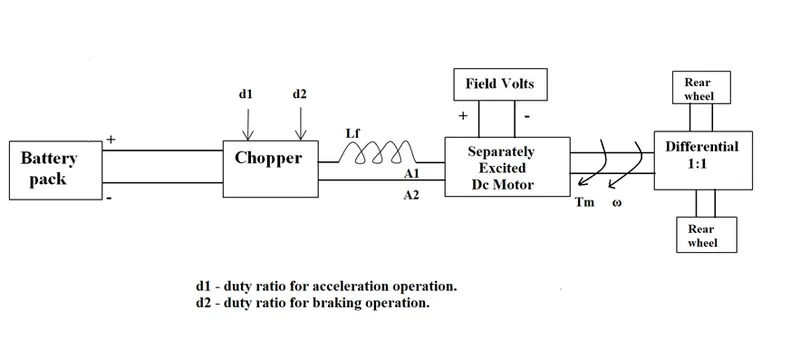
Voltage applied to DC motor (`V_(i"n")`)= (Duty cycle of chopper)* (Battery voltage)
= `70/100**72` `=0.7**72`
50.4volts
Speed-torque characteristics of DC motor (Shunt motor Separately excited motor) :
`omega = V_("in")/(k*phi) -R_a/(k*phi)^2**T_L`
= `50.4/0.7 -0.5/(0.7)^2**T_L`
`omega=72 - 1.024T_L`
`1.024T_L= 72 - omega`
`T_L = 72/1.024 - omega/1.024`
`:.T_L = 70.31-0.976omega` `-> ②`
At steady state, the torque developed by the motor is equal to the torque demanded by the vehicle.
Equating ① & ② equations
`24.7+(0.0051)omega^2 =70.31-0.976omega`
`(0.0051)omega^2 +0.976omega+24.7-70.31=0`
`(0.0051)omega^2 +0.976omega-45.61=0`
Solution of quadratic equation, `ax^2+bx+c` is
`x= (-b+-sqrt(b^2-4ac))/(2a)_`
`omega= (-0.976+-sqrt(0.976^2-(4**0.0051**(-45.61))))/(2**0.0051)_`
`omega = 38.84 or omega =-230.2`
Here, angular speed cannot be negative so negative value of `omega`is neglected.
`:.omega = 38.84`rad/sec`
Speed of the motor(in rpm) = `omega**60/(2pi)`
= `38.84**60/(2pi)`
`= 370.95`rpm
Therefore, steady state speed of the motor = 370.95rpm
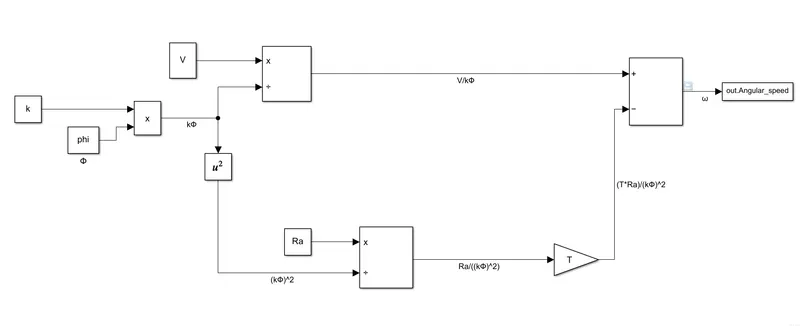
3). The mathematical model of DC motor's speed torque equation, `omega=V/(kphi) -R_a/(kphi)^2**T` is modelled using Simulink as shown in the below figure:
where
V is the input voltage to the DC motor
k is back emf constant
`phi`is the flux per pole in webers.
Ra is the armature resistance in ohms.
T is the torque developed by the motor.
`omega` is the angular speed of the motor.
Procedure to model speed-torque equation using simulink:
- Constant blocks are used to define V, k, `phi`and Ra.
- Constants k and `phi` are multiplied to get k`phi` term.
- Thereafter, `V/(kphi)`term is obtained using divide block.
- k`phi` is multiplied by itself using square block and the result is applied at divide block along with Ra to get `R_a/(kphi)^2` which is later multiplied with the gain of T to get our second term(`R_a/(kphi)^2T`) in the required eqution.
- Therefore, angular speed(`omega`) is obtained by subtacting `R_a/(kphi)^2T` from `V/(kphi)` using add block.
4). Brief explaination of author's perspective in the following blog:
https://www.tesla.com/blog/induction-versus-dc-brushless-motors
- One type of engine cannot be the best option to suit for personal requirements, price and performance same as in case of motor to drive electric vehicles.
- Then, compared the two best available motors(i.e, DC brushless motor and AC Induction motor) which are used to drive electric vehilces.
- AC motor's stator construction is virtually identical to that of DC brushless motor.
- DC brushless motor require inverter to control its stator currents(magnitude and direction is varied) to generate torque continously whereas induction motor doesn't require any inverter circuit for starting as they can start by itself when connected to consumer utility terminals(AC supply). But, inverter is required in electric vehicle to power the induction motor because available energy is DC in battery which enables the speed control of induction motor by changing the frequency in the inverter.
- In DC brushless drive, rotor losses are less and cooling of rotor is easy.
- DC brushless motor can operate at unity power factor but induction motor can operate at 85 percent maximum. This means that the peak point energy effiencies of DC brushless motor are typically few points higher than that of induction motor.
- We can adjust the magnetic field density(B) which is proportionate to V/f (voltage to frequency), by which magentic losses are reduced at low speeds as less voltage is applied which is not possible in DC brushless drive. Therefore, average effieciency of the induction motor is actually better when compared to brushless drive as the size of the machines increases.
- Induction motors are cost advantage because permanent magnets in the brushless drive are expensive.
- The speed control of induction motors is very complex (which includes further development costs regarding controlling techniques) when compared to the control of DC brushless drive.
- Finally, author concluded that DC brushless drives will likely continue to dominate in hybrid and plugged-in hybrids(because capacity of motors is small compared to that of pure EVs) whereas induction motors will likely maintain dominance for high performance pure electric vehicles.