Week-6 Challenge: EV Drivetrain
Q1 Which types of power converter circuits are employed in electric and hybrid electric vehicle?
Answer 1 :
Power Converters Employed in Electric and Hybrid Electric Vehicles.
AC to DC - (Rectifiers )for Battery Chargers
DC to AC - ( Inverters) for Motor Drive
DC to DC- ( choppers) for DC auxiliaries
2. An Electric Vehicle's powertrain with 72V battery pack in shown in the diagram below. The duty ratio for acceleration operation is 'd1' and for the braking operation the duty ratio is 'd2'.
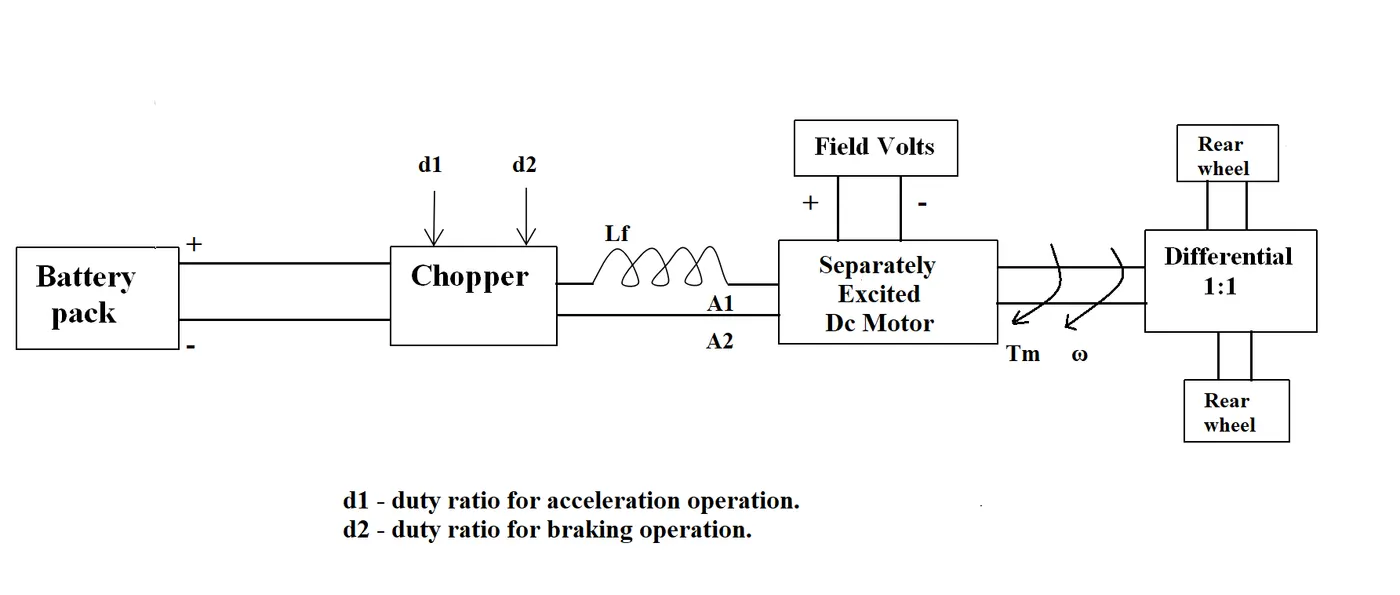
The other parameters of the electric vehicle is given below,
Motor and Controller Parameters:
Rated Armature voltage= 72 V
Rated armature current= 400 A
Ra= 0.5Ω, KΦ= 0.7 Volt second
Chopper Switching frequency= 400 Hz
The vehicle speed-torque characteristics are given by the below equation

What is EV steady state speed if duty cycle is 70%?
Answer 2:
From the previous lesson the torque speed character
T = (V * K`phi` / Ra) -((k`phi`)^2/ Ra)*`omega``
Rated Armature voltage= 72 V with duty cycle 70 % = 50.4 V
Rated armature current= 400 A
Ra= 0.5Ω, KΦ= 0.7 Volt second
Chopper Switching frequency= 400 Hz
Subsitituting the values of Rated Armature voltage = 72V at duty cycle 70 %
V= 50.4 V
Ra, and K`phi` in the above equation we get.
T= (50.4 * 0.7/ 0.5) - (0.7)^2 / 0.5 * `omega`
solving the equation we get
T = 70.56 - 0.98 `omega`
At steady state the Tv will be equal to T where Tv is given by the below eqaution:
Equating T = Tv
we get
70.56 - 0.98 `omega` = 24.7 + ( 0.0051)`omega ^2`
Rearragning the equation we get a quadratic equation
`.0051 omega +0.98 omega- 45.86 =`
Solving this equation in matlab
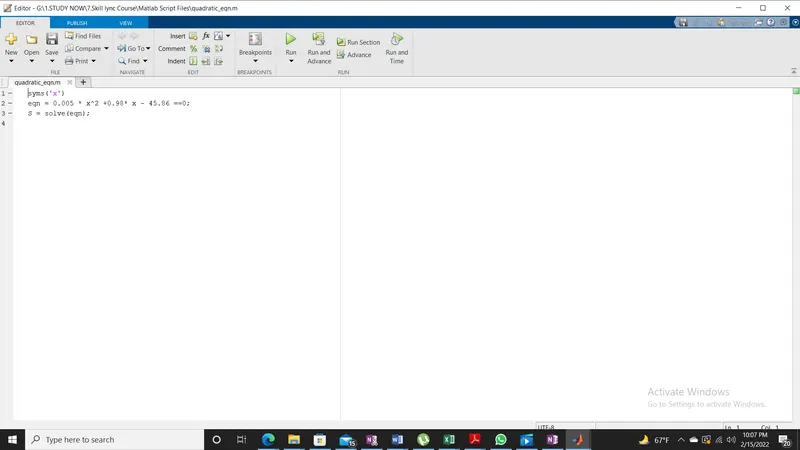
we get

`2root () 2 * root () 2347 -98`
-`2root () 2 * root () 2347 -98`
which is equal to
= -39.025545 and + 39.025545
Thus at `omega` = 39 .0255; EV is at Steady state speed.
The matlab Script file for Quadratic Equation is attached.
Q3. Develop a mathematical model of a DC Motor for the below equation using Simulink.
`omega =`V/K`phi`-Ra / `Kphi^2*T`
To build this model
we will use input blocks
`V, Kphi and Ra and T` and get the output `omega`
The values assumed
V= 72
Kphi = 0.7
Ra = 0.5
T =1
The Simulink model is shown below.
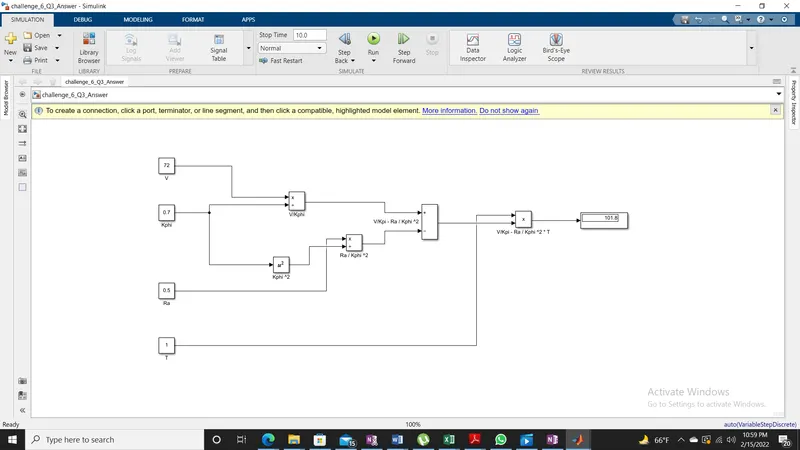
The simulink file is attached.
Q4. Refer to the blog on below topic:
Induction Versus DC brushless motors by Wally Rippel, Tesla
Explain in brief about author’s perspective.
Answer 4:
The Auther Wally Rippel, discusses the history, construction , similarities and differences of DC brushless motor and Induction motor for EV applications. He compares performance, cost and future dominance in EV application.
The main similarities he points out is that both motor have very similar stator and use modulating invertors, while differ in their rotor and invertor controls.
In performance, he informs DC brushless motor generates less heat, is earier to cool the rotor, and has better peak performance. However the DC motor has limitations in optimum efficiency because of using permanent magnets; which results in high I^2 R losses and eddy current losses during low speed and low torque requirements respectively.
In contrast, Induction motors can provide better efficiency as the magnetic field can be adjusted according to the load demand,making it suitable for high performance and giving good efficiency in wide range.
Since permanent magnets are expensive, induction motors becomes more cost effective when high performance are required.The development cost of Induction motors are higher due to their complex control systems design.
The auther percieves that even with their varied difference in Operation and Control, both the motors have their usage in the future.He thinks DC brushless motor will dominate the hybrid and plug in hybrid applications while Induction motor will be more prominent in Pure EVs.