Week-6 Challenge: EV Drivetrain
Q1. Which types of power converter circuits are employed in electric and hybrid electric vehicle?
Answer: Types of converter used
1) AC to DC converter or Rectifier: For charging battery an AC-DC converter is required to convert the AC supply to DC, which is also known as Rectifier.
2) DC-AC converter or Inverter: If the electric derive motor is an AC motor, then DC-AC converter is used to convert DC supply from the battery to AC to feed the AC motor. This type of converter is also known as inverter
3) AC-AC converter or regulator: To control the speed of the AC motor by regulating the voltage fed to the AC motor, a regulator is used
3) DC-DC converter or Chopper: If the derive motor is DC type, then to supply required DC voltage to control the speed of DC motor, chopper or DC-DC converter is used
Answer2:
Given Specification of battery and motor and duty ratio as
72V battery pack,
Rated Armature voltage= 72 V
Rated armature current= 400 A
Ra= 0.5Ω, KΦ= 0.7 Volt second
Chopper Switching frequency= 400 Hz
The vehicle torque-speed characteristic is given as
Tv= 24.7 + (0.0051)w^2..........(1)
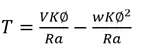
As a separately excited DC motor is used, whose torque-speed characteristics can be given by below equation
 ..........(2)
Where V is the voltage applied to the motor, as for buck converter the output voltage is given as
V= dVs
given d= 0.7 and Vs = 72 V
so V= 0.7*72 = 50.4 V
Under steady-state condition motor torque characteristic is equal to the vehicle torque characteristics, so
equating equations 1 and 2
(50.4*0.7)/0.5-(w*(0.7)^2)/0.5=24.7+0.0051w^2
solving above equation we get w= 38.91 rad/sec (take positive speed) which is the steady-state speed of the EV.
Objective3: TO develop a mathematical model of a DC Motor using Simulink
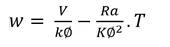
Solution: The mathematical model of a DC motor can be represented by the below equation
Simulink model:
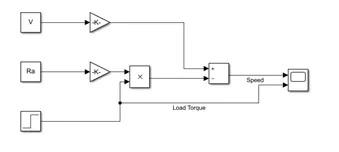
In the Simulink model, V and Ra is taken from the workspace, and a gain block is used to define 1/Kϕ">ϕ
ϕ">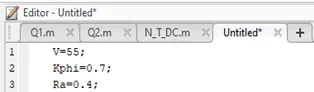
Load torque is provided by using step input of magnitude 5 at time t=5sec
Results:
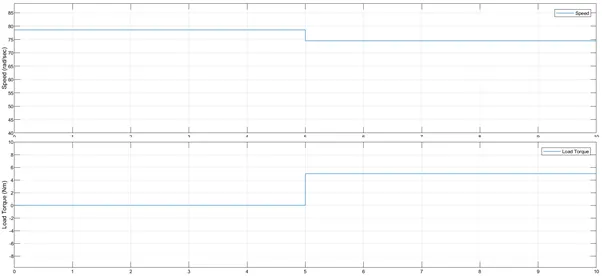
Speed Vs Time and Load torque Vs time plot are shown above.
Discussion: Where there is no load torque the motor is running at 78.57 rad/sec speed, but when the load torque is applied at t=5sec the speed decreases
which can be seen from the above plot.
Answer4: In the blog https://www.tesla.com/blog/induction-versus-dc-brushless-motors the author wally made a comparison between brushless DC drive and
Induction motor drive. According to the author, the construction of Both Brushless DC and Induction motors is quite similar and the difference lies in the rotor construction.
In Brushless DC motors the rotor is essentially a permanent magnet, whereas in induction motors the rotor is made of stacked steel laminations, shorted at the ends.
Unlike Brushless DC motors Induction motors can produce starting torque at loaded conditions. But AC machine shaft speed is dependent on the utility frequency which is not in case with the brushless DC motor.
According to wally, the torque performance of AC motor is inferior to DC motor when an inverter without feedback is used to convert the power from DC battery. But if inverter with feedback is used AC motors performance is comparable to brushless DC for vehicle application.
In terms of heat generated by rotor brushless DC motors have an edge over Induction motors. Also the power factor of operation DC motors is better.
In case of Ideal brushless DC motors magnetic field strength B can be adjusted according to the torque requirement which can help in minimizing the copper and core losses, but permanent magnets B cannot be changed easily. But in Induction motor the magnetic field strength can be adjusted to maximize efficiency.
Also when the comparison is made in terms of cost brushless DC motors are more expensive.
If one need to compare in terms of control of speed then according to author DC machines have clear edge over the AC machines due the cost of permanent magnets.
For future perspective, the author predicted that in the future for Hybrid and plug-in Hybrid Brushless DC motors would likely dominate, but for pure Electric derive, Induction motors will be dominating.